

Rich in aesthetics, a collection of ritual objects celebrate Jewish tradition.
WRITTEN BY ILLANA GREENBERG
The Talmud encourages us to enhance each mitzvah by
"making it beautiful": Through hiddur mitzvah, a simple
ceremonial object can take on a new dimension.
Lisa Van Allsburg grew up with this idea all around
her. When her parents died, she and her two siblings
didn't fight over money or jewelry. "It was the Jewish
ritual objects — the Passover plate and Shabbat candles
— that we wanted," she says. "They were very simple
pieces, but to us they were show business."
Although she lives in Providence, R. I., with her hus-
band and their two children, Van Allsburg remains very
close with her sister Laura M. Babai, who lives in Israel,
and brother David Morrison, who lives in Huntington
Woods; and the three have traveled together extensively
over the past 10 years. The Jewish objects they saw in
the museums of Eastern and Central Europe and the
Middle East reminded them of the pieces they looked
at in the books that were in their home growing up in
Detroit. Unable to find Judaica to purchase with a simi-
larly traditional sensibility, rather than modern, even
cutesy, interpretations, Van Allsburg and her siblings
were encouraged to create their own collection.
Forgotten Judaica is the realization of their passion
and dedication to Judaica that is not only beautiful but
also spiritually meaningful. The Passover seder plates,
Shabbat candles, yads (Torah-reading pointers) and
menorahs are designed in the figurative period that was
popular from the 1780s-1920s and are reminiscent of
the Judaica that the Nazis pilfered during the war.
"Forgotten Judaica recalls a time when craftsmen
embellished Jewish ceremonial objects with leaves and
vines, pomegranates and sunflowers, rams and lions
— a time when ritual objects were narrative, pulling the
beholder back to an age that recalls heroes and miracles,
providing a keen sense of protection and satisfaction,"
writes Van Allsburg on the Forgotten Judaica Web site.
"These embellished Judaica pieces often depicted a pas-
sage found in the Torah or Talmud. They might recall a
popular Yiddish folktale. More often, Judaica from this
era simply celebrated nature itself."
Crafted using the "lost wax" process — an ancient
technique of casting from sculpture — and traditional
fabrication methods, these museum-quality pieces are
not reproductions of antique pieces but original designs
worked in copper, bronze and sterling silver, some
embedded with precious stones. The mold and wax
maker and casters are the children and grandchildren
of the artisans who once cast 19th-century English
Gorham and Reed and Barton, using the techniques
their ancestors passed down to them.
Among the team of artists is Van Allsburg's own
husband, Chris, the renowned children's book writer
and illustrator whose work includes The Polar Express
and Jumanji. Chris met Lisa when both attended the
University of Michigan and converted to Judaism before
they were married.
"Our work is a narrative," Van Allsburg explains. "It
points to a time in the past. Today, we are all careful
about what we spend money on and invest in. These
pieces are meant to be keepsakes that are passed down
from generation to generation."
The Forgotten Judaica collection ranges from $160-
$1,200. Find it online at forgottenjudaica.com , at the
Jewish Museum in New York and at the Holocaust
Museum in Washington, D.C. Visit the Web site to
view video and narrative of the artistry, love and
comfort of Jewish ritual that has gone into creating
the collection. Platinum readers can receive a 20-
percent discount by logging on to the Web site and
entering code DJN20 or calling (877) 404-1004.
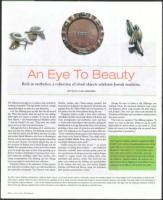
Top left: A set of Shabbat candlesticks, crafted in Israel, "grows" out of hand-carved walnuts. Historically, Jewish law forbade artisans from using images of the human figure; as early as the
third century, Judaica makers turned to animal forms, vegetable and fruit motifs and even architectural images to express aesthetic pleasure. Top middle: This seder plate is the centerpiece of
the Forgotten Judaica collection — each of the Passover symbols are cast in sterling silver and applied to the hand-hammered copper plate.
author Chris Van Allsburg, designed four bronze mezuzahs for the collection, including this one depicting Jeremiah's dove.
B 1 8 •
APRIL 2009 •
JN platimun
Top right: Lisa Van Allsburg's husband, children's