

DETROIT
JEWISH NEWS
iN
teen overspending can be exciting — and troubling.
by Gabriella Ring
T2T staff photo by Jessica Avery Polk
eenagers naturally want to shop
to impress their peers by looking
good, fitting in and feeling happy.
If and when spending reaches uncontrol-
lable levels, those same peers could label us
as "shopaholics" or compulsive shoppers.
And they may be right.
Shopaholism effects boys and girls equal-
ly, but an image of a giddy obsessive teen-
age girl springs to mind when thinking of
the tem' "shopaholic." No teens are exempt
from the glitz and glamour of marketing
campaigns and tactics.
Jordyn Dresner, 13, of Birmingham shops
every other weekend, spending an average
of $80 per trip on typical teen items like
clothing and jewelry. She considers herself
a shopaholic. Dresner had to cut back from
the $130 she used to spend because of the
economy. Her allowance funds her shop-
ping habit.
"When I see something I want, I need to
find it," Dresner said. "It's exciting."
Although Dresner sometimes buys things
she wants but doesn't need, she ends up do-
nating clothes to charitable causes.
Dresner watched the current movie, Con-
fessions of a Shopaholic, and said she would
never become as obsessive as the main
character and destroy her relationships and
herself financially.
Shopping is "fun to do once in a while,
[but] eventually you have to know when to
stop," she said.
Melanie Rosen, 15, of Oak Park also feels
the effect of a floundering economy and
has cut back dramatically on her shopping.
From shopping every other week to now
once a month or every six weeks, she spends
an average of $60 per trip. Because Rosen
does not receive allowance, she funds her
purchases through babysitting money she
earns. She tends to look for bargains.
"I've been spending less," Rosen said.
"I probably could limit my spending more.
Sometimes I buy way too much stuff, but I
usually end up wearing it. My parents have
always taught me you shouldn't spend what
you don't have and that you should always
save."
Rosen did provide insight on why she be-
lieves shopaholism develops — people "use
shopping as an alternative in order to make
themselves feel better."
thiderr,,, lth ShrrelholisTr
Terrence Shulman, 43, of Southfield is a
counselor who works with compulsive shop-
pers through therapy. He deals with the un-
derlying emotional problems of overspend-
ing as a way to cure addition. He knows
what causes shopaholism, how to detect
it, what can be done to stop it and how to
avoid it. (Go to JNt2t.com for more details.)
In the current financial slowdown, shopa-
holics may not be able to spend as much as
they're used to, but continue to spend on
bargains and discounted merchandise.
Shopaholics today are like "drug addicts
going through withdrawal," Shulman said.
They get upset, disappointed and cranky,
but the free time also gives them opportuni-
ty. Shopaholics have more time and energy
to devote to thinking, exploring interests
and developing skills, sobering them up.
Yet, in today's economy, without ad-
equate money to spend, shopaholics may
turn from compulsive shopping to compul-
sive shoplifting, an area Shulman also coun-
sels. He said that shoplifting will increase
among teens because of the lack of money.
continued on B2
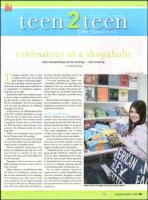
Jordyn Dresner, 13, indulges in one of her favorite hobbles.
teen2teen March • 2009 Bi