

Metro
Budget Cuts
Detroit Federation joins national wave of staff layoffs.
Alan Hitsky
Associate Editor
T
he Jewish Federation of
Metropolitan Detroit (JFMD) laid
off six full-time employees March
20 and reduced six others to part-time
status, joining Jewish federations around
the country in budget reductions.
JFMD executives, who asked not to be
identified, said the cuts, amounting to 8
percent of the staff, were part of $700,000
in budget reductions. "We have to ensure
that allocations for people in need will
remain intact," a spokesperson said.
Federation ended its 2008-09 Annual
Campaign last month — six weeks early
— in an effort to begin the allocations
process and get the next fiscal year's
funding to its agencies more quickly.
The spokesperson said the process will
be completed in the next 30-60 days and
allocations announced, including JFMD's
operating budget for next year.
Last year, JFMD bought out 12 long-
time employees in an effort to reduce its
operating budget.
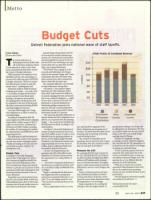
According to Federation's 2007-08
annual report, the 2008 Annual Campaign
achieved $42.2 million as part of $101.4
million in total revenue. Combined dis-
tributions were $98.5 million, including
$3.4 million for fundraising, $3.6 million
for administration and $900,000 for other
supporting services.
The spokesperson said that many fed-
erations across the country were announc-
ing cuts now as their campaigns ended.
"People are looking at this year and next
year and the economic realities',' the
spokesperson said.
Similar Cuts
According to the Jewish Telegraphic
Agency, three of the largest U.S. federa-
tions announced significant layoffs this
month. The Jewish federations in New
York, Cleveland and Atlanta have laid off
between 11 percent and 25 percent of their
professional staffs. Each organization cited
shrinking donations because of the eco-
nomic downturn.
Nonprofits across the board have been
forced to enact similar levels of staff cuts.
Hillel, Hadassah and a slew of other orga-
nizations have all made similar moves, as
have Yeshiva and Brandeis universities.
Howard Rieger, the president and CEO
of the federation system's national orga-
nization, the United Jewish Communities,
expressed significant concern for the sys-
tem and UJC's own well-being as an orga-
nization that relies on dues from increas-
ingly cash-strapped federations.
"We all know what is going on in the
economy, and federations are trying to
adjust to the moment:' Rieger said. "Some
communities have been hit harder than
others and we know some communities
where it looks like the status quo.
His comments followed a run of layoffs
at major federations, among them:
• On March 11, the country's largest
federation, the UJA-Federation of New
York, which raised some $153 million in
its annual campaign last year, announced
that it was cutting 52 employees — slight-
ly more than 11 percent of its staff. The
federation is 10 percent behind in its
fundraising pledges compared to the
previous year and 12 percent behind on
collections, and has seen its $675 million
endowment shrink by 25 percent.
• The same day, the Jewish Federation of
Greater Atlanta laid off 14 employees in an
effort to cut 19 percent from its operating
budget — the second round of layoffs that
the federation has faced, according to UJC
staff members.
• On March 5, the Jewish Federation of
Greater Cleveland announced that it had
laid off 25 staffers as part of a plan to trim
$600,000 from its operating expenses in
the face of a $3 million budget shortfall.
Donations to the federation's annual cam-
paign reportedly are down by about $5
million, and its endowment funds have
decreased in value by 29 percent.
• On Dec. 19, Doug Seserman, the
president and CEO of the Allied Jewish
Federation of Colorado, announced that
the organization was cutting staff by 15
percent.
• The Jewish Community Federation of
San Francisco recently laid off three staff-
ers, in an effort to help cut $400,000 from
its budget.
Rieger is warning that the federations
are dangerously close to putting their
operations in jeopardy if they have to cut
more. "It is a two-edged sword:' he said.
"You cut all you can and see how you can
work better.
"But as organizations look to cut, they
JFMD Profile Of Combined Revenue
$160
$100
$100
0
$80
$60
$40
$20
2004
2005
Endowment
& Campaign
Contributions
have and should be cognizant of the
future. Federations are not going out of
business. The needs that they meet are not
lessening; they are growing. In free fall,
needs are going to grow.
"Yes, we need to rationalize cuts in
operations, but we need to be able to grow
for the future. You can't cut back so much
that you can't grow in the future!"
Pressure On UJC
It's a message that hits close to home for
the UJC. Last May, the UJC cut 37 jobs in
an effort to reduce its budget from $40.2
million to $37 million, and it is facing
more cuts in the near future. The organi-
zation is under intense pressure from the
federations it serves to cut its budget even
further.
Prior to a February powwow of more
than 200 federation leaders in Florida
to discuss the future of the UJC, a letter
signed by several major federations asked
the organization to cut its budget.
Rieger responded at the meetings by
offering to slice the budget another 10
2006
2007
2008
I
Other
Income
Investment
Income
percent and is waiting to see if that will
be sufficient for the federations. The deci-
sion could be made over the next several
weeks, as the UJC is set to hold budget
meetings soon in Chicago.
This has UJC employees on edge,
according to sources within the organiza-
tion, who feel that the UJC already has cut
as much fat as it can and now is in danger
of cutting into meat and bones.
"If that 10 percent proposal were to be
sustained, that would mean that in the
course of a handful of years, we have cut
our staff by 45 percent:' Rieger said. "The
question for us is no different than the
question for all the federations:
"What do we need to do to sustain
operations? What elements of this work
that we do would we just stop doing
because we have reached the limit on pro-
portionality?
"The last thing we want to be is equally
non-productive in all areas."
National material for this report
was provided by JTA.
March 26 2009
A17