
Arts & Entertainment
Bringing Back Brundibar
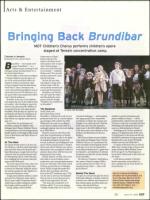
MOT Children's Chorus performs children's opera
staged at Terezin concentration camp.
Michael H. Margolin
Special to the Jewish News
B
rundibar — the German word
means "bumblebee" — is a
children's opera receiving its first
Michigan outings Saturday, March 21, at
the Detroit Opera House.
But Brundibar is more than an ordinary
35-minute children's operatic piece: It is
one of the works performed within the
infamous Terezin concentration camp
in Nazi-occupied Czechoslovakia during
World War II. There it flowered in the
voices of the performing children, most of
whom did not survive the Holocaust. It is
the opera's 2003 reincarnation that will be
seen by Detroit audiences.
Brundibar is the story of two children
who desperately need to buy milk for their
sick mother. After deciding to sing in the
street to earn the money, the children are
overpowered by the cruel organ grinder
Brundibar. With the help of a sparrow, cat
and dog that aid them in rounding up all
the neighborhood kids, the children and
their friends out-sing the tyrant and con-
quer evil.
There will be two performances of
Brundibar, sung by the children of the
Michigan Opera Theatre Children's Chorus.
Local performers of Jewish heritage include
Natalie Chaiken of Farmington Hills, Rachel
Curtis of New Boston and Taylor Wizner of
Grosse Pointe.
At The Helm
The opera's Jewish mentor is 28-year-old
Eric Einhorn, a tall, lean, dark-haired bari-
tone from New Jersey, who found he dis-
liked rehearsing as a singer but loved it as
a director. Now an assistant director with
the Metropolitan Opera in New York City,
he is indulging his two primary interests:
opera and the Holocaust.
"For every opera book I have, I have two
on the Holocaust" he said recently when
in Detroit for rehearsals. Einhorn's spiritu-
ally inclined mother, he said, "thinks I'm a
reincarnated Holocaust victim!'
In high school, Einhorn entered a contest
sponsored by a Holocaust center and pro-
duced a poem called "Anonymous Prayer!'
Asked to give a public reading, he realized
that "people could be reached by art"
During college at Ohio's Oberlin
Conservatory of Music,
Einhorn directed The
Emperor of Atlantis for his
senior project. Also an opera
with a Terezin lineage —
albeit more well known and
even recorded — suddenly,
Einhorn said, "Two very dis-
tant dots connected": opera
and the Holocaust.
For him, the next steps
were logical: to bring some
of these works to life, the
voices and the memories, the
sounds and the memorials.
Brundibar, says Einhorn,
was still "under the radar";
and after doing his senior
project, Einhorn thought,
"Wouldn't it be wonderful to
do Brundibar?"
The Backdrop
A scene from
Jewish Czech com-
poser Hans Krasa created
Brundibar in 1938, but the work was not
performed until 1941, in a Jewish orphan-
age in Prague. With a libretto by Adolf
Hoffineister, the work was an allegory
to give hope to children and adults in a
seemingly hopeless time, the years leading
up to World War II.
However, it was not until 1943, with
more than 50 performances in Terezin,
that the opera began to take on the status
of underground legend. German intel-
lectuals, academics and intelligentsia were
sent to Terezin, which became a "hotspot
of arts and culture," Einhorn says. Operas
and concerts were arranged for visitors to
convince them of how well the Jews were
being treated in the camps.
In 2003, Einhorn was able, after a year
and a half, to secure funding, create a
production, cast it and give performances
at the City University of New York. David
DiChiera, general director of Michigan
Opera Theatre, bought the production
shortly after its premiere, and it has
been in the MOT warehouse since. "This
was the time to showcase the Children's
Chorus [now in its second year] and a
work of such importance,' he said.
"The music has a modernity to it;'
DiChiera added. "It is not just singing,
`Twinkle, twinkle, little star.' It has a lot
Brundibar
of musical challenges — and Brundibar
(the organ grinder) has a remarkable
resemblance to Hitler; the Germans just
thought it was a little fairytale." (Interest
in the opera also has been sparked in
recent years by the 2003 children's book
of the same name with a libretto by Tony
Kushner and illustrations by Maurice
Sendak.)
MOT Chorus Master Suzanne Mallare
Acton leads the Michigan Opera Theatre
Children's Chorus. It is a permanent chil-
dren's ensemble for Metropolitan Detroit
youth ages 10-16 who are interested in
vocal-musical-theatrical art. A grant from
the Mandell L. and Madeleine H. Berman
Foundation provided the startup funding
for the ensemble.
The Chorus is "fantastic:' said Einhorn,
who came to Detroit in August 2008 to
cast the soloists from its ranks."It's an
amazing bunch of kids — smart, with
good instincts."
Behind The Music
The opera has 10 lead roles plus the chorus.
Technically calling for a chamber orchestra,
it features four violinists and musicians on
flute, clarinet, guitar, accordion, piano, per-
cussion, cello and double bass.
A short piece by the composer — and
similarly scored for instruments and
players available at Terezin — will be
performed first. Called Overture for Small
Orchestra, it will serve to introduce Ela Stein
Weissberger, who will speak of her experi-
ences as a child performer in Terezin.
Weissberger, now 79 and a resident of
Tappan, N.Y.; played the part of the Cat in
55 performances of the opera and will join
the MOTCC performers to sing on stage for
the finale. She is one of only 100 Terezin
children who survived World War II.
Co-author of the book The Cat with the
Yellow Star: Coming of Age in Terezin with
Susan Goldman Rubin (Holiday House;
$6.95; for ages 9-12), Weissberger just
learned that a film based on the book is in
the works.
A well-known member of Detroit's
Jewish community, actress Mary Lou
Zieve, will play the role of the Teacher in
the production.
Ideal for children and families,
Brundibar will be performed 12 and
5 p.m. Saturday, March 21, on the
Detroit Opera House main stage,
1526 Broadway. Tickets: $11-$36.
Call (313) 237-7464 or visit
www.MichiganOpera.org .
March 19 s 2009
C27
Scanned image of the page. Keyboard directions: use + to zoom in, - to zoom out, arrow keys to pan inside the viewer.
March 19, 2009 - Image 141
- Resource type:
- Text
- Publication:
- The Detroit Jewish News, 2009-03-19
Disclaimer: Computer generated plain text may have errors. Read more about this.