

Health & Fitness
FOOD
Cracker Is Back
Manischewitz promises Tam Tams for Passover.
Sue Fishkoff
Jewish Telegraphic Agency
San Francisco
D
uly chastened by the Great Tam
Tam Crisis of spring 2008, the
Manischewitz Company went
into overdrive and will have plenty of the
crunchy six-sided unleavened crackers
available this Passover season.
'Absolutely," declared the company's for-
mer CEO Bruce Bossidy in November.
Bossidy joined the country's first and
still largest matzah-making concern in
January 2008, when Manischewitz was
in dire straits. Quality standards weren't
being met and the 120-year-old kosher
manufacturing subsidiary of R.A.B.
Holdings was having trouble filling orders.
Bossidy spent much of his year with the
company cleaning house, bringing in new
management and getting the new matzah
production line up and running at the
company's year-old, $15 million facility in
Newark, N.J.
But the clock ran down and early last
year, Bossidy was forced to cancel Tam
Tams for the first time in 68 years.
The outcry was immediate; Jewish
consumers coast to coast mourned the
absence of the beloved cracker. A black
market sprang up, with one rabbi offering
three boxes of the previous year's crackers
on eBay; bidding started at $10.
This year, however, there will be more
than enough to go around. All flavors of
Passover Tam Tam crackers will be avail-
able except for Tiny Tams, which were not
made because of complications with the
die cut used to create them.
Bossidy also promised a sufficient
amount of Passover matzah; last year saw
shortages of the unleavened bread in the
Northeast and along the West Coast dur-
ing the eight-day holiday.
While Manischewitz makes an array of
kosher products, it was founded in 1888
as the country's first commercial matzah
bakery and matzah remains central to its
mission.
Like most kosher food manufacturers,
Manischewitz's busiest season is Passover.
Fifty percent of its business involves
kosher-for-Passover food, particularly
matzah, which is an extremely labor-
intensive product.
As one of two sacramental foods
required at the seder table, along with
C24
March 19
a
2009
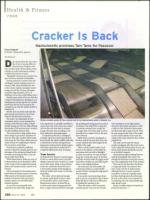
Shmura matzah comes off the conveyor belt at the Manischewitz plant in Newark, N.J.
wine, production is carefully controlled to
ensure that water only comes into contact
with the flour for less than 18 minutes.
Longer than that and, according to rab-
binic authorities, leavening begins.
In industrial production, a mashgiach,
or kosher supervisor, must watch the flour
from the time the wheat is milled until water
is introduced to the flour during the mix-
ing process. At that point the dough is given
even closer supervision to make sure it is
completely baked in less than 18 minutes.
Trade Secrets
At Manischewitz, Passover matzah begins
its life in a wheat field in one of the Mid-
Atlantic states; the exact location is a trade
secret. Red winter wheat is the preferred
variety for unleavened bread because it
is low-protein; protein in the dough pro-
duces air pockets that cause it to rise dur-
ing baking.
The wheat is harvested and brought
to another undisclosed location, a fam-
ily-owned flour mill in rural western
Pennsylvania, where it is stored for up
to three weeks before being ground into
flour. A single wheat kernel moves through
the grinding and sifting process in about
20 minutes. The milled flour is kept dry
in moisture-resistant bins, usually for
no longer than a few days, until it can be
transferred to a tanker truck for the jour-
ney to Newark.
Rabbi Yoel Lowenstein, mashgiach at
the flour mill for the past four years, has
a work schedule that often begins in the
middle of the night.
When a newly washed tanker truck
arrives at the mill, he crawls inside the
enormous steel tank with a flashlight
to check for moisture. He runs his hand
along the curved sides, peers at the floor
and feels carefully under the jagged metal
rim before crawling out and climbing the
stairs to the loading platform.
The truck pulls up underneath, and
Lowenstein watches as nearly 50,000
pounds of flour is pumped at high speed
into the tanker.
At one point, Lowenstein leaps down
and scoops out a few plastic bags of flour,
which the driver will carry to Newark to
be checked for moisture levels.
When the tanker is full, Lowenstein
stretches plastic wrap over the 18-inch
valve opening to seal it tight, replaces
the heavy metal hatch and closes it with
a yellow or blue Orthodox Union plastic
seal that looks like a large twist tie. Then
he runs around to the back of the tanker
to place similar plastic seals on the dis-
charge valves, from which the flour will be
pumped out.
The seals can be removed only by
another mashgiach after the truck arrives
at the company's Newark plant. If even one
seal is compromised during the journey,
so is the flour's integrity.
Manischewitz begins making Passover
matzah immediately after Labor Day
through late February. During the season,
up to 20 mashgichim work on the product.
This year, for the first time, the factory
is using only kosher-for-Passover flour
year-round, even for its daily matzah.
Although the flour is more expensive
to produce, it costs the company much
less than shutting down the entire plant
for four or five weeks every summer for
re-kashering. Now the annual kashering
takes about a week.
Nearly 76 million sheets of matzah are
produced each year.
❑