

Opinion
Editorials are posted and archived on JNonline.us.
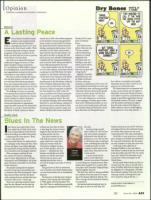
Dry Bones
WNAT'S IN
A NAME?
THEY WANTED TO
CALL IT THE "WIPE
THE JEWISH STATE
OFF THE MAP"
WEEK . .
"ISRAEL
APARTHEID"
WEEK?
Editorial
A Lasting Peace
E
ven as Hamas-launched rockets
continue to hit southern Israel,
America will use Palestinian
relief as a springboard toward a two-state
solution to the Arab-Israeli conflict. That's
a reasoned approach as long as America
recognizes it may have a partner in the
Fatah-run West Bank but it has no partner
in the Hamas-run Gaza Strip.
Last week, at an international donors'
conference in Egypt, Secretary of State
Hillary Rodham Clinton announced a
U.S. contribution of $900 million targeted
for rebuilding Gaza. At least 80 nations
and organizations took part in the parley,
which plans to raise nearly $3 billion.
The cause is noble if it helps the Gazans
who lost their homes in the three-week
war with Israel that Hamas precipitated
by its years-long missile attacks on Sderot,
Ashkelon and other southern cities in Israel
and its refusal to renew a tacit cease-fire.
The challenge, of course, is assuring
the humanitarian aid doesn't fall into the
evil grip of Hamas' radical forces. Hamas,
which translates to Islamic Resistance
Movement, continues its use of ter-
rorism and opposition to agreements
signed between Israel and the Palestinian
Authority; as a result, it was barred from
the Sharm el-Sheik conference. Hamas
started out in 1987 with welfare programs
to lure destitute Gazans long ignored by
Yasser Arafat's corrupt Fatah. But Hamas
has always boasted an Islamist-terrorist
ideology seeking the destruction of Jews
and Israel. n the 1990s, suicide bomb-
ings in Israeli cities became Hamas' call-
ing card in an effort to disrupt the Oslo
peace process and radicalize Palestinians.
Coupled with the widespread ineffective-
ness of secular Fatah, Hamas prevailed in
Gaza's 2006 parliamentary elections.
Some Hamas leaders may see the merit
of a two-state solution, as do many of their
counterparts in the West Bank. But unfor-
tunately, it is the Hamas extremists who
call the shots from Damascus and Tehran.
America's partner in the pursuit of a
durable peace is the Palestinian Authority
led by President Mahmoud Abbas, who
governs only the West Bank with Israeli
assistance. (Hamas separatists overthrew
his Gaza loyalists in a 2007 coup.) We
have no problem with Clinton saying the
P.A. hopes for "a peaceful, independent
and more prosperous future." But were
she entirely forthright, she'd acknowledge
that the P.A., not just Hamas, continues to
glorify terrorists as role models for kids
by naming schools, summer camps and
athletic facilities after brazen murderers.
o.
••■•■
Clearly, the P.A. must
clean its internal
house.
And Clinton must
deliver when she says,
BUT "ISRAEL
"We have worked
APARTHEID" WEEK IS
with the Palestinian
MORE POLITICALLY
Authority to install
CORRECT.
safeguards that
will ensure that our
funding is only used
where, and for whom,
it is intended and
does not end up in the
wrong hands."
cg,
Egyptian President
Hosni Mubarak's call
www.DryBonesBlog.com
for Fatah and Hamas
that without a committed and capable
to form a unity gov-
Palestinian partner, there can be no real
ernment is a pipedream at best. Gaza will
need a different leadership to become part progress on a Palestinian state.
The United States has an important role
of a Palestinian state coexisting peacefully
to play as peace broker, and we support it.
with Israel. (History shows Israel already
Meanwhile, Israeli and Palestinian leaders
coexists in relative peace with the first
must adhere to previous commitments and
majority Palestinian state — Jordan.)
engage in good-faith negotiations that ren-
A two-state solution is a cornerstone
der prudent decisions. This tack, coupled
of the campaign of Kadima party leader
with the political and financial support
Tzipi Livni. If Palestinian leaders are seri-
from the Arab world and the Sharm el-
ous about it, the Israeli people will make
Sheik conference donors, would brighten
sure Likud's Benjamin Netanyahu warms
the prospects for a two-state solution.
up to that idea, too. Netanyahu knows
■•■■ 11.
❑
Reality Check
Blues In The News
I
don't know how many times I have
been asked what I think of the reduc-
tion in home delivery by the Detroit
dailies that will go into effect this month.
I always give the same answer: "Beats
me, but I wish them well."
I have traded dozens of e-mails with for-
mer colleagues at the Freep and News. None
of them can figure it out, either, although
the experiment is being watched closely by
every executive in the newspaper industry
With newspapers tanking all over
the country, it's obvious something
must be done. Bankruptcies in Chicago,
Minneapolis and Philadelphia. One paper
gone in Denver and another on the brink
in San Francisco.
The people running the local papers
are pretty smart guys, presumably, and
as someone who loves newspapers I hope
they can save them. But they are faced
with undoing the basic mistake their pre-
decessors made some 15 years ago.
There was a growing awareness back
then that the Internet was the new big
thing and they better get on board. So
without any clear idea of where
or how large the revenue stream
might be, they decided to send
out their product for free.
That hasn't worked out too
well. Only 8.4 percent of news-
paper profits now come from
online ad revenue while the
Internet has stripped newspa-
pers of their greatest source of
income — classified ads. The
business model that served the
industry so well for more than
100 years lies in pieces, and
slashing distribution costs is
one way of trying to put some of it back
together.
The good news is that no newsroom
cuts or buyouts were made. Neither paper
can stand any further loss of institutional
memory.
The bad news is that the most common
response I hear among older subscribers
is "What paper will we get instead." The
New York Times is conducting an especially
vigorous campaign for home delivery in
this area.
Among younger people
there is silence. I can't see how
they will consider paying for
information they already are
getting at no cost. The fact that
a subscription price would give
them something that looks like
a traditional paper on their
computer screen means noth-
ing to them. They have no ties
to that model.
A recent article by Jeff
Zaslow in the Wall Street
Journal even advised Detroiters
to avoid dying on a Sunday, because their
death notice wouldn't be in a home-deliv-
ered paper until Thursday. Tough getting a
minyan together that way.
The Free Press will be a strong candidate
for a Pulitzer Prize this year for its report-
ing of the Kwame Kilpatrick debacle. The
News' coverage of the automotive industry
is exceptional.
But national and international news in
both papers is about an inch deep. The
Freep has shed its movie and TV reviewers
and replaced them with syndicated strang-
ers and the News chooses to run op-ed
commentaries by WJR radio personalities.
I don't like to come across as a curmud-
geon. Change is inevitable and sometimes
it's even good. Sometimes. But the papers
are only a shadow of what they once were.
I look back at the collection of
deranged, brilliant writers and editors
with whom I worked at the Free Press back
in the late 1960s and early '70s. On certain
days, and I believe this sincerely, we put
out the best-written newspaper in the
United States.
But the earth shifted under our feet. As
we pass from the scene we are left with a
sense of futility, skills that no longer mat-
ter, allegiance to a dying ideal. I wouldn't
have missed a minute of the ride, but the
merry-go-round is slowing down and
we've stayed too long at the fair. L
George Cantor's e-mail address is
gcantor614@aol.com .
March 12 • 2009
A23