

World
COMMENTARY
A Personal War
T
A Detroiter finds the faces of Israelis withstanding terrorism.
Imes are Tough, We are Tougher!
Join Hadassah's Solidarity
Mission to Israel Jan. 25-30."
At the time, Israel was in the midst of
"Operation Cast Lead" in Gaza to remove
the launchers of the 10,000 rockets and
mortars fired at
hundreds of thou-
sands of Israeli citi-
zens in the south-
ern part of Israel
for over seven years
and to bring down
the Hamas killers.
I felt compelled
to join 28 others
from 13 states to
visit Israel. For me,
it was the best way
to show my sup-
port and love for
the people in Israel.
My husband, Marc, and I went on the first
Hadassah Renaissance Solidarity Mission
to Israel in October 2002, after the start of
the Second Intifada.
That visit was a turning point in my life
as I embarked on a personal and profes-
sional journey to explore and share the
experiences of survivors and families liv-
ing with terrorism in Israel. Between 2004
and 2007,1 interviewed 63 terror-attack
survivors and family members in Israel.
Once again, I felt that January's mission,
six years later, would provide the oppor-
tunity to see first-hand what is happening
and to participate in meaningful activities
that would benefit the people of Israel.
We visited Sderot and nearby Kibbutz
Nir-Am, Beersheva and Ashkelon — all
hard hit by rocket and missile attacks. We
had unbelievable access to military, politi-
cal and media leaders — including Prime
Minister Ehud Olmert and his spokesper-
son, Mark Regev; the mayors of Jerusalem,
Beersheva, Ashkelon and Sderot; and
Israel Defense Forces (IDF) spokesmen.
But, most importantly, we met with the
people affected by the crisis — the human
faces behind the headlines.
At Kibbutz Nir-Am, we met Dana, who
suffers from epilepsy and has "to be strong
and not cry for her siblings." She is very
angry at Israel for not doing anything for
eight years "while Hamas picked on us"
and has recorded the story of her own
near-misses on YouTube.
We met air force pilots who had recently
returned from the operation, and saw
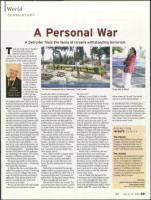
The Sderot playground has a "caterpillar" bomb shelter.
Israeli tanks still on reconnaissance
because, even though a ceasefire had been
declared shortly before we arrived, a few
hours earlier an IDF tracker was killed
and several others wounded by a Hamas
explosion.
We stood on a hill with the red roofs of
Sderot to our left and the tall buildings
of Gaza City on our right. Much has been
said about casualties in Gaza City, heart-
land of Hamas terrorism, where explosives
and rocket launchers are kept under the
kitchen sinks, in mosques and elementary
schools. Less is said about Sderot, a city
of 25,000 Israelis and the target of 10,000
missiles in the last eight years.
The schools in Sderot are covered
with concrete double roofs to protect the
children; playgrounds in Sderot are built
with bomb shelters. Even the cute paint-
ing of a caterpillar on the side of a shelter
does not diminish the reality: When a
"red alert" is sounded, everyone in town
has 15 seconds to leap for shelter. They
don't always make it.
To be a Sderot mother is unique. Chava
Gad was a "wonder woman" — a wife,
mother of three, secretary and student.
Four years ago, a rocket fell close to her
house. She now calls herself an "anxiety
mother."
She lost her secretarial job because she
simply couldn't concentrate anymore. She is
terrified to go outside, but visited with us at
the playground because "it is necessary to
tell my story" She describes living in Sderot:
"It hurts mentally, kills your spirits."
She and all the others stay because "I'm
stuck. Real estate values are down. And if I
leave my home now, the rockets will go to
the next town."
Ashkelon, a city 122,000, is 16 miles
north of the Gaza Strip. It is now within
range of newer rockets. None of the
schools is protected from missile attacks,
so they were shut down for the three
weeks of the recent operation. The Jewish
community center ran programs for young
children who were literally climbing the
walls from fear.
Erez, a 16-year-old clown who works
with kids, was a hero who wasn't in uni-
form. He understood how to be with these
children and the importance of being
happy, making them laugh and making a
difference. He played with them all day long
and thanked us for being there, telling us,
"It brings us power that you are her'
We met a Hadassah Hospital doctor,
injured in the Lebanon War and again in
Gaza where he was shot by a sniper. As a
physician, he is committed to saving lives;
but as a citizen of Israel, he knows that he
has to protect the country.
We met with a commander who was
injured, but who is now recovering at
Hadassah Hospital and talked to his wife
and their parents. At Soroka Hospital in
Beersheva, we met with the parents of an
injured Israeli soldier. They were waiting
and praying for their critically wounded
son to come out of a coma. As Jews, they
have been raised to value life, while the
enemy values death.
And we visited with the head of the
Coordination and Liaison Administration
at one of the crossings into Gaza, where
he described the 100 trucks of supplies,
water, fuel and ambulances going to Gaza's
civilians daily. "We cannot treat others as
Chava Gad of Sderot
others treated us:' he said. "Our Jewish
value is to care for human beings."
Dr. Zieva Konvisser, Ph.D., of Orchard Lake is
a post-doctoral researcher with the Fielding
Graduate University in Santa Barbara, Calif. Her
doctoral dissertation is titled "Finding Meaning
and Growth in the Aftermath of Suffering: Israeli
Civilian Survivors of Suicide Bombings and
Other Attacks." She is in the process of publish-
ing a book of survivor stories.
Answering
Israel's Critics
The Charge
Turkish Prime Minister Recep Tayyip
Erdogan criticized Israel last month,
charging a "disproportionate use of
force" during its three-week military
conflict with Hamas in the Gaza Strip.
The Answer
According to international laws regard-
ing war and the use of military force,
Israel is not required to calibrate its
use of force precisely according to the
size and range of the weaponry used
against it. In addition, Israel makes
every attempt to minimize civilian
casualties and property damage by pin-
pointing military targets.
— Allan Gale,
Jewish Community Relations Council
of Metropolitan Detroit
© Feb. 19, 2009 Jewish Renaissance Media
February 19 • 2009
A21