

World
Lincoln's Bicentennial
The president's lifelong connection to many things Jewish.
Wendy Rose Bice
Special to the Jewish News
century from now, Jewish histo-
rians will sit back and judge the
presidency of Barak Obama.
They will examine how Obama's
Mideast policies affected Israel's stability
and prosperity, how his economic strate-
gies staved off or promoted an impend-
ing disaster. Historians of the future will
reflect upon Obama's treatment of the
Jews and the issues affecting the Jewish
communities in this country and world-
wide. They will inspect the relationship
between the president and his top adviser,
Rham Emanuel. And, undoubtedly every
once in a while during the month of
February, they will pull up images of the
man Barak Obama held in the highest
regard, President Abraham Lincoln, and
reflect on the similarities and differences
of these two men, underdogs themselves
who championed diversity and equal
rights.
There were no Rham Emanuels by
President Lincoln's side, but the 16th pres-
ident of the United States, whose 200th
birthday is celebrated Feb. 12, did have
a handful of Jewish associates, friends
and even advisers-of-a-sort. Even more
importantly, Lincoln's stand on key issues
of the day supported the position of the
American Jews.
Despite a brief spate of recent rumors
theorizing that this distinctly tall man
with dark hair was possibly Jewish,
Abraham Lincoln was born to Baptist
parents, Thomas Lincoln and Nancy
Hanks on Feb. 12, 1809. Although the fam-
ily attended church on Sundays, Lincoln
remained reserved about his religion.
Scholars agree that despite his upbring-
ing, Lincoln rarely, if ever, made use of
the word Jesus or Christ in his writings,
as most Christians of the period did. He
favored the Old Testament and made use
of the phrase "Our Lord:'
At age 23, the self-educated, avid reader
entered politics with an unsuccessful
run for the Illinois General Assembly. He
began to study law and was admitted to
the Illinois bar in 1837. By then, he already
had been elected to the Illinois State legis-
lature, his first of four consecutive terms.
In 1842, Lincoln wed Mary Todd. The
couple had four boys, only one of whom
lived to maturity. In 1858, Lincoln ran
Isachar Zacharie.
"Not only did Zacharie remove the
presidential corns; writes Holzer, "he
also fitted Lincoln with huge, new, made-
to-order boots that allowed him to walk
without pain."
Happy feet made for a fruitful relation-
ship. Lincoln retained Zacharie not only as
his physician but also put him to work as
a goodwill ambassador. He sent the doc-
tor to Jewish communities in the South to
serve as an unofficial envoy and then on
the road as a campaign chief for the pres-
ident's re-election bid in 1864. Zacharie's
mission was to deliver the Jewish vote.
According to Holzer, the inference that one
man could secure the "Jewish vote" caused
quite a stir within the Jewish community.
Regardless though, the doctor served the
president well.
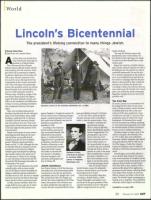
Abraham Lincoln on the Antietam battlefield, Oct. 3, 1862
against Stephen A. Douglas for senator. He great-grandfather, Samuel G. Alschuler.
In the mid-1850s, political hopeful
lost the election, but, in debating Douglas,
Abraham
Lincoln came to Alschuler's
gained a national reputation for honesty
studio
to
have
his portrait taken. Even
and candor that ultimately won him the
though
he scheduled the
Republican nomination for
appointment,
Lincoln
president in 1860.
chose
to
wear
an old linen
According to the American
duster
that
Alschuler
quickly
Jewish Archives, Lincoln not
deemed
inappropriate.
The
only surrounded himself with
photographer,
a
good
foot
influential Jewish political
shorter than the circuit
figures, it is believed the first
lawyer,
loaned the man his
suggestion for his presidential
velvet-collared jacket. As
nomination came from Lewis
the Soman family tale goes,
Dembitz of Kentucky, a well-
Lincoln's long arms extended
known Jewish leader. Another
through the sleeves about a
important Jewish commu-
quarter of a yard. A few years
nity leader in Lincoln's life
Abraham Lincoln,
later,
President-elect Lincoln
was Samuel G. Alschuler, a
ambrotype by Samuel
returned
to Alschuler's stu-
Bavarian immigrant who
G. Alschuler, 1858.
dio to have another picture
operated a photographic gal- Library of Congress,
taken. It was the first photo
lery in Urbana, Ill.
Washington, D.C.
of Lincoln growing a beard.
One of Lincoln's closest
Jewish Assistance
Jewish friends, a man who ultimately
Jean Powers Soman, a Civil War historian
became a trusted adviser, was Lincoln's
and author, has several interesting family
chiropodist, his foot doctor.
connections to Lincoln: her great-great
Lincoln had chronically aching feet,
grandfather, Marcus M. Spiegel, was a Civil
according to Harold Holzer, a noted
War colonel from Ohio who fought and
Lincoln biographer and author of sev-
died for the Union. Studying his Civil War
eral books on the great president. When
letters, she learned of his evolution into
Lincoln heard about a doctor with great
an ardent abolitionist and supporter of
Lincoln. She also researched the life of her skill for curing lousy feet, he sent for
The Civil War
Of course, Lincoln is not remembered for
his aching feet but rather for his innate
sense of fairness, justice and his devotion
to abolish slavery. In 1861, at the start
of the Civil War, Jews numbered a mere
150,000, just one-half of 1 percent of the
population, many of whom were recent
immigrants. Six thousand Jews would
serve in the American military, including
12 who would become generals. Six would
be awarded medals of honor and dozens
of men served as military physicians.
Chaplains began serving as part of the
military during the Revolutionary War
in 1775. At first, they were exclusively
Protestant. Catholic chaplains were added
during the Mexican War in 1848. As the
Civil War began, a Federal law stipulat-
ing that all chaplains must be ordained
ministers of Christian denominations still
stood.
Even though several rabbis offered to
serve, all were flatly refused. The matter
came to the attention of President Lincoln
when a largely Jewish, Pennsylvania-based
regiment elected Rabbi Arnold Fischel
from New York as their chaplain. With a
quick and flat denial of his application,
prominent Jewish leaders, including Rabbi
Isaac Mayer Wise, founder of American
Reform Judaism and editor of the Jewish
paper The Israelite, began campaigning to
include Jews as chaplains. They published
editorials, rallied support and finally took
Lincoln's on page A28
February 12 • 2009
A27