

Israeli Elections
SPECIAL REPORT
Ready On The Right
Polls point to a decisive win for Israeli hard-liners.
Leslie Susser
Jewish Telegraphic Agency
Jerusalem
I
f the polls are right, the outcome of next Tuesday's
Israeli election is a foregone conclusion. Not only
does Benjamin Netanyahu's Likud seem bound to
emerge as the largest single party, but the bloc of right-
wing and religious parties that it leads seems certain to
garner a winning majority in the 120-member Knesset.
All the latest polls put Likud ahead of Tzipi Livni's rul-
ing Kadima Party, some by as many as 12 seats (34-22),
others by as few as three (28-25), which theoretically is a
small enough margin to be overcome via a coalition deal.
But all the surveys without exception give the religious
and right-wing parties as a group a virtually unassailable
lead, ranging from at least 10 seats (65-55) to as many as
18 (69-51). That means Netanyahu is almost certain to be
invited to form the next government following the Feb. 10
elections.
The only question seems to be the nature of the coali-
tion he forms. Will he go for a narrow right-religious gov-
ernment that includes the hard-line Yisrael Beiteinu Party
led by Avigdor Lieberman; two fervently Orthodox par-
ties, Shas and Torah Judaism; and two national-religious
parties, Jewish Home and National Union, associated with
supporters of the settlements?
Or will he opt for a national unity government that
also includes Kadima and/or Ehud Barak's Labor Party?
Netanyahu claims his biggest mistake as prime minister
from 1996 to 1999 was in not forming a national unity
coalition with then-Labor leader Shimon Peres.
It is a mistake he does not intend to repeat.
This time, Netanyahu says, he wants to establish the wid-
est possible national unity government with the parties on
the right balanced by Kadima and Labor on the left. Likud
insiders, however, suggest that he would actually prefer to
leave Kadima in opposition, where he believes it will disin-
tegrate as a political force. The thinking is that Kadima in
opposition might split, with the hawks rejoining the Likud
in return for government portfolios.
Moreover, including Labor without Kadima would
be enough to enhance the otherwise hard-line govern-
ment's international image and, more importantly, give
Netanyahu a degree of flexibility in the Cabinet in dealing
with peacemaking initiatives.
Livni, who just four months ago seemed certain to
become the country's next prime minister, is now very
much the underdog, and she is pulling out all the stops.
Her most recent campaign tactic is to appeal for support
as a woman.
A campaign ad suggests that no one would question the
prime ministerial credentials of a man with her record:
army officer, Mossad agent, head of the government
companies' authority, minister of immigrant absorption,
regional cooperation, justice and foreign affairs, and
apla sin 4 'urn
N
0
0
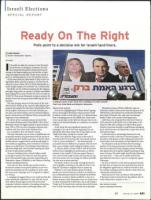
A billboard shows Israel's three main candidates for prime minister:
Tzipi Livni, Ehud Barak and Benjamin Netanyahu.
deputy prime minister.
Livni is also highlighting the "Obama factor" arguing
that an intransigent Netanyahu-led government would
be almost certain to clash with a new U.S. administration
bent on bringing peace to the Middle East. Israel needs
to put a peace plan on the table now because time is run-
ning out, she declared Monday at a conference on national
security.
As for Barak, the most significant element of his
campaign is the way he has been targeting Livni, not
Netanyahu. More than anyone else, he has played on the
"think twice before voting for a woman" card.
When Livni called for tough action in the wake of
renewed rocket fire from Gaza this week, Barak referred
to her as "gveret mebarberet" — the chattering lady —
and said he found it difficult to see people who had never
held a gun or fought a battle calling for military action.
In contrast, Barak, a former chief of staff of the Israel
Defense Forces, highlights his performance as defense
minister in last month's 22-day war against llamas in
Gaza. Given Israel's tough security environment, he sug-
gests that anyone who can manage the defense portfolio
can also serve as prime minister.
But Barak's chances of actually winning the election
seem negligible. According to the polls, the best he can
hope for is perhaps to supplant Livni as runner-up.
Whether or not Labor finishes ahead of Kadima,
Barak's post-election dilemma is likely to be whether to
join a Netanyahu government that includes the hawkish
Lieberman. As much as Barak would like to stay on as
defense minister under Netanyahu, there are strong voices
in Labor insisting that if Lieberman, who is advocating a
"loyalty test" for Israeli Arabs and says that only he knows
how "to deal" with them, they will stay out in principle.
Netanyahu, however, will find it difficult to keep out
Lieberman. Indeed, Lieberman has been the big story of the
2009 election. Latest polls give his strident Yisrael Beiteinu
party about 16 Knesset seats, with some even placing it
ahead of Labor as the country's third largest party.
Lieberman, who emigrated from the Soviet Union in
1979, started his political life close to Netanyahu in the
Likud. In 1999, after a falling-out with the then-prime
minister, Lieberman founded a small Russian immigrant
party, which has since developed into a major force on the
international stage.
In this election, he calculatingly fanned anti-Arab
sentiment to build a wide base of electoral support. The
showdown with Hamas and the widespread criticism by
Israeli Arabs of the devastation in Gaza helped his cause.
One thing that could prevent him from becoming a
minister in the next government is the fact that police
have just accelerated a long-standing criminal investiga-
tion against him involving the alleged laundering of huge
sums of money. The probe might actually help Lieberman
win more seats — many see its sudden renewal just
days before the election as a part of a conspiracy against
Lieberman.
But if he is indicted or if the attorney general disquali-
fies him from serving in the new government because of
the allegations against him, he would not be able to join
the coalition, making it easier for Barak to lead Labor into
a Netanyahu administration.
Thirty percent of voters say they are still undecided.
If they have not been factored in by the pollsters, Feb. 10
could still provide a surprise or two.
More election coverage:
www.jrco.illhotsiteili-elect.htm
February 5 • 2009
A21