

Arts & Entertainment
Israeli Film Stirs
An Oscar Buzz
Long before Israel's strike against Hamas, Waltz With Bashir
had staked its claim as one of the most important films of 2008.
Michael Fox
Special to
the Jewish News
0
n Jan. 3, the National Society of
Film Critics named the Israeli
film Waltz with Bashir the Best
Film of 2008 at its annual meeting in New
York. In L.A., the film took the Golden
Globe for Best Foreign Language Film on
Jan. 11. Can an Oscar be far behind?
True, the top pick by the national critics
is rarely emulated by the Academy Awards
voters, but the buzz in Hollywood is that
Waltz may well become the first Israeli
film to win an Oscar. (Academy Award
nominations were announced today, after
this story went to press.)
The film combines state-of-the-art
animation, an anti-war documentary
theme and a psychoanalytical approach
to recover the memory of a traumatized
Israeli soldier — that of Israeli director
Ari Folman, who is the film's central char-
acter as a 20-year-old infantryman whose
unit spearheaded the Israeli advance into
Lebanon in June 1982. The announced
goal was to stop incursions and rocket
attacks on northern Galilee towns by the
Palestine Liberation Organization. Israel's
current incursion into the Gaza Strip to
eliminate Hamas rocket attacks provides
Waltz an added relevance.
Folman's experience turns out to
encompass some of the most painful
moments of what's come to be seen as
Israel's Vietnam, notably the massacre
of Palestinian civilians by Christian
Phalangists in the Sabra and Shatila refu-
gee camps. Although the film serves as
a savage critique of Israel's military and
political leadership — notwithstanding
Folman's assertion that he set out to make
an autobiographical film, not a political
statement — its release at home didn't
trigger a re-examination of the war.
"The film brings no news in regard
to what happened, in terms of facts and
responsibility," the bearded 50-ish film-
maker says during a recent stop on his
marathon international publicity tour.
"I didn't want to spend four years of my
life dealing with politicians. I kept it on a
very personal level, the story of the corn-
SS
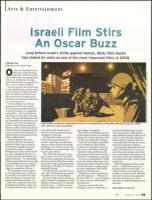
Israeli director Ari Folman's unsentimental voice-over in his animated anti-war film, Waltz With Bashir, drips with a world-
weary, distinctly Israeli existentialism.
mon soldier. All the other facts in the
film, they were all exposed in the Kahan
Commission 25 years ago."
The film's release in the wake of the
debacle of the second Lebanon war
may have contributed to its enthusiastic
response at home, Folman acknowledges,
admitting to some curiosity as to how the
film would have been received had it come
out prior to the 2006 war.
Waltz With Bashir premiered to enor-
mous acclaim in May at the Cannes Film
Festival and was snapped up for American
distribution. Israel's official Oscar submis-
sion for Best Foreign Language Film opens
Friday, Feb. 6, at the Maple Art Theatre in
Bloomfield Township.
Not unlike the four sons of the Passover
seder, Waltz With Bashir presents veterans
with different views of their obligation.
The movie is kick-started by an old army
buddy of Folman's recounting his recurring
nightmare of being chased by 26 dogs. Boaz
knows the source — the job he was given
during his military service — but he can't
stop the dream or his anguish.
Boaz's PTSD is disturbing but no more
so than Folman's amnesia. Ari remembers
nothing of his wartime experience, which
is to say he has suppressed everything.
But he feels an amorphous responsibil-
ity, so he embarks on a kind of detec-
tive story, interviewing men he'd served
with 25 years earlier. With each strange
or ghastly anecdote, and fresh clue, the
same question bubbles under the surface:
What's better, remembering or forgetting?
Ari flies to the Netherlands for a darkly
comic visit with his buddy Carmi, a bril-
liant aspiring scientist who left Israel after
he left the army. Now a wealthy, perpetu-
ally stoned entrepreneur, Carmi starkly
illustrates Israel's brain drain.
Although he's no fool, Carmi plays the
part of the simple son — "What has all
this to do with me?" — when Ari explains
the nature of his quest. He's moved on;
why doesn't Ari?
If you know about the Christian
Phalangists' massacre of Palestinians in
the Sabra and Shatila refugee camps in
1982, you may harbor a dark suspicion
where Folman's excavation of the past will
lead. If so, Waltz. With Bashir plays like a
murder mystery in which you know the
victim and possibly the killer, but are anx-
ious about the narrator's complicity.
The remarkable thing about Waltz With
Bashir is that Folman's use of color-satu-
rated, often poetic, animation doesn't dis-
tance us from the grievous realities of war.
He achieves a potent and enthralling kind
of surrealism that works as both eye candy
and bad trip.
While the splendid animation in Pixar
movies — notably fluid camera move-
ment that mimics live-action films — is
designed to entice us into surrendering
ourselves to an artificial world, Waltz With
Bashir never wants us to lose sight of the
real world. This reality, of war and its
aftershocks, is continually heightened and
immediate.
Oscar Buzz on page B6
January 22 s 2009
B5