

World
Rejuvenation!
Ron Kampeas
Jewish Telegraphic Agency
Washington
B
arack Obama's pledge to use his
presidency to revive the black-
Jewish alliance starts the day
before he becomes president.
The president-elect's inaugural com-
mittee has asked Jewish groups to make
black-Jewish dialogue and joint outreach
to the poor a focus of Martin Luther King
Day commemorations Jan. 19. Renewing
the classic civil rights alliance is part of
the inauguration's "big picture," a senior
inauguration official said.
The emphasis comes after a bruising
campaign in which Jewish voters were tar-
geted by anonymous campaigns attempt-
ing to depict Obama as a secret Muslim as
well as conservatives who questioned the
candidate's pro-Israel bona fides.
It also comes after decades of mistrust
fueled by disagreements over affirmative
action, Israel's relationship with South
Africa and outright expressions of hostil-
ity from prominent black figures such as
the Rev. Al Sharpton and Louis Farrakhan.
Obama, who has strong ties with influ-
ential members of the Chicago Jewish
community, made it clear during the cam-
paign that the alliance which helped bring
about civil-rights change in the 1960s was
a central focus of his Jewish outreach.
Invoking this alliance was a linchpin of
his speech in May to thousands of mem-
bers of the American Israel Public Affairs
Committee, where references to domestic
policy often fall flat. Not so with Obama:
The Washington convention center filled
with cheers when he invoked the memo-
ries of the three civil-rights volunteers
— two Jews and an African American
— who were murdered in Mississippi in
1964.
"In the great social movements in our
country's history, Jewish and African
Americans have stood shoulder to shoul-
der:' Obama said. "They took buses down
south together. They marched together.
They bled together. And Jewish Americans
like Andrew Goodman and Michael
Schwerner were willing to die alongside a
black man — James Chaney —on behalf
of freedom and equality."
A few months earlier, during a speech
at last year's commemoration of the King
holiday at the slain civil rights leader's
church in Atlanta, Obama criticized anti-
immigrant and anti-gay sentiment in
some corners of the black community. He
also lamented that the "scourge of anti-
Semitism has, at times, revealed itself in
our community."
Throughout his campaign, Obama made
his desire to bridge the divide a focus of
his talks with Jewish leaders, said Deborah
Lauter, the Anti-Defamation League's
national civil rights director.
"When Abe [Foxman, ADL's national
director] met with Obama, Obama con-
veyed to him he would like to see the his-
toric black-Jewish roots renewed;' Lauter
said.
Obama's commitment, she added, might
help spur an alliance that has faltered in
recent years. Charged with reviewing what
ADL chapters had planned for Martin
Luther King Day (Jan. 19), she noticed that
plans for events bringing blacks and Jews
together had decreased.
"There are some pockets of activity, but
they're not what they used to be," Lauter
said. "The ones that exist work well, but it
hasn't been a priority."
In recent weeks, however, Lauter noticed
an enthusiasm for re-establishing the affi-
ance. Obama's 78 percent support among
Jewish voters — higher than expected
— was pivotal.
"The numbers were so strong in terms
of the Jewish vote for Obama," she said.
"There's a spirit of renewal, looking for
opportunities to renew old ties and look
forward generally."
Rumors of the demise of the alliance
are overstated, said Rabbi Marc Schneier,
who co-founded the Foundation for Ethnic
Understanding with hip-hop impresario
Russell Simmons. The tensions stoked by the
radical inclinations of an older generation
had been replaced by the outreach favored by
younger blacks, including Obama.
"Crown Heights was the lowest point,"
he said, referring to the 1991 riots in
Brooklyn, "but since those difficult and
trying days, there has been a cadre of
African-American and Jewish leaders
dedicated to repairing and restoring the
relationship:'
Schneier says he likes to tease Eleanor
Tatum, the publisher of the Amsterdam
News, an African-American weekly, that he
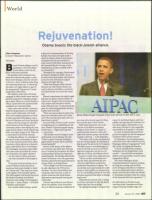
Photo courtesy of AIPAC
Obama boosts the black-Jewish alliance.
Barack Obama brought thousands of pro-Israel activists to their feet in June.
sees more ads in Jewish papers for King
Day activities than he does in hers.
Rabbi David Saperstein, who as the
director of the Reform movement's
Religious Action Center is a leader of
national Jewish outreach to other civil
rights and minority groups, says the rela-
tionship is thriving — in the leadership.
"The reality is day in, day out, blacks and
Jews are working together for education, to
help the poor," he said. In the U.S. Congress,
"the black caucus is overwhelmingly pro-
Israel, the Jewish caucus has overwhelm-
ingly been supportive, not just on civil
rights but on aid for sub-Saharan Africa."
It needs to trickle down, Saperstein says.
"There's too little social interaction;'
said the rabbi, who delivered the invo-
cation the night Obama accepted the
presidential nomination in August. "We
can develop more opportunities for youth
groups to work together on common proj-
ects. It is the building of levels of trust and
personal connection that helps us through
tough times."
Using Internet outreach, ADL is asking
its activists and others to take the Martin
Luther King Day "service pledge"
"By signing this pledge, I recognize that
respect for individual dignity, achieving
equality and opposing anti-Semitism, rac-
ism, ethnic bigotry, homophobia or any
other form of hatred is a non-negotiable
responsibility of all people," it concludes.
An array of national and local Jewish
groups have signed up with the inaugural
committee's black-Jewish outreach.
In Washington, Jews attending inaugu-
ral festivities also will be asked to join the
Washington Hebrew Congregation's "work
day" on Jan. 19, helping the homeless.
"If you're a Jewish person coming to
Washington for the inauguration, you'll
see that — but you'll also see homeless
shelters and soup kitchens:' said the senior
inauguration official.
The Greater Washington Jewish
Community Relations Council is marking
the King Day evening with the Black-
Jewish Dialogues, described as "a hilarious
two-actor, multimedia romp of sketches,
theater and video that reveals the absurdi-
ty of prejudice and hate within the context
of the American Black-Jew experience'
❑
For information on the Detroit-area
American Jewish Committee and Urban
League's King Day breakfast: page A25.
January 15 2009
All