

Front Lines
Finding A Bad Apple
Holocaust "memoir" proven to be fabricated.
East Lansing
I
n researching a book on children
and youths at Buchenwald and its
sub-camps, I interviewed many
former youths at Buchenwald, including
many from the Piotrkow ghetto, where
Herman Rosenblat, the author of Angel
at the Fence, was from. These informants
told me two years ago they thought the
Rosenblat story was a false story, but they
didn't say how they knew.
Herman
Rosenblat was
among hundreds
of boys 16 years
old and under at
Buchenwald and
its sub-camps. He
arrived Dec. 2, 1944,
on a transport from
Piotrkow with 21
boys among 354
prisoners. He was
sent almost imme-
diately among 294
prisoners on Dec. 8,
1944, to Schlieben,
a Buchenwald sub-camp northeast of
Leipzig, where the Germans exploited
slave labor to make Panzerfaust (anti-tank
weapons). I sought to interview Herman,
but my letters were not answered.
More recently, in November, I was con-
tacted by other investigators looking into
the veracity of the Angel at the Fence story,
which was now slated to appear as a mem-
oir (Penguin Berkley), as a child's story
(Angel Girl) and as a movie (Flower of the
Fence). I joined the effort of two forensic
genealogists named Sharon Sergeant and
Colleen Fitzpatrick who earlier worked on
the Misha Defonseca case and, because I
had connections with survivors from the
camps and historians who knew about
Schlieben, I wound up coordinating the
investigation.
Behind The Probe
We asked questions, gathered data and-
information, collected survivor testimony
and asked more questions. Each discovery
pointed to the story being false. By mid-
December, we had proved the story was
made up. We communicated our concerns
to the literary agent, publisher and movie
producer, but they ignored us.
A8
January 8 . 2009
iN
The story was sus-
me that he was with
story, part of a family group that watched
picious immediately.
Herman and Roma the
over and saved the youngest boy — three
The idea of a youth in
night before the Oprah
older brothers who took an oath never
a camp like Schlieben
show in 1996, and that
to part from their younger brother. They
autonomously going to
he asked Herman's wife
fed him in the camp, lied upward about
the fence daily, every
where she was during
his age to protect him. Herman wrote his
day, for months, and
the war. Roma said
brothers out for a fantasy tale about a
there meeting an "angel"
she was hiding with
young girl meeting at the fence.
at the fence who threw
her parents elsewhere
Roma, the compliant wife, erased her
him apples was at the
in Germany (not in
own compelling story, too. She was part of
far end of implausibil-
Schlieben).
a family group which nearly alone from its
ity. It was prohibited
Finally, we looked for town of origin, Krosniewice, survived. She
on pain of death to go
Roma's real story, dis-
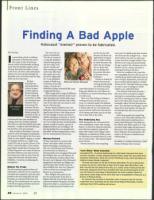
Roma and Herman Rosenblat
also reconstructed her family as a family
to the fence in the Nazi
covering that the family of four not five. The third sister, too young,
camps; it was also pro-
was indeed in hiding
too dark, to pass in hiding as a Polish
hibited for civilians external to the camp
under false identity in Germany, but in
Catholic, was, sadly, left behind.
to approach the fence.
Brieg, near Breslau, in Lower Silesia, not
Thus, Herman and Roma invented a
When we got hold of maps of Schlieben, in Schlieben, in south Brandenburg, about false story about a young boy and girl
we discovered the only fence in the mann- 210 miles away.
meeting by a concentration camp fence
lager opening to the outside of the camp
There were Poles hiding in Schlieben
and then re-meeting years later on a blind
was right by the SS barracks. The civilian
working on farms, but there were no
date in New York. They created what the
road on the other side was closed to civil-
traces of a Radzicki family. The Radzicki
bookseller called "the first Holocaust love
ians in 1943 and after.
family survived near Breslau and returned
story" They did this even though it caused
We also learned Schlieben was a dif-
to Poland after the war. The family then
huge rifts in their families. But they did
ficult place. The HASAG factory was sabo- went to Israel in 1949 and to New York in
not abandon their false story until the
taged in mid-October 1944. More prison-
1954. Herman and Roma met for the first
very end.
ers were brought to build a new factory
time in New York in the 1950s.
Sadly, these people had compelling
quickly and restore production. A new SS
stories to tell. They didn't tell these but
unit arrived, which brutalized the prison-
The Underlying Key
instead substituted something else to
ers. This is when Herman and his brothers While all memoirs are constructed and
make people feel good. They played to
arrived, in early December, a period of
often embellished, written with varying
the culture; they didn't speak to it. They
heightened terror and surveillance. We
degrees of selectivity, imposed coherence,
calculated what might sell and made it
also learned the fence was guarded and
and subjective emphasis, memoirs do
their story. They marketed a false story.
electrified. All these things made us ques-
make truth claims, and in doing so have
Harris Salomon, the moviemaker, still
tion the central premise of the story.
obligations to authenticity. When a mem-
wants to do the movie, falsehood not-
oir substitutes an invented story for a real
withstanding. 0
Moving Forward
one, it crosses a line. This memoir leaped
We then went back to survivors with
across the line.
Ken Waltzer is a professor and director, Jewish
whom I had earlier talked and estab-
Herman erased his own compelling
Studies, at Michigan State University.
lished relationships, including some
who were with Herman from Piotrkow
to Buchenwald, to Schlieben, to
'Love Story' Book Canceled
Theresienstadt, even in England afterward.
Jerusalem/JTA – A second book based on a fabricated Holocaust love story
Ben Helfgott, who was with Herman all
has been recalled. A newly released children's book, Angel Girl, was pulled from
the way, phoned in London told me that
bookstore shelves Dec. 30 by the Lerner Publishing Group, which specializes in
the story was "a figment of his (Herman's)
children's books, Reuters reported.
imagination" and made up. Helfgott also
The book was based on the life of Herman Rosenblat, 79, who claimed that
said Herman's older brother Sam with
a woman he met on a blind date in New York 12 years after World War II and
whom Helfgott was close was "ashamed"
later married was the same person who, as a Jewish child in hiding during the
of the story and was estranged from
Holocaust, disguised herself as a Christian farm girl and tossed apples to him
Herman as a consequence.
over the fence of a sub-camp of Buchenwald. He wrote a memoir about his
When Helfgott went public (as he
experiences called Angel at the Fence that was to be published in February by a
was the natural leader of the Boys in
division of Penguin Books.
England after the war and later became
His contract was canceled in December when it became clear he had fab-
a prominent British Olympian), this then
ricated the story. Rosenblat and his wife, Roma Radzicki Rosenblat, recently
empowered others to come forward. Sid
celebrated their 50th wedding anniversary.
Finkel, another boy from Piotrkow, told