

Opinion
Editorials are posted and archived on JNonline.us.
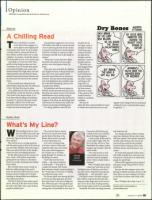
Dry Bones Pigly
Editorial
A Chilling Read
T
here is probably no country
on the planet that engages in a
more rigorous and ongoing self-
examination than Israel. It is practically
a cottage industry among the literati in
that country, and the surest way to make
a splash is to produce a book that attacks
the philosophical roots of the Jewish state.
According to a recent New York Times
profile, Avrum Burg has done just that.
A member of one of Israel's most promi-
nent political families, and a man who
seemed destined for high office, his book
Defeating Hitler asserted that the funda-
mental connection between Zionism and
the Holocaust had distorted the national
vision.
It has recently been released in the
United States under the title The Holocaust
Is Over: We Must Rise from Its Ashes.
At its publication in 2007, the book was
described by a writer for Ha'aretz as being
"anti-Israel in the deepest sense. It is a
book from which loathing of Israeliness
emanates." A review in the same Israeli
newspaper called it "one of the most
spaced out and in-your-face books this
country has seen in many years."
Among Burg's suggestions was to close
Yad Vashem and make it an international
court to prevent genocide. He also wants
to separate Israel from its Jewish identity
and base it instead on "optimism, faith
in humans and full trust in the family of
nations."
"What does it mean that Jews define
themselves by genetics 60 years after
genetics were used against them:' he
wrote.
Those who have read both the Hebrew
and English versions of Burg's book note
that some of its more radical claims
have been toned down for an American
audience. The part about Israel passing
anti-Arab legislation that would be simi-
lar to the Nazi Nuremberg Laws has, for
example, been deleted.
His defenders, and there are many on
both the Israeli and American left, assert
that Burg was raised as part of the nation's
establishment and is merely trying to
expose the contradictions that Israelis try
to ignore. If his ideas are disturbing, that's
only because the tensions that define the
country are nearing a breaking point.
So is Burg's political career. He has
OKAY BERME ,
SO YOU LOST
$S0 BILLION,
SO YOU SNOOK
THE JEWISH
PHILANTHROPIC
WORLD,
decided that he
no longer wants to
emulate his father,
Yosef Burg, a gov-
ernment minister
for almost four
decades, and has
pursued a career in
private business.
The book may
have triggered that
decision. While
Israelis may be
more dedicated to
free speech than
any other country
and Burg is still
respected as a
writer and thinker,
his ideas remain
abhorrent to most
of the country. They
would be hard to
defend as a political
candidate.
But they do
reflect the fierce internal debate in Israel
of which most American Jews are only
SO YOU'VE BEEN
ARRESTED FOR
RUNNING THE
BIGGEST PONZI
SCHEME IN
HISTORY
APPARENTLY
YOU'VE MADE THE
GUINNESS BOOK
OF RECORDS!
O
www.drybonesblog.com
vaguely aware. Burg's book is not pleasant
reading, but it is a viewpoint that cannot
be ignored. 111,
Reality Check
What's My Line?
W
hile standing in line at a the-
ater box office many years ago
I overheard the man in front
of me ask, "How far from the back are
those tickets?"
That struck me as a strange question.
Isn't the point to get as close to the front as
you can? After all, that's where the stage is.
Who cares about the back of the theater,
unless you have an enlarged prostate?
On the other hand, you also can get too
close. I had a stiff neck for weeks after
getting front row tickets in a Broadway
theater. It was like watching Gwen Verdon
from a ditch.
But I recently came across a study on
behavior while waiting in line, and it
turns out that this ticket buyer had a very
human reaction. Seeing a lot of people
standing or sitting behind you reinforces
two strong convictions.
The first is that you have made a good
choice. After all, if the show wasn't worth
the wait or the ticket why would all those
people be behind you?
The second is that no matter
how far you may be from reach-
ing the front of the line or the
theater there are lots of people
in worse shape than you.
A far more irritating thing
is to have a choice of lines and
watch the other ones move faster
than yours, which happens to
me 10 times out of 10 when
going through U.S. Customs at
the bridge or tunnel.
That's why most fast food
outlets — the major exception
is McDonald's — have gone to
a single-line format. They found
that customers deeply resented getting in
the "wrong" line, to the point of walking
out without buying a meal.
The Disney parks were among the first
to use the uni-line approach, and even
then they found it was best to fudge the
facts. When you get to the sign that says
"20 minutes from this point': the actual
waiting time will probably be less than 15.
Customers will feel they got
a break and be more cheerful
about the Magic Kingdom.
I came across all this stuff in
a book called Traffic: Why We
Drive the Way We Do, by Tom
Vanderbilt. The subject matter
intrigues me because I don't do
well in traffic.
"You come across as such
a reasonable person in your
columns," says my daughter
Jaime, "when actually you're a
madman."
Well, I wouldn't quite phrase
it that way. I just have an over-
developed sense of fairness; and when I
see some idiotic, demented nincompoop
violating that ... well, naturally I react.
I've toned it down a bit after trying to
give a fellow motorist the bird and jam-
ming my index finger hard on the roof of
my car. For all you kids reading at home,
don't do that unless you're in a convertible.
Vanderbilt did write one thing, however,
that ticked me off.
In a merge situation, where warning
signs have informed drivers that a lane
will close ahead, I have always muttered
terrible oaths at those who stay in the
restricted lane until the last possible
moment before cutting in front of the
obedient drivers who had moved over
sooner.
He writes that repeated studies show
that traffic actually does move faster for
everyone by 15 percent or so when more
people do exactly that.
When traffic engineers put up signs at
that point saying "Merge Now:' it works
even better.
Because the late-mergers seem to be
getting an official sanction, drivers in the
other lanes are more willing to let them
in and there are fewer side-swipe colli-
sions.
Sure. I'll believe that when I see it. ❑
George Cantor's e-mail address is
gcantor614@aol.com .
January 1 • 2009
B1