

Metro
More Than A Building
Downtown Synagogue gains unlikely supporters bent on revitalization.
Shelli Liebman Dorfman
Senior
T
Writer
he deterioration and the declining
use of the Isaac Agree Downtown
Synagogue building has spurred
an expected proposal for its future.
The newly formed Detroit Action
Synagogue Committee (DASC) — made
up largely of non-synagogue members
— hopes to fundraise to renovate the
building into revenue-producing offices,
possible living space and a revitalized
home for the synagogue.
The synagogue's
board of directors is in
the midst of a series of
meetings with the com-
mittee to listen to their
proposal and discuss its
feasibility.
54,
Martin
At its height, the con-
Herman
gregation had hundreds
of members and count-
less others attended daily, Shabbat and holi-
day services. The Conservative synagogue
attracted individuals working in and visit-
ing the city, many of whom sought a place
to say Kaddish or observe a yahrtzeit.
The synagogue now holds services only
on Shabbat mornings, on holidays that fall
on weekends and on the High Holidays.
On a typical Shabbat, sometimes there are
not enough participants to make a min-
yan; several of the regular members have
moved from the area or have become ill.
The only time services are well attended
is on the High Holidays, when hundreds
participate in the shul's free services.
"For 6 1/2 days of a typical week, the build-
ing is unoccupied," said synagogue presi-
dent Dr. Martin Herman of Detroit, a retired
Wayne State University educator who has
been involved with the congregation since
seeking them out in 1989 as a place near
his office to say Kaddish for his parents.
"We have approximately 100 members
in good standing, though our mailing list
of members and friends runs to about
500. About eight to 10 people keep the
year-round synagogue going; about 450
attend our annual Rosh Hashanah servic-
es, with perhaps as many as 575 appearing
for Yizkor on Yom Kippur.
The four-story building houses only
the synagogue and its related resources.
"The shut uses the basement — where
the kitchen is located — and the first
two floors of the building:' Herman said.
A16
January 1 • 2009
"The first floor has an office, a library and a
social room. The sanctuary, located on the
second floor, can seat about 70. The third
and fourth floors are vacant. We have no
renters and our building manager, an offi-
cer of the synagogue, occupies the building
on occasion, more or less as a caretaker."
In addition to its emptiness, the build-
ing is in great need of repair. "The roof
leaks, and there is a great deal more that
is wrong with our old building — a large,
aging and deteriorating structure whose
upkeep is enormous," Herman said. "The
utility bills alone are monumental."
With only a handful of active members,
Herman said, "We would be delighted to
have more people get involved. But if a
group becomes involved, what do they
want to do?"
That question will be answered in com-
mittee meetings. But there is a concern.
"Some [on the board] fear the group
is particularly interested in the building,
and not concerned with the function of
the synagogue and its services and the
Conservative movement:' Herman said.
But the board is willing to listen openly.
Costs And Contributions
The Downtown Synagogue's membership
and incoming funds may be down, but
the congregation is keeping its head above
water. Operating with a $60,000 annual
budget — for minimal necessities includ-
ing officiating clergy, repairs and upkeep,
escalating utility bills and increasing
insurance costs —the synagogue's income
is about $35,000 a year. That comes from
nominal dues of $75 per person and $100
per family, contributions and subscrip-
tions to a High Holiday memorial book.
"Until two years ago, we had legacy
money from the synagogue's founders:'
Herman said. "We had hoped to use the
interest on the funds last year, but the
installation of a new $25,000 heating sys-
tem and major plumbing repairs took up
the whole legacy."
In November 2007, after Herman
requested that members seek funds, several
supporters made large donations and the
Kosin's Family Foundation offered a $50,000
challenge grant. The synagogue's annual
membership and contributions plus the
foundation's matched funds will cover the
operational budget for this year and next.
Through the years, suggestions for the
synagogue building's survival have ranged
from trading the larger building for small-
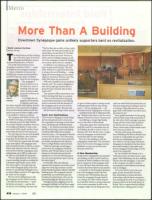
The Downtown
Synagogue sanctuary
er space in better repair to renting out the
building's upper levels or even sharing
space — but not merging with — the
Reconstructionist Congregation of Detroit.
And there's been talk of selling the build-
ing. "Nobody really wants to, but the cost of
upkeep is beyond our means:' Herman said.
And offering no-charge High Holiday
services also takes its financial toll.
"Real estate agents have estimated that
$440,000 would be a reasonable price for
the building, should we choose to list it:'
Herman said. "Over the last seven or eight
years, the synagogue received several
unsolicited offers for the building."
But even if the building is sold, the
congregation would exist. "The institution
that is the Downtown Synagogue and the
building it occupies are not the same
Herman maintained.
A New Membership
Except for the congregation's vice president
and building caretaker, DaVid Powell ben
Avraham of Detroit, members of the DASC
had no connection to the synagogue until
25-year-old Wayne State University senior
Courtney Henriette Smith became involved.
A bartender at Cafe D'Mongo's Speakeasy
next to the synagogue, Smith, who lives
in Detroit, said, "My boyfriend, Ben, and
I found the synagogue through a lead by
Larry Mongo [the club's owner]. He grew
up in Oak Park and has a strong connection
to the Jewish community. He told us the
synagogue might rent out living space. Ben
and I met with DaVid and, shortly after, our
direction changed from wanting to move in
to wanting to bring folks down to a syna-
gogue that we felt needed a lot of love and a
great deal of care
Smith gathered members for the group,
which includes some staff and patrons of
the club, where DASC meetings took place
during off hours. Some DASC members
are Jewish, some are not; but all live in
Detroit, where many of their families once
lived. Many are in their 20s.
The hope of the group, said member
Oren Goldenberg, who lives in Detroit's Cass
Corridor, is "to get people who care about
both the city and keeping a Jewish pres-
ence within it. The Isaac Agree Downtown
Synagogue was founded so that Jews down-
town could worship. It only makes sense
that the synagogue should change to fit the
needs of its community"
"As a Jew, I believe for Detroit to be a
viable place to live, it needs to have a syna-
gogue," said Goldenberg, who lives walking
distance from the synagogue. "I also look
at the synagogue as a place to define a
contemporary urban Judaism that doesn't
exist in Michigan.
"At the first DASC event at the syna-
gogue, people shared their histories,
their relationship to Detroit and their
relationships with the black community.
Surrounding all the work we are doing is a
poignant interest in the Jewish history in
Detroit. This is a reason that the building
itself has been a rallying point for these