

World
ANALYSIS
History Lesson
Samuel Adams learned from a Jewish story.
Ira Stoll
Jewish Telegraphic Agency
New York
N
atan Sharansky, who spent nine
years in Soviet prisons before
moving to Israel and embarking
on a career in politics, turned to me in the
front lobby of the building that housed the
offices of the New York Sun. I had walked
him down the stairs after an editorial
board meeting in which I gently teased
him about his latest book, Defending
Identity, and his previous book, The Case
for Democracy.
"It's all so abstract and general' I said.
"Identity, democracy ... when are you
going to write a book about the Jews?"
He looked skeptical. Before we parted, I
mentioned that I, too, had a book coming
out soon.
"Oh? What about?" Sharansky asked.
"It's a biography of Samuel Adams:' I
replied.
He raised his eyebrows. "Ah, so you, too,
are not writing just about the Jews."
Not quite.
Let's get this out of the way: Samuel
Adams — an organizer of the Boston
Tea Party, a member of the Continental
Congress, a signer of the Declaration of
Independence — was not Jewish. But he
illustrates one of the fascinating features
of the Jewish Exodus story — the way it
has inspired even non-Jews to fight for
their freedom.
The Backdrop
The Congregationalist Protestant
Christianity Samuel Adams practiced was
less distant in its trappings from Judaism
than are many forms of modern-day
Christianity.
One of the places Adams worshiped,
Old South Church in Boston, still stands
today. A visitor there can't help but
be struck by the absence of Christian
imagery. There are no crosses, no cruci-
fixes, no Madonnas. The Massachusetts
Congregationalists shared with the Jews
an aversion to graven images.
And that was not all they shared.
Samuel Adams, one of the most signifi-
cant, moving spirits behind the American
Revolution, was related to and influenced
by Cotton Mather, a Puritan minister in
Boston and one-time head of Harvard
A28
December 25 = 2008
College.
Mather, in his 1726 book Faithful
Account of the Discipline Professed and
Practiced in the Churches of New England,
cited Jewish practice as a guide, though
not law, on everything from how many
congregants were required for a new
church ("The Jews of old held, that less
than Ten Men of Leisure, could not make a
Congregation"), to the reading of scripture
aloud on the Lord's day ("The Pentateuch
was divided into fifty four Parashoth,
or Sections, which they read over in the
Synagogue every year").
Part of the required curriculum for
Harvard students from 1735 to 1755,
which includes the time Samuel Adams
was there, was the study of Hebrew gram-
mar from a textbook written by Judah
Monis, who had converted to Christianity
from Judaism one month before joining
the Harvard faculty.
One of Adams' nicknames, "the psalm-
singer:' refers to the joy he took in singing
texts that are part of the Jewish Bible.
Even the names Samuel Adams gave to his
children — Hannah and Samuel — could
have easily belonged to Jews.
Beyond The Horizon
But the link between Samuel Adams, the
strand of New England Congregationalism
he personified, and Judaism goes well
beyond the formal or stylistic, extend-
ing into the ideology and rhetoric that
motivated Adams and his fellow New
Englanders against the British.
Again and again, both subtly and direct-
ly, Adams placed the American colonists
in the role of the Israelites fleeing slavery
in Egypt and likened the British to the
oppressive Egyptians.
Writing in the Boston Gazette on Aug.
8, 1768, Adams referred to the British as
"taskmasters," a term the Bible uses to
describe the Egyptians. Earlier, he referred
to the Stamp Act as "a very grievous & we
apprehend unconstitutional tax:' echoing
the language Exodus uses to describe the
"very grievous" hail, cattle disease, and
locust plagues.
From Philadelphia, Adams wrote home
to Massachusetts that the heart of the
British King, George III, "is more obdurate,
and his Disposition towards the People of
America is more unrelenting and malig-
nant than was that of Pharaoh towards the
Israelites in Egypt."
In a speech to
his fellow members
of the Continental
Congress, Adams is
said to have credited
God with provid-
ing the Americans
a "cloud by day and
pillar of fire by night:'
which had, accord-
ing to the Bible, also
guided the Israelites
in the wilderness
after Egypt.
In a private let-
ter on Dec. 26,
1775, Adams wrote
of the people of
Massachusetts,
"Certainly the People
do not already hanker
after the Onions &
the Garlick!" It was a
reference to Numbers
11:5, which recounts
the restless Israelites
in the desert, com-
plaining to Moses
about the manna, and
recalling wistfully the
food back in Egypt:
fish, cucumbers, mel-
ons, leeks, onions and
garlic.
Like Moses?
When, after the
Revolution, Adams
became governor of
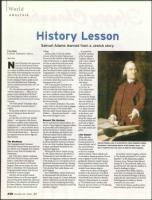
Samuel Adams, seen in a portrait by John Singleton Copley,
Massachusetts, one of illustrates a fascinating feature of the Exodus story — the
the annual Election
way it inspired even non-Jews to fight for their freedom.
Day sermons went
so far as to compare
Adams to Moses. "Moses affords such
Yet another, Samuel Langdon, referred
an example to human governors. He was
to "the Jewish government" as "a perfect
wont to apply to God for direction, in
Republic." In the influential pamphlet
guiding his refractory people Samuel
Common Sense, Thomas Paine likened
Deane preached to Adams, one of the
George III to "the hardened, sullen-tem-
more religious of a set of founders that
pered Pharaoh" who kept the children of
included some famous skeptics.
Israel in bondage in Egypt.
Adams was not alone in linking the
A prominent New Yorker, John Jay,
Israelites to the Americans. One fellow
wrote that "our having been delivered
revolutionary, Reverend Samuel Cooper
from the threatened bondage of Britain,
of the Brattle Street Church in Boston,
ought, like the emancipation of the Jews
referred to Massachusetts in a sermon
from Egyptian servitude, be forever
as "This British Israel." Another, John
ascribed to its true cause."
Hancock, gave an oration in 1774 referring
After the Revolution, another patriot,
to Boston as "our Jerusalem."
Elias Boudinot, spoke of how the Jews