

World
In The Lead
Likud in front, despite far-right presence.
Leslie Susser
Jewish Telegraphic Agency
Jerusalem
D
espite its hard-line Knesset
slate and the presence on the
ticket of extremist Moshe Feiglin,
Benjamin Netanyahu's Likud Party still
leads in the polls to win Israel's national
election in February.
So far, it seems that the inclusion of
Feiglin, who has advocated transferring
Israeli Arab citizens to Arab states, has not
hurt Likud nearly as much as Netanyahu
feared. But with less than two months left
until Election Day, the question is whether
Likud could be tarred with an extremist
hue that would drive away centrist vot-
ers and deter potential centrist coalition
partners.
To avoid alienating centrists and solidify
his position as front-runner in the Feb. 10
race, Netanyahu had hoped Likud mem-
bers would choose a far less hawkish list in
the Dec. 8 primary. But party voters elected
at least seven hawkish ideologues, six
figures who opposed Ariel Sharon's 2005
disengagement plan from Gaza and six
members allied with Feiglin.
That means that about half the Likud
Knesset faction is likely to oppose any
peace moves Netanyahu may seek if he
becomes prime minister.
What makes the list even more prob-
lematic for Netanyahu is the high-profile
presence of Feiglin, who holds some
radical, anti-democratic views. The Jewish
Leadership movement he heads advocates
an authoritarian theocracy, expulsion of
Palestinians and non-recognition of Israel's
Supreme Court. In short, it rejects Israel's
secular democracy.
To marginalize the Feiglin factor,
Netanyahu challenged the results of the
primary. He argued that, according to
party rules, the candidates elected on the
various district lists should have been
placed higher.
The Likud court upheld his appeal,
pushing Feiglin down the list from the
safe 20th spot to the borderline 36th. That
means that if Likud wins 35 or fewer seats,
Feiglin is out. Feiglin says he won't appeal
the decision because he does not recognize
the Supreme Court, which he derided as "a
branch of Meretz," the left-wing party.
Polls taken after Likud primary show
A26
the party still well ahead of Tzipi Livni's
Kadima, with Labor a distant third. The
polls give Likud 31 to 36 seats, Kadima 20
to 28, and Labor 11 to 15 in the 120-seat
parliament.
More significantly, the polls all give
a Likud-led right wing-religious bloc a
majority over a center-left coalition, boost-
ing Netanyahu's chances of becoming
Israel's next prime minister.
The Likud comeback from just 12 seats
in the current Knesset to its anticipated
showing in February is unprecedented in
Israeli politics.
Several factors made it possible: The
2005 disengagement from Gaza, Kadima's
raison d'etre, generally has been perceived
as a failure because of the enusing rocket
attacks on southern Israel; the Kadima-
led government was discredited by its
poor handling of the 2006 Lebanon War;
and Netanyahu, with his strong economic
background and despite his free-market
orientation, is seen as the best person to
deal with the impact on Israel of the global
economic crisis.
Likud also has been helped in its revival
by the relative weakness of Netanyahu's
rivals. Labor chief Ehud Barak is widely
disliked because of his perceived arrogance
and poor interpersonal relations. And the
failure by Kadima's Livni to form a new
coalition government following the res-
ignation of Prime Minister Ehud Olmert
raised questions about her ability to han-
dle Israel's top job.
Should Likud win 35 seats, it would
mean a gain of apporoximately 800,000
new supporters — some 20 percent of
the electorate. Most of them, pundits say,
are Likudniks returning to the party after
leaving to vote for Kadima or traditional
blue-collar Likud supporters who stayed
home last election to protest Netanyahu's
welfare cuts.
Lilcud's rivals in Kadima are attacking
Netanyahu's character, saying he panics in
a crisis, tends to distort the truth and is not
reliable. Labor is emphasizing Netanyahu's
capitalist orientation, blaming him for
losses to the pension fund that the govern-
ment is being asked to underwrite.
Both argue that under Netanyahu, a
head-on clash with the Obama administra-
tion in the United States over peacemaking
is almost inevitable — especially given
Feiglin's role in the party.
.
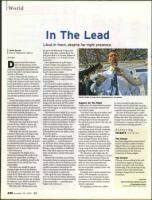
Moshe Feiglin is seen here campaigning in Jerusalem.
Support On The Right
Feiglin rejects the notion that his presence
on the list or its hard-line character will
cost votes for Likud.
"One-third of the electorate defines itself
as right of the Likud," Feiglin said. "And
if the Likud can open a door for them by
putting people on its list who represent
the national camp, its share of the vote will
actually grow."
Feiglin's influence in Likud is consider-
able. His large camp of Jewish Leadership
supporters, estimated at 6,000 to 7,000,
was able to push hard-line candidates up
the list and relegate moderates, such as
former Foreign Minister Silvan Shalom
and ex-Justice and Finance Minister Dan
Meridor, to the bottom. Shalom, nominally
the No. 2 man in the party hierarchy with
a large camp of his own, finished a disap-
pointing seventh. Meridor came in 17th.
The showdown with Feiglin after the
primary constituted something of a victory
for Netanyahu. By showing revulsion for
Feiglin and what he stands for, Netanyahu
made the Likud list potentially more
attractive to centrist voters and paved
the way for possible coalition moves with
Kadima and Labor.
During his term as prime minister from
1996 to 1999, Netanyahu was forced to
navigate between U.S. pressure for land
concessions to the Palestinians and hard-
line opposition in his coalition to any ter-
ritorial compromise.
His zigzagging cost him his credibil-
ity and eventually brought him down.
Netanyahu says his big mistake was going
for a coalition with the far right rather than
a national unity government with Labor.
This time, if elected, he hopes to offset
right-wing pressure through a coalition with
Kadima and Labor. That could give him
enough votes around the Cabinet table and
in the Knesset to cooperate with new U.S. or
international peacemaking initiatives.
Answering
Israel's Critics
The Charge
Israel has charged that current United
Nations General Assembly President
Miguel D'Escoto is trying to block its
participation in the 60th anniversary
commemoration of the Universal
Declaration of Human Rights.
The Answer
D'Escoto, a former official of the radi-
cal Sandinista regime in Nicaragua,
instead of acting to unify the diverse
membership of the international body,
has been divisive and controversial,
leading to charges that he has abused
his position.
- Allan Gale
Jewish Community Relations Council
of Metropolitan Detroit
© Jewish Renaissance Media, December 25, 2008
December 25 • 2008
;*441,1 di M. .
'M *1-** M
,...**1_.,
4 01". ..;414
44**V4**C41
,
*