

Metro
Peace Ties
A Southfield man has completed 19 journeys to sow the seeds of peace.
R
udy Simons does not expect his
recent trip to Iran to suddenly
end the hostility between the
Islamic republic and the West.
He just hopes that his 12-day trip Nov.
25-Dec. 7 will forge some bonds that will
make more people think.
"I've been involved with the peace
movement for close to 50 years;' says
Simons. "You can see how successful we've
been;' he adds ruefully. "But I've met mar-
velous people, and their accompaniment
along the way makes it worthwhile."
Locally, those people include Catholic
Bishop Thomas Gumbleton, who was
Simons' roommate on trips to Colombia,
Haiti and Iraq, and the Rev. Edwin Rowe
of Central Methodist Church in Detroit.
Simons also speaks fondly of Ernst
Conrad, rabbi emeritus of Temple Kol Ami
in West Bloomfield who has been "coura-
geous in standing up for human rights."
Simons' latest trip was under the aus-
pices of the Fellowship of Reconciliation,
the world's oldest peace organization,
founded in 1914. The 14 "tourists" on the
recent trip included 10 Jews, mostly clergy,
and the Iranians knew this was a "major-
ity Jewish group to interact with religious
faiths in Iran."
The motivation for Simons' travels is
to see that the United States "doesn't start
another war." He worries about the U.S.
and Israel in any Middle East conflict and
says, "For the first time, I'm more opti-
mistic, but by no means assured. There's
less of a threat after Jan. 20" when Barack
Obama is sworn in as president of the U.S.
"War [with Iran] would be a catastrophe
for the United States, Iran and Israel:' he
says. The losses would be the immediate
victims of any kind of attack by any side
and "the wrath of the world on the U.S."
Even though Iran is Shi'ia and most of
the world's 1 billion Muslims are Sunni,
Iran is still Muslim. He says the anti-U.S.
feelings following a U.S. or Israeli attack
on Iran "would play out everywhere."
Simons, who turned 80 this week and
has a business in Berkley as a music pub-
lisher and lyricist, remains optimistic that
war with Iran can be avoided. He reasons
that the Bush administration is "winding
down; the American people are beginning
The Tehran area has 25 synagogues serv-
ing 7,000 Jews; the staff of Tehran's Jewish
hospital is almost completely Jewish, but
only 5 percent of the patients are Jewish;
the Jewish community publishes a glossy
monthly bulletin in Farsi, Hebrew and
English.
On the subject of Iraq, Simons believes
the international peace movement was a
catastrophic failure. "There were 10 to 15
million people in the streets saying,`Don't
start this war.' But they were treated with
contempt by our great leader [George W.
Bush] and we failed to make our voices
count."
He says animosity towards his views
is rare and he has never heard from U.S.
government officials about his travels.
"People, including many in the Jewish
community, don't always agree with the
views that I take; and from time to time
there is some vituperation. But I am
really treated very kindly ... sympatheti-
cally." ❑
by Ang le Baan
Alan Hitsky
Associate Editor
The Resume
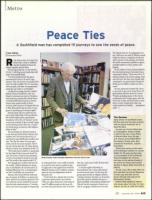
Rudy Simons looks through mementos from his trip to Iran.
to understand that a war would be bad for
us as well as Iran; and as a political mat-
ter right now, a war against Iran would be
difficult" because of U.S. military commit-
ments in Iraq and Afghanistan and the
financial cost.
"I don't deny for a minute that Iran has
a repressive government:' says Simons.
"They are quasi-democratic. And many of
Iran's 70 million people are far more lib-
eral than their government. But at the first
shot [in a war], they would all back their
government."
It was the eighth Fellowship of
Reconciliation trip to Iran, and Simons'
second in recent years. On this trip, the
group spoke mostly to religious leaders,
visiting Armenian churches, an Armenian
genocide museum, Muslim mosques, a
major ayatollah, a Zoroastrian temple and
Tehran's Jewish community. Simons was
told at synagogue Shabbat services that:
Rudy Simons of Southfield turned
80 this week and has been involved
with the peace movement for at
least 50 years.
He grew up a Conservative Jew
at Congregation Shaarey Zedek
in Detroit and was a close friend
of Sherwin Wine since the age
of 9. Simons joined Rabbi Wine's
Birmingham Temple when Wine
started the Humanistic Judaism
movement.
Simons has served on the board
of the Michigan Coalition for Human
Rights for 25 years and has been
a vice president of the Cranbrook
Peace Foundation for 14 years.
He's also on the advisory board of
the Center for Peace and Conflict
Studies at Wayne State University in
Detroit.
He has a son, 38, in Italy. After his
first wife died, he married Roseanne
19 years ago and their son will
be bar mitzvah next year at the
Birmingham Temple.
Simons often speaks to commu-
nity groups about his trips. For infor-
mation, call him at (248) 543-4550.
December 25 • 2008
A13