

Arts & Entertainment
'The Maccabees' Sister'
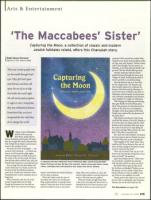
Capturing the Moon, a collection of classic and modern
Jewish folktales retold, offers this Chanukah story.
Rabbi Edward Feinstein
Special to the Jewish News
There are certain people who
see the world through God's
eyes. They feel God's pain
and distress, and they call
upon the rest of us to help
pturing
the Moon
iznard16.4G-ncirseisi fL;b:s
God make the world right.
We call such people prophets
or sages or seers. Sometimes
they are celebrated as heroes.
Sometimes they are never
recognized for the work they
do to change the world.
W
e know of great Mattathias
and his brave sons, the
Maccabees: Judah, Eliezer,
Simon, Yochanan and Yonatan. We know
that they fought the Greeks, liberated the
Holy Temple from idolatry and returned
Israel to the worship of God.
We know the story of the lights — the
miracle of the menorah — in which one
tiny jar of oil burned for eight nights,
demonstrating that God had returned to
the midst of the Jewish people. We know
that the Maccabees minted coins and cele-
brated God's miracles in rescuing the Jews.
But we forget that the Maccabees had
a sister. Her name was Dinah. And it was
because of her that all those miracles
came to be. Dinah is the real hero of the
Chanukah story. So let's remember how it
happened.
When Antiochus and the rest of the
Greeks brought idols into the Holy
Temple in Jerusalem, the Jews did not
protest. There was a harvest to bring in,
RETOL D B\'
Rabbi .dwa rd
•
-einstem
In Capturing the Moon (Behrman House Publishing: $22), California-based Rabbi
Edward Feinman narrates 36 tales that transmit Jewish culture and inform Jewish
values, concluding each with questions that explore the stories' themes.
crops to store before the winter. Everyone
was too busy to protest.
When the Greeks made the Jews of
Jerusalem bow down and worship the
idols and forced them to abandon their
study of Torah, the rites of the Covenant
and the worship of God, no one said a
thing. There were families to raise, chil-
dren to teach, elders to care for, homes to
tend to. Who had time for politics?
When the Greeks brought their idols
to the towns of Judah and forced Jews to
abandon the God of their ancestors and
bow low to Zeus, no one stood up and
protested. Who needed the trouble? Who
wanted to face down armed soldiers? After
all, they were only farmers. "Better to keep
quiet," they thought, "lay low, attract no
attention, in the hope that the Greeks will
go away" But the Greeks didn't go away.
Instead, Antiochus and the Greeks
pushed forward through the towns and
villages of Judah, destroying the faith of
Israel. And still no one did anything.
Once the harvest was in, it was time
for the village feasts. The farmers and
their families gathered to celebrate the
bounty of the land and the blessings of
God. In the town of Modi'in, the town of
Mattathias and his family, Jewish farmers
and craftsmen, shopkeepers and laborers,
came together for a night of celebration.
With singing and dancing and feasting,
they gave thanks for all God had given
them. The presence of Antiochus and his
armies in the land was soon forgotten.
Thoughts of the desecration of the Holy
Temple were replaced by the pleasures of
the joyful feast.
Only Dinah remembered. Only Dinah
could feel the shame of the Holy Temple as
if it were in her own body. And she could
feel the evil of Antiochus that crept upon
the Land of Israel as if it crept along her
own arms and legs. Why could no one else
feel it? Why did no one else care?
She cried out to her brothers, erusalem
has been ruined, and our Temple has been
wrecked! Why don't you do something?"
They laughed at her. "Little sister, what
could we do? We are farmers; they are sol-
diers. Besides, tonight is the feast. All year
we have waited for the feast!"
"How can you feast? How can you cele-
brate? Can't you feel the evil that has come
upon our land?" she inquired.
Again they laughed at her. "Little sister,
you sound like a prophet! Go and play
with the girls, and let us enjoy our feast!"
But Dinah did not give up. She faced
her brothers and pleaded: "Judah, you are
the bravest. Are you afraid to fight these
Greeks? Eliezer, no man is mightier than
you. Why are you suddenly so weak?
"Simon, you are the wisest of us. Can you
not see what is coming this way? Yochanan,
Yonatan, you are the most loyal and the
The Maccabees on page C16
December 18 • 2008
C15