

HOME
Completing The Look
Wallpaper is back. Textures are in. It is almost anything goes for your walls.
Steve Raphael
Special to the Jewish News
W
ho needs paint or wallpaper
when you have faux paint-
ing and stenciling to perk up
your walls? Paint and wallpaper are still
the materials of choice; but why stop there
when you can decorate your walls with
tapestries, bamboo or leather, not to men-
tion the time-honored tradition of family
pictures.
We are putting things on the wall
that we never would have done before
for more texture says Bob Schaerer, an
interior designer and owner of Schaerer
Architextural Interiors in Bloomfield Hills.
"You can literally take fabric that we put
on a sofa and send it to companies that
will apply acrylic to the back of the fabric
so we can put it on the wall!"
Paint remains popular and wallpaper is
making a comeback. "People are afraid of
wallpaper ... We all remember spending
weeks trying to take it off the wall," says
Caroline Smith, an interior designer and
owner of Caroline Inc. in Royal Oak.
Smith likes wallpaper for its texture,
originality, individuality and warmth.
"Each room has its own wallpaper and its
own personality. As a matter of practical-
ity, you can wipe stuff off wallpapet"
But, she cautions, wallpaper also can
lower the resale value of a house.
"Wallpaper is making a comeback today
... The younger generation wants it. They
like the big patterns and bold colors, the
reds and golds:' Smith says.
"Paint is still a major player in home
decoration as it is inexpensive and can be
changed easily:' she adds. "It is durable
and cost effective. Negatives? I don't know
if there are any"
Leather-upholstered wall panels are
popular among upscale families. You sim-
ply put leather on plywood and affix the
plywood to the wall using nails or Velcro.
Interior designer Tovah Feinberg, owner
of Tovah Design LLC, based in Royal Oak,
likes the aesthetic appeal of wallpaper
and wall coverings, especially the latter
as there is a lot of material now available.
A graduate of the College for Creative
Studies in Detroit, Feinberg is now in New
York City studying for a master's degree in
design management at the Pratt School of
Art and Design.
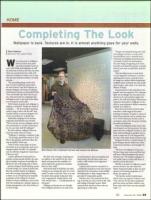
Bob Schaerer with a handmade tree bark wall treatment by Weitzner.
She likes wall coverings, "anything you
can adhere to the wall the for the color,
depth and natural looks available. I've
seen people blow up pictures and place
them on their walls."
Paint lends itself to flexibility, she adds,
noting you can change the color of a room
easily, "as often as you like. There is no one
hot paint color popular today, just what-
ever is appropriate. People tend to stick
with warmer tones ... It really depends on
the home!'
Wallpaper and paint are eco-friendly.
Most wallpaper products are made from
recycled products that are washable and
long-lasting. Recycled latex paint now
meets a wide variety of eco-approved
specifications.
If paint is not reused or recycled, it is
considered a hazardous waste and must be
disposed of in a hazardous waste landfill.
Recycled paint is often cheaper than vir-
gin paint of comparable quality
Bamboo, once a hot material for floor-
ing, is moving up in the world, to the walls
and ceilings of peoples' homes. Other
materials that started on floors also are
appearing on walls today.
"People are putting flooring onto walls
and ceilings to achieve a certain look:'
says builddirect.com, a manufacturer/
wholesaler of building materials based
in Canada. And it's not just bamboo;
the same thing is happening with stone,
porcelain and slate flooring tiles as people
look for new ways to make their interiors
unique!'
Wall stenciling traces its roots back
to early Egyptian civilization. It involves
applying paint across a stencil to form
an image on a surface below. Sometimes;
multiple layers of stencils are used on the
same image to add colors or to create the
illusion of depth.
Computers have made stenciling more
popular and less expensive. The computer
spits out the design; the artist places the
stencil on the wall and then applies the
paint to the wall. Stenciling is always more
expensive than paint or wallpaper as the
artist is more expensive. Before computers,
stencils were hand cut.
Faux (from the French word for fake)
describes a wide range of decorative
painting techniques. It began as a form of
replicating materials such as marble, plas-
ter or wood with paint, but has come to
encompass many other decorative finishes
for walls and furniture.
When decorating the entire home, inte-
rior designers see the big picture. You may
paint one room, wallpaper another or use
other wall furnishings in another, but we
want to make sure it is all integrated for
the sake of the entire home, Schaerer says.
Designers look for a cohesive design. "A
good designer doesn't make every room
in the home look like a new thought;' he
adds.
"We don't use wallpaper in big areas.
We have large, open rooms and that look
will have to flow throughout the house
Schaerer says. "We relegate wallpaper to
non-public spaces, rooms with doors or
private areas in the home!'
Whether it is paint or wallpaper, people
are less afraid to use color than ever
before. People get bolder as they see their
options in decorating magazines or TV
shows, the experts say.
"The fashion industry determines
which colors are popular;' Schaerer says.
"The colorists for the paint companies
grab the colors and then, within a year,
those colors find their way onto people's
walls." 0
j
December 18 • 2008
C9