

Ii
sr
ill MIL 4411111111—
Business & Professional
Digital Memorials
Audiovisual screens provide comprehensive view of loved ones.
Julie Edgar
Special to the Jewish News
T
he dead have always had a place
in the synagogue, their names
and dates of birth and death
etched on brass plates set into baroque
frames. The simplicity is elegant and the
materials enduring.
But when generations have passed, the
boards become, well, dead wood.
Honoring the tradition of memorial-
izing the dead, while bringing it into the
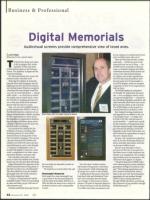
digital age, has been Steve Katz's mission
over the last decade. What has emerged is
a dazzling Web-based display board that
can carry as much information — textual,
audio, visual — as a loved one or institu-
tion might want to include about a mem-
ber. The effect is dazzling, allowing view-
ers to delve into the life of the deceased
person with the touch of a screen.
Katz, a 42-year-old Southfield resident,
recently displayed the APIOH (A Place In
Our Hearts) board at a conference of syn-
agogue administrators in Atlanta, showing
its other applications as a donor board
that highlights an organization's fundrais-
ing campaigns and honors givers and as
a display of lifecycle events, be they b'nai
mitzvah, births or weddings.
An accountant by training who has
worked as a business consultant, Katz
decided to pilot the 32-inch APIOH
memorial board at Young Israel of Oak
Park, his family's synagogue. This one has
a keypad (deactivated on Shabbat and
holidays) and holds 650 names and asso-
ciated information, and it cycles through
12 "plaques:' or biographies, every 10
seconds. The display is framed in a dark
wood, a complement to the older memo-
rial boards that line a sanctuary wall.
Katz said older users prefer a touch
screen, so that's the standard now; and the
boards can carry far more than 650 entries.
Mintzi Schramm's first impression of the
APIOH Memorial board at Young Israel of
Oak Park was that it was a bit "gimmicky"
Then Katz asked her to post her mother's
photograph with a few words. Schramm
did, and her skepticism faded.
"It really is a living memorial:' said the
Southfield resident."You're not just looking
at names and dates; you get a full view of
who the person wae
Schramm added that she people beyond
C2
December 18 • 2008
A PLACE !N
our HEARTS
Geoie
Washington's
1, , gorition as our
first President
Stx,re Utz.
APIOVI
At, ...411t.ts
Steve Katz with his digital memorial board
her own family are interested in what's on
the board, too.
"It's made for our visual culture she said.
Meaningful Memorial
Katz's quest for a more meaningful way
to pay tribute to the deceased deepened
with the death of his father, Wolf Katz, in
2003; but Katz has always been a keeper of
the flame by nature and a sentimentalist
at heart.
"As a kid, when I looked at memo-
rial boards at Young Israel or elsewhere,
I always found it a little disturbing that
all you got was a name or date of death
— nothing about the person, where they
lived, their trials and tribulations:' Katz
said. "And eventually, when the family
was no longer in that location, it had no
purpose. The point of memorial plaques is
to connect the person with the institution.
If we didn't care [about association], we'd
put up a plaque on a random park bench
and it wouldn't matter who saw it"
There are Web sites devoted to online
memorials — ti11120.com and virtual-
memorials.com are two of them — but
APIOH's closest competitor is Planned
Legacy, a Canadian company that offers
customized electronic donor boards and
touch-screen informational displays
for religious and secular organizations.
However, Katz said, the products don't
have the same level of functionality as
the APIOH displays, which are designed
to generate revenue for the organizations
that buy them.
The APIOH displays are administra-
tor-friendly. The organization that wants
one — be it a synagogue, church, school
or corporate headquarters — controls the
site, uploading biographies and photos and
video and audio, all of which can be modi-
fied at any time, either on site or by Katz.
The APIOH display can be encased in a
customized frame or set flush in a wall.
Katz charges licensing, maintenance
and upgrade fees in addition to the cost
of the display board — it ranges from
$15,000 to $27,500, with discounts for
second modules — and the rest is profit
for the institution. At Young Israel, those
who have already bought a brass plaque
get a discount for placing a loved one's
biography on the board. Information can
also be shared by organizations as long as
they own a display board.
Because a few schools have asked Katz
about it, he's also developing displays for
photos and daily information, much like
an electronic bulletin board.
By year's end, Katz plans to have a
portal on his Web site (www.apioh.net )
that allows users to make donations and
tributes to an organization. He's consider-
ing providing access, by password, to the
information that appears on displays.
"The great thing about APIOH is that
we're connecting past, present and future
generations through our products:' Katz
said. "We're helping organizations and
their members develop their relation-
ships in the same way: By showing their
appreciation for one another through
APIOH Donors, sharing experiences
through APIOH Life Events, and sharing
their memories of past members through
APIOH Memorials."
❑