

Wor
Z.
Mideast Cooperation
Red Cross humanitarian prize honors the joint work of
Israel's Magen David Adorn and Palestinian Red Crescent.
0
n Nov. 20, the American Red
Cross Southeastern Michigan
Chapter hosted a reception at
the University of Michigan-Dearborn for
the recipients of the inaugural Red Cross
Humanitarian Prize.
Younis Al Khatib, president of the
Palestinian Red Crescent Society (PRCS),
and Noam Yifrach, M.D., chairman of
the executive committee of Magen David
Adorn (MDA) in Israel, were honored for
the work they have accomplished in estab-
lishing a formal, ongoing collaboration
between their two organizations, which
has led to improved humanitarian condi-
tions for Palestinians and Israelis.
The Humanitarian Prize represents the
highest honor awarded by the American
Red Cross. The prize recognizes the
achievements of one or more individuals
who exhibit extraordinary bravery and
dedication to the fundamental principles
of the International Red Cross and Red
Crescent movement. These principles
include humanity, impartiality, neutrality,
independence, voluntary service, unity
and universality.
According to the Red Cross, Al Khatib
and Yifrach were chosen because they
display tremendous personal courage in
their efforts to improve life and the living
conditions in their conflict-torn region.
The two received the Humanitarian
Prize during a Nov. 18 ceremony in
Washington, D.C., where U.S. Secretary
of State Condoleeza Rice offered keynote
remarks. The two leaders then visited New
York City, Detroit and Los Angeles before
heading back to the Middle East.
"This award represents triumph of
humanitarianism over politics, coopera-
tion over confrontation, and peace over
violence said James Laverty, chief execu-
tive officer of the American Red Cross
Southeastern Michigan Chapter. "These
men have a desire to improve human con-
ditions, and in this case, it is a daunting
challenge!'
During the luncheon, Yifrach and Al
Khatib discussed projects the two orga-
nizations are collaborating on, challenges
still facing their organizations, and how
the American Red Cross has supported
their efforts.
Dan Cherrin, press secretary for Detroit
A30
December 18 • 2008
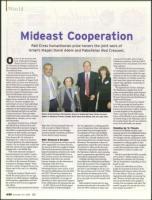
Shown at the luncheon with honorees Younis Al Khatib and Noam Yifrach are local
leaders of American Friends of Magen David Adorn: Eva Mames, left, and Judy Grant
Mayor Ken Cockrel, presented both men
with an award on behalf of the city.
Laverty read remarks from Michigan
Governor Jennifer Granholm and Robert
Ficano, Wayne County executive.
MDA Shunned 6 Decades
The road to the prize has not been easy for
either organization. For almost 60 years,
the American Red Cross sought to include
MDA in the international movement, the
largest humanitarian network in the world
that includes 186 national Red Cross or
Red Crescent societies, the International
Federation of the Red Cross and Red
Crescent Societies, and the International
Committee of the Red Cross.
As the humanitarian needs of
Palestinians became more critical, so did
the need for collaborations between MDA
and PRCS. The Red Cross believed that
inclusion of these organizations into the
movement would better encourage col-
laboration, as well as government support
of the collaboration and humanitarian aid.
In 2005, Yifrach and Al Khatib signed
a memorandum of understanding for
the two organizations, outlining specific
areas of cooperation. Many international
governments were encouraged by the
commitment of Yifrach and Al Khatib
to work together and in 2006 the PRCS
and MDA were officially admitted to the
International Red Cross and Red Crescent
Movement. The admission of these two
organizations marked the end of 58 years
of exclusion for MDA and the first time
a Palestinian organization appointed by
the Palestinian Authority enjoys standing
equal to organizations appointed by inter-
nationally recognized governments.
Al Khatib said there were two basic
ideas behind the collaboration and desire
to join the movement. "First, recognize the
humanitarian focus always comes first
and then to acknowledge we live in a con-
flict area and move past it," he said. "When
you talk about the human factor of the
Red Cross movement, people are forced to
focus on people, the need for equality and
dignity."
Major progress between the two orga-
nizations was achieved in November 2007
when five PRCS ambulances began oper-
ating in east Jerusalem and serving its
Palestinian population. Until then, PRCS
ambulances were only allowed in the West
Bank and Gaza.
The MDA has also been instrumental
in creating group cooperation. A unified
communication system enables the orga-
nizations to call on each other for support.
MDA volunteers are available around the
clock near check points and anyone can
request help, regardless of nationality or
religious affiliation.
The organizations still face challenges.
The Palestinians complain that check-
points and permits hinder quick response
to those in need, and that closures along
the Gaza Strip prevent easy distribution of
supplies and assistance.
The American Red Cross has stepped
in to help encourage the Israeli govern-
ment to allow the five PRCS ambulances
based in east Jerusalem to deliver patients
to Israeli hospitals in west Jerusalem.
There is also hope that the PRCS ambu-
lances will be allowed to serve residents of
Jerusalem living on the Palestinian side of
the security barrier but who are entitled to
access the Israeli health care system.
Standing Up To Threats
Yifrach and Al Khatib are both under
immense pressure from influential leaders
within their countries and governments
who disagree with the collaboration. Both
have received threats. Yet both men remain
committed to working together as they
recognize their organizations are designed
to meet the humanitarian needs of their
communities, in times of conflict and
peace.
Yifrach is proud that the MDA currently
serves almost 7 million people in Israel,
including Jews, Muslims and Christians.
"We are committed to responding to all in
Israel: he said.
However, he added that not all Jews
accept the document of inclusion of the
Palestinian Red Crescent and are distrust-
ful of the alliance. "There are constant
negotiations and politics to overcome he
said. "However we both need each other
and can provide better aid to people by
working with, not against, each other. The
number one goal is to save the lives of as
many people as possible." O