

Special Report
ON THE COVER
FOREVER
JNF river park to help bring Negev to life.
Marcy J. Levinson
Jewish Renaissance Media
I
t was David Ben-Gurion's dream to
make Israel's desert bloom. Many
Israeli organizations and private
donors are working hard at fulfilling that
dream, especially the Jewish National
Fund through its Blueprint Negev initia-
tive.
This plan will bring to life the Negev,
Israel's southern desert region, an area
that comprises 60 percent of Israel's land
but only 8 percent of its population.
"The Negev is the future — Ben-
Gurion was right:' said Rick Krosnick,
JNF national campaign coordinator and
Midwest Zone director based in Chicago.
"It's taken us 60 years to really push for-
ward."
Currently, the focus is on Beersheva,
largest city in the Negev. Through its
Beersheva River Park project, JNF plans to
make "Beersheva a destination place and
the capital of the Negev," Krosnick said.
Now Beersheva is dusty, hot and eco-
nomically shrinking. The main draws
are Ben-Gurion University and Srochi
Medical Center. Other than that, there are
factory jobs; and most enticing to people
is the easy commute to Tel Aviv. A second
rail line and a rail between Ashkelon and
Tel Aviv are being built, which will make
the city even more accessible.
But now, many people merely travel
through the Negev on their way to Eilat at
the country's southernmost tip or to the
Bedouin communities to enjoy a tradi-
tional dinner under a hafla tent. Few stop
in Beersheva.
But the Negev, according to JNF repre-
sentatives, needs more than a few pass-
ers-through to make an impact on the
111111
11111
1 1 1 11 ,
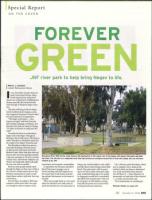
Beersheva River Walk will be a San Antonio-like destination in the capital city of the Negev, with parks, bike paths and walk-
ing trails. The site was on a neglected canal that has become an ecological hazard full of trash and sludge, but now has been
cleaned up by JNF.
area's future and economic sustainability.
In September, Itai Freeman, Beersheva
River Park project manager, was in
Detroit meeting with JNF supporters at
the annual Tree of Life dinner and shar-
ing updated information on the status of
the park.
When most people think of a river park
often San Antonio's river walk comes to
mind; but Beersheva's river park project is
along a dry riverbed called a wadi, which
provides flood control during winter flash
floods. The park project calls for green
spaces for kids to play, restaurants, shop-
ping, residential living, places for people
to congregate socially and a recreational
lake filled with recycled water. Total cost
for the project is $100 million, coming
from JNF, the private sector and several
Israeli governmental ministries.
The 1,700-acre park's first phase, which
now is complete, was to clean up the
riverbed, which was home to abandoned
cars, trash and residue from chemical
run-off. Phase II — three kilometers of
promenades on both sides of the riverbed
— is under way, Krosnick said.
The transformation is something he
Forever Green on page A15
JN November 13 2008
A13