

Metro
VETERANS' DAY
Aka
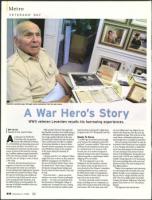
Malcolm Leventen goes through some mementos from his war years.
A War Hero's Story
WWII veteran Leventen recalls his harrowing experiences.
Bill Carroll
Special to the Jewish News
A
s time goes by, World War
II veterans who are genuine
heroes, like Malcolm Leventen,
91, of Southfield, are becoming more and
more scarce; and their "war stories" are
becoming more and more sacred and nec-
essary to preserve for posterity. Among
the 2 million military people involved in
WWI, the veterans, mostly in their 80s
and 90s, now are dying at a rate of about
1,500 a day.
Leventen, who first learned to be an
engineer at Detroit's Cass Tech High
School, spent the entire war on Pacific
Ocean battlegrounds, fighting the Japanese
practically up to Japan's doorstep. Along
the way, two of his legs were broken; he
was shot in a leg; he had several concus-
sions causing periodic blackouts, and
he suffered from recurring malaria. He
was one of 620,000 wounded in the war;
405,000 were killed.
A16
November 6 • 2008
AN,
With another Veterans' Day approach-
ing Tuesday, Leventen, now mostly using a
wheelchair and experiencing the infirmi-
ties of age, quietly reflected on the war,
his ardent pro-Zionist and anti-terrorism
views, and his post-war life as a builder
of structures familiar to those in Metro
Detroit's Jewish community. His memory
was refreshed at times by his caregiver
of five years, MaryLou Kennedy of
Southfield.
Leventen said his "very religious" father
taught him how to daven as they attended
different synagogues each Shabbat in
the area of Detroit's Tuxedo Street, where
the family lived. "That's when I began to
develop my strong Zionist feelings and
love for Israel that have lasted to this day:'
he said.
From Cass Tech — where one of his
teachers was aviator Charles Lindbergh's
mother — he went on to graduate from
the University of Michigan's College of
Architecture. Leventen also was a strong
anti-Fascist, and only his mother's pleas
kept him from running off to fight them
in Spain in the 1937-38 Spanish Civil War.
Ready To Serve
"I couldn't get an architectural job right
away because the companies weren't hir-
ing Jews," Leventen recalled. "There was an
awful lot of anti-Semitism in those days.
So I enlisted in the U.S. Army in 1942,
became part of an airborne engineers'
regiment and got some quick training in
engineering and as a paratrooper before
shipping off to the Pacific.
"We were supposed to go to the
Philippines; but the Japanese captured
the country before we got there, so we
were diverted to New Guinea. I remember
attending Shabbat services conducted
by Rabbi Morris Adler of Congregation
Shaarey Zedek in Detroit [who was serv-
ing in the Army at the time]."
Leventen eventually made 28 combat
jumps, including one on a temporary air
strip in New Guinea when both of his legs
were broken. "All of the other men with
me were killed, and I was helped by two
natives who found me alive the next day
and splinted my legs. They took me to the
coast where a submarine picked me up
and brought me to a hospital in Australia!'
After recovering "somewhat:' he said, he
returned to New Guinea and was assigned
to Gen. Douglas MacArthur to help build
an air base and prepare for the invasion
of Leyte, leading to MacArthur's famed
return to the Philippines. During the inva-
sion in early 1945, he was "caught in the
middle;' being exposed to U.S. naval guns
that were providing them with cover and
Japanese artillery fire and strafing by the
Zero fighter planes.
"Many of our engineers were paratroop-
ers who jumped into the battle area; and
gliders brought in our equipment, expos-
ing our men to a high mortality rate:' he
said. "One of our glider pilots was Jackie
Coogan, the famous child actor [who later
played Uncle Fester on TV's The Addams
Family] .
"The Japanese had started their