
-Special Report
ON THE COVER
Medical Barrier
Holocaust forced Jewish physicians to flee.
Ilene Wolf
Special to the Jewish News
work, titled "The Effect of Nazism on
Medical Progress in Gastroenterology: The
Inefficiency of Evil," in 2006.
His publication this year used the same
research, but the article focused on patient
care rather than physician persecution.
A
s a son of Holocaust survivors
and descendant of relatives
who perished in Auschwitz, Dr.
Mitchell Cappell wanted to honor his fam-
ily by researching the plight of European
Jewish doctors during World War II. His
digging revealed that medical progress
was unnecessarily delayed due to Nazi
persecution of Jewish physicians.
The development of a surgery proce-
dure to eliminate acid reflux; a convenient,
widely used screening test for colon can-
cer; a safer, more patient-friendly way to
look inside the stomach; and other medi-
cal advancements were delayed for years
because of the Nazis.
"If these treatments and tests had been
available earlier, they would have eased
suffering for thousands of people and
saved countless lives:' says Cappell, chair-
man of gastroenterology at Beaumont
Hospital in Royal Oak.
Cappell, 55, of Southfield, published
results of his research, "Profound Long-
Term Effects of Nazism on Patient Care in
Gastroenterology:' in the Israeli Medical
Association Journal earlier this year.
More than 6,000 Jewish doctors fled
Europe amid Adolf Hitler's brutality, start-
ing in 1935 when they lost their citizen-
ship and were prohibited from practicing
medicine.
Cappell identified 52 Jewish and one
anti-Nazi Christian gastroenterologist —
doctors who treat disorders of the stom-
ach and gut -- whose work was thwarted
by Hitler and his followers.
"I was astonished that I found 53:' he
says. "Being famous, being a great scientist
was no protection from Nazi persecution."
He has since added a 54th physician,
Eugen Alexander Polya, a Hungarian sur-
geon who developed a stomach procedure
that is named after him. It is believed Polya
was murdered by a Nazi group during the
siege of Budapest in December 1944.
Cappell is the first to comprehensively
report on Jewish doctors persecuted by
the Nazis, in any medical specialty, to his
knowledge.
Honoring The Dead
Cappell's quest started five years ago when
he was chief of gastroenterology at St.
A14
November 6 • 2008
3N
A Hobby Grows
Researching and writing about Jewish
gastroenterologists who perished during
World War II grew out of Cappell's hobby
of collecting Holocaust-era items. He has
more than 3,000 original letters and docu-
ments.
Among those documents are peti-
tions from 400 rabbis who marched on
Washington on Oct. 6, 1943, to convince
President Franklin Delano Roosevelt to
do more to help the Jews in Europe. When
FDR sent Vice President Henry Wallace
in his place, the religious leaders were
so incensed that they declined to submit
their petitions. Cappell bought the peti-
tions at an auction several years ago.
"Museums were bidding, too; but I don't
think they realized the historical signifi-
cance:'
Another gem in his collection is a letter
from Hanna Szenes, a Hungarian Jewess
who risked her life by working with the
Yugoslavian and Hungarian resistance. She
was subsequently captured and executed
at age 23. Cappell's Szenes letter is the
only one by her that is not in a museum or
owned by her family.
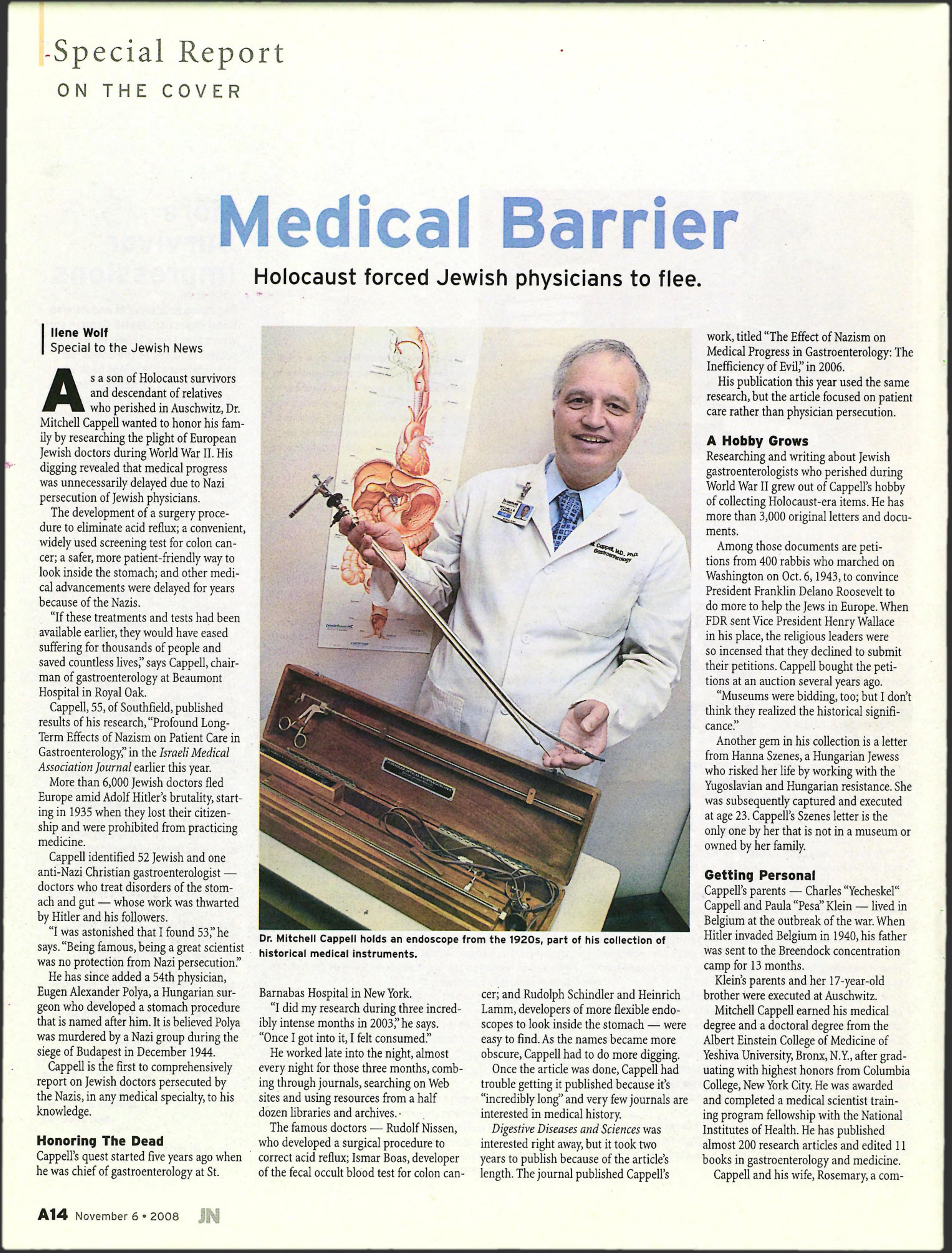
Dr. Mitchell Cappell holds an endoscope from the 1920s, part of his collection of
historical medical instruments.
Barnabas Hospital in New York.
"I did my research during three incred-
ibly intense months in 2003:' he says.
"Once I got into it, I felt consumed."
He worked late into the night, almost
every night for those three months, comb-
ing through journals, searching on Web
sites and using resources from a half
dozen libraries and archives. •
.
The famous doctors — Rudolf Nissen,
who developed a surgical procedure to
correct acid reflux; Ismar Boas, developer
of the fecal occult blood test for colon can-
cer; and Rudolph Schindler and Heinrich
Lamm, developers of more flexible endo-
scopes to look inside the stomach — were
easy to find. As the names became more
obscure, Cappell had to do more digging.
Once the article was done, Cappell had
trouble getting it published because it's
"incredibly long" and very few journals are
interested in medical history.
Digestive Diseases and Sciences was
interested right away, but it took two
years to publish because of the article's
length. The journal published Cappell's
Getting Personal
Cappell's parents — Charles "Yecheskel"
Cappell and Paula "Pesa" Klein — lived in
Belgium at the outbreak of the war. When
Hitler invaded Belgium in 1940, his father
was sent to the Breendock concentration
camp for 13 months.
Klein's parents and her 17-year-old
brother were executed at Auschwitz.
Mitchell Cappell earned his medical
degree and a doctoral degree from the
Albert Einstein College of Medicine of
Yeshiva University, Bronx, N.Y., after grad-
uating with highest honors from Columbia
College, New York City. He was awarded
and completed a medical scientist train-
ing program fellowship with the National
Institutes of Health. He has published
almost 200 research articles and edited 11
books in gastroenterology and medicine.
Cappell and his wife, Rosemary, a com-