

Spirituality
THE SHOFAR'S BLAST
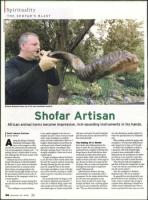
Richard Mukamal blows one of his own handmade shofarot.
Shofar Artisan
African animal horns become impressive, rich-sounding instruments in his hands.
Shell! Liebman Dorfman
Senior Writer
A
mong the things in Richard
MukamaPs Farmington Hills
home is his trumpet, an office
used for his commercial real estate prop-
erty and management company and — 14
antelope horns. A shofar maker by avoca-
tion, Mukamal has the horns as part of his
personal collection.
Mukamal has been a shofar blower at
Temple Shir Shalom in West Bloomfield
for the past 12 years, where he volunteers
under the direction of cantorial soloist
Penny Steyer overseeing students who
blow shofar during High Holiday services.
He also donates profits from the sales of
his shofarot to the synagogue, where he is
a board member.
It was Mukamal's trumpet playing that
spurred him into the shofar-making "busi-
ness!'
"The mouthpiece on most shofarot
B6
September 25 • 2008 Ai
is very small compared to the one on a
trumpet:' he said. "I knew if one was made
with a wider mouthpiece it would be
easier and more comfortable to blow. So I
bought a shofar, lopped an inch from the
end tip and used a dremel [small grind-
ing tool] to fashion a mouthpiece from
the larger opening, closer to the size of a
trumpet mouthpiece. I blew into it and it
sounded great.
"A larger mouthpiece allows the blower
to use the front of their mouth rather than
the side. The sound is made by air passing
through vibrating lips into the mouth-
piece. By using the front of the mouth
and a larger mouthpiece, more of the lips
are used in vibration, resulting in a fuller,
richer sound. In a way, these are ancient
trumpets!"
For six months before he began to sell
the shofarot, Mukamal experimented. "I
tried a lot of different things, spoke with
other people and even talked with a guy
who makes pipes in Toronto and periodi-
cally uses cow horns:' he said. During the
past four years, he has sold about 60 sho-
farot internationally.
The Making Of A Shofar
Each shofar takes Mukamal about five
hours to make. He uses antelope horns
purchased from a supplier in Florida who
brings them in from South Africa. Most
commonly, he makes them from horns
of greater kudu, which come in different
shades of brown and have a wide range of
size. Known for their rich sound and spi-
ral shape, "they are twisty and impressive-
looking horns and make an impressive
sound:' Mukamal said.
Called Yemenite shofarot, his large,
twisted shofarot are commonly used in
synagogues. He also makes shofarot from
the rare and exotic gemsbok or oryx
horns, which are about 30 inches long,
straight and black, with a striking appear-
ance and an airy trumpet-like sound, he
said. "They are often purchased by some-
one who already has another shofar, but
wants this specialty item, toe Mukamal
said.
When making a shofar, he begins with
mouthpiece. "It is the most difficult part,
and I spend a lot of time on it:' he said.
He makes the mouthpiece as large as
is practical, with well-rounded edges
to make it more comfortable to blow.
Mukamal says the mouthpieces he makes
are done in a way contrary to most sho-
farot, which are made in Israeli factories.
"They heat the end and straighten it
and then drill into the straight tip;' he said.
"I start out with the curved end and drill
into the curved surface!"
After the mouthpiece is finished,
Mukamal said, "The rest is aesthetic!'
He generally has several partially com-
pleted shofarot in his workshop so when
orders come in it doesn't take as long to
complete them. Referring to himself as a
"shofar artisan:' Mukamal said, "No two
horns are ground the same way so no two