

Building Relationships
Young Detroiters bridge communities by working with children from Sderot.
Adam Finkel
Special to the Jewish News
Sderot
B
ig cities have recognizable
sounds. Think of the blasts and
booms on July 4 in Washington.
The million or so people excitedly count-
ing down for the new year in New York
City. The annual parade of classic engines
cruising down Detroit's Woodward Avenue.
And yet, in the region of Sderot, the
sound of a blast wreaks the fear of a
nightmare. Distance is counted in decibels.
Alarm breeds panic. It's where the louder
the pitch means the sharper the urgency
for safety.
At the youth village of Nitzana, 40 miles
from the established city of Beersheva,
they understand the sanctity of silence.
You're more likely to hear the buzz of an
insect than any whimper from the sky, or
rocks falling from the ancient ruins next
door, or a car passing you on your morn-
ing bike journey past pomegranate trees,
or riders chatting on the enclosed Egged
Bus 44 that slips between the front gates
when the clock hits 2 p.m.
This summer, the Jewish Agency for
Israel organized a week of refuge for 6,800
children aged 6-17 from the besieged
Negev area in and around Sderot where
missiles from Gaza are launched almost
daily. It's no wonder one of the camps was
at Nitzana, where the natural serenity is
a refuge for needed peacefulness. At the
Nitzana camp, there were eight weeklong,
overnight-camp sessions for 100 students
grades 5-9 each week.
Silence, though, is readily interrupted by
discussion. Just ask Bar and Ziv — two kids
boasting smarts and excitement. They'd
share the stories of their lives with you as if
you were long-lost neighbors. As time went
on, they'd certainly seem more like family.
Guaranteed: a mutual interest and friend-
ship rooted in a shared heritage as Jews.
Bar and Ziv were two of the children
who spent five days at Nitzana this sum-
mer — away from the threats and attacks
back home that scarred parts of their
childhood. The Jewish Federation of
Metropolitan Detroit provided financial
support to help the affected southern
Israel communities.
Federation's Howard Neistein said
A42
September 25 • 2008
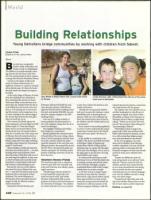
Ilana Riback of Keego Harbor with a young Israeli friend
at Nitzana.
Federation allocated $550,000 for assis-
tance this past summer; $300,000 was
approved from the Sakwa Challenge Fund
last April, and another $250,000 was sent
early this summer, charged to the 2009
Challenge Fund.
I was one of 22 college students or
recent graduates that participated in a
two-week volunteer component. Ten of us
were from Michigan.
The highlight: building relationships
that bridged our communities.
Michal explained the emotional nature
of Israeli life as if he were writing a thesis
about it for his nearing bar mitzvah. Roni,
an Israeli counselor, helped me under-
stand the demands of the army that were
filling her head as she prepared for service
this fall. Kfir is entering ninth grade and
already aspiring for the Technion, Israel's
premier technology university (Trust me,
he's a shoo-in.)
Volunteers Become Friends
The Americans signed up as volunteers,
arrived to give their time and skills and,
at the end of the day, were offered a mean-
ingful experience.
"Volunteering at Nitzana allowed us
to step beyond the typical role of an
American Jew in Israel:' said Jordan
Sherman of Bloomfield Hills, a recent
graduate of the Ross School of Business at
the University of Michigan. "The children
we worked with did not see us as tourists
Jordan Sherman, right, of Bloomfield Hills with one of the young
Israeli boys he befriended.
or part-time visitors, but instead as role
models and leaders.
"Having these young Israeli children
look up to you gave the volunteers a more
identifiable sense of Jewish pride and
purpose. While our visit to Nitzana was
short, the mutual impact that we had on
the children [and the children had on us]
was immense:"
If you wanted to see Jewish peoplehood
in action or better understand the unique
connections between Jews in the United
States and Israel, spend a few hours at
Nitzana.
In the middle of a sand dune in the
middle of the desert, you'd find University
of Michigan College of Engineering
student Ilana Riback of Keego Harbor
chanting songs on a guitar she'd brought
all the way from Michigan. One by one, as
the night aged on, her fan base of young
Israeli children grew larger.
In a classroom the next day, you could
find Danny Devries of West Bloomfield, who
is studying economic and political science
at the University of Michigan, using his
considerable Hebrew skills to help younger
students learn new science concepts.
As the first session in August began,
less than an hour after the volunteers
had arrived, a high school student named
Omer approached the recently arrived
Americans during lunch and invited the
volunteers for afternoon prayers. At the
Nitzana synagogue, helping to make the
required quorum for prayers, a connection
was made between the two groups.
The children were very excited to see us,
and they bombarded us with all sorts of
questions in English. Sam Zerin of West
Bloomfield, a student at the University of
Michigan School of Music, recalled them
asking, "'Where are you from?' How old
are you?' Do you know where Chicago is?'
`Say something in Hebrew!'
"They helped us find our page in the
prayer books, which were numbered with
Hebrew letters instead of numerals, sat next
to us, told us about their religious experi-
ences and immediately became friends"
In this very synagogue, a few days
afterward for Shabbat, Torah blessings
would be chanted by a 20-year old Israeli
entering yeshiva in Jerusalem this fall,
Ethiopian teenagers who had miraculously
arrived in Israel, and a volunteer from
Detroit.
"Despite our differences, both cul-
tural and personal, we are all Jews:' Zerin
reflected. "We have connected with the
children, and they have connected with
us on a more personal level, even during
those activities that have not required
communication in our common language,
even when the children resorted to using
their own native tongue.
"During bicycle rides, hikes and cook-
ing in the waterless Nitzana River, we feel
that we have made a positive impression
Building on pageA44