

I
World
ISRAELI POLITICS
Last Chance
Leslie Susser
Jewish Telegraphic Agency
Jerusalem
W
ith his Kadima Party just
a week away from electing
a new leader, Israeli Prime
Minister Ehud Olmert is making a con-
certed last-ditch effort to reach a peace
deal with the Palestinians.
Olmert has drawn up a detailed
peace offer and presented it to U.S. and
Palestinian leaders. After being shown the
plan, U.S. Secretary of State Condoleezza
Rice described it as "very generous!'
Although the Palestinians say wide gaps
remain, Palestinian Authority President
Mahmoud Abbas and Olmert reportedly
agreed in talks Aug. 31 to make every
effort to wrap up a full-fledged peace
agreement by the end of the year.
But both sides are skeptical.
Israeli Foreign Minister Tzipi Livni and
former P.A. Prime Minister Ahmed Qureia,
who are involved in a parallel negotiation
that is conducting line-by-line drafting
of a final-status agreement, estimate that
the process could go on well into 2009 and
beyond. They say the effort must be given
all the time it needs.
Warning against the danger of rushing
things, Livni said artificial deadlines could
lead to frustration on the Palestinian side
and spark a third intifada. Alternatively,
time pressure could lead Israel to compro-
mise on vital interests.
Right-wing opposition to the Olmert-
Abbas talks go even further. Opposition
leaders have questioned the very legiti-
macy of Olmert's conducting a vigorous
peace drive so close to the end of his term.
Likud Party leader Benjamin Netanyahu
described Olmert's peace plan as "morally
and substantially flawed" and warned that
it would strengthen Hamas.
There are problems on the Palestinian
side, too.
Abbas' term could end early next year,
leaving the Palestinians with a more
radical leadership before an agreement is
finally wrapped up.
What's worse is that as long as Hamas
controls the Gaza Strip, the chances of
implementing any Israeli-Palestinian
peace deal are virtually zero.
Olmert's latest proposal deals with four
core issues: territory, security, refugees
and Jerusalem.
On territory, he offers the Palestinians
93 percent of the West Bank, with Israel
retaining large Jewish settlement blocs in
the remaining 7 percent. As compensa-
tion, the Palestinians would get an area
equivalent to 5.5 percent of the West Bank
in Israeli land close to the Gaza Strip, and
a land corridor connecting Gaza and the
West Bank, linking the two in a single
Palestinian state.
On security, Olmert proposes that the
future Palestinian state would be demili-
tarized and barred from building military
alliances. Israel would have early warning
stations on the Samarian hills in the West
Bank, a temporary army presence in the
Jordan Valley, a presence at border cross-
ings, control of airspace over Gaza and the
West Bank, and access to the main east-
west corridors in the West Bank.
On refugees, Olmert categorically rejects
the so-called Palestinian right of return:
Palestinian refugees would be entitled to
return to the Palestinian state in unlimited
numbers, but not to Israel proper. Still, there
is a small concessionary loophole in the
Olmert proposal: 1,500 to 2,000 Palestinians
would be allowed to "return" to Israel proper
every year for 10 years for "humanitarian
reasons." In other words, Israel could, at its
discretion, allow the immigration over 10
years of 15,000 to 20,000 Palestinians.
Although Olmert insists that Jerusalem
has not been on the negotiating agenda
— the Orthodox Shas party has threatened
to topple the government if Jerusalem is so
much as discussed — the prime minister
does include a temporary solution for the
city in his proposal.
The final Israeli-Palestinian document
would include reference to "a joint mecha-
nism with a fixed timetable" for resolving the
dispute over Jerusalem. Olmert aides refuse
to elaborate but say there would be elements
in the joint mechanism "attractive to the
Palestinians!'
This apparently refers partly to an
offer by Olmert to involve other Arab and
international parties — including Jordan,
Morocco, Egypt, the Vatican and the interna-
tional Quartet grouping of the United States,
Russia, the European Union and the United
Nations — in seeking a permanent solution
for Jerusalem and its holy places.
The Palestinians, however, argue that
Olmert's proposals do not go far enough and
they insist that the gaps between the Israeli
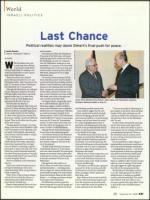
Photo by Ben Gers hom/Governmen t Press O ffIce/BPH Imag es
Political realities may doom Olmert's final push for peace.
Israeli Prime Minister Ehud Olmert, right, meets with Palestinian Authority
President Mahmoud Abbas on Aug. 31.
and Palestinian positions remain wide.
Some analysts suggest that the only
realistic way forward would be through
American bridging proposals. But the
Americans are unlikely to be forthcoming:
During a visit in June, when Rice asked
for a paper highlighting key points of
agreement and disagreement, both sides
refused on the grounds that that kind of
hands-on American intervention would
not be helpful at this stage.
"We and the Israelis told Dr. Rice that the
decisions are required from Palestinians and
Israelis',' said senior Palestinian negotiator
Saeb Erakat."I am sure the Americans, the
Arabs and the Europeans will stand shoulder
to shoulder with us in order to implement
whatever we agree. But the decisions are for
Palestinians and Israelis."
Officials close to Olmert argue that even
if it can't immediately be implemented,
a joint Israeli-Palestinian document on
permanent-status issues would constitute
a historic breakthrough.
"We believe it would become a galvaniz-
ing point for all the moderates and offer
an alternative to the Hamas-Hezbollah-
Tehran paradigm:' Olmert spokesman
Mark Regev said.
Regev believes that not only would the
deal win wide international support and
boost the moderates in the Arab world,
it also would help resolve the problem of
Israeli settlement in the West Bank.
"If we are successful in delineating to a
great degree of specificity where the final
borders will be, then obviously we will
continue to build in the settlements on our
side and not in those on the Palestinian
side," he said.
In other words, immediately upon sign-
ing the deal, Israel would regard settle-
ments on its side of the border as part of
Israel proper, with no extrinsic restrictions
on development and growth. Those on
the Palestinian side, by contrast, would
be seen as living on borrowed time and
slated for evacuation.
For any agreement to stand a chance of
implementation, its advocates would have to
find a way around Palestinian rejectionists
— including Hamas in Gaza — and around
Israeli opponents. In both cases, opponents
may press for new elections, which would
serve as a referendum on the peace deal.
That does not bode well for a deal.
Hamas is unlikely to allow elections in Gaza
unless it is sure of winning. On the Israeli
side, polls suggest the right-wing opposi-
tion will win the next general election.
Should either of these likely scenarios
occur, the "shelf agreement" the Olmert
administration is working on probably
would be shelved indefinitely. That would
leave Olmert's 11th-hour effort to set a
new peace agenda, like many others before
it, dead in the water of Middle Eastern
realities. E
September 18 • 2008
A31