

HEALTH & FITNESS
wellness
Missions Am mplished
Philanthropic couple thrives on volunteering in developing lands.
Judith Doner Berne
Special to the Jewish News
T
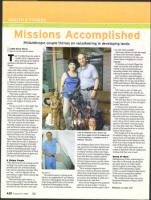
....Phoebe and Harris
Mainster at home
hey've bedded down for weeks in
a monk's cell in a Ugandan mon-
astery and slept on lice-infested
mattresses with mice for company in
Bhutan.
They've become accustomed to using
Asian-style toilets, eating a country's
staple (rice, noodles, cornmeal) for break-
fast as well as dinner and washing their
clothes in the local river.
But Drs. Harris (D.O.) and Phoebe (Ph.
D.) Mainster consider it just part of their
35 years of medical-surgical and teaching
volunteer service in government and mis-
sionary hospitals in developing countries,
done at their own expense.
"What other people consider a hard-
ship, Phoebe considers an adventure says
Harris, who at age 17 fell in love with the
15-year-old daughter of friends of his
parents.
"For me, it was love at first sight:' says
Harris, 71. "I had to convince her."
The two transplanted New Yorkers, long-
time members of Congregation Beth Ahm
in West Bloomfield, are active in Metro
Detroit's academic, medical, philanthropic,
cultural and Jewish life. (See related story.)
But each summer, the Bloomfield
Township residents pack one suitcase
each and head for some remote village at
the invitation of a missionary group or a
country's government. "This is the most
important thing we do:' Phoebe says.
This year, it was the small village of
Nyakato in Mwanza, Tanzania in East
Africa where Harris, who is chairman of
the department of surgery at Botsford
Hospital, Farmington Hills, had a daily
routine of performing multiple surger-
ies and lecturing five University of North
Carolina medical students on upper and
lower gastro-intestinal surgery.
A Unique Couple
"What Harris loves is the treating and the
teaching;' says Gersh Cooper, longtime
president and CEO of Botsford Health
Care, "and no committee meetings. What
can I say — the Drs. Mainster are an
extraordinary couple. There's nobody that
does what they do:'
"They have had people walk for 12
hours to have surgery;' says Jill Menuck,
who accompanied her parents each sum-
mer from the time she was a baby until
A32
August 28 • 2008
pi
Left: Dr. Mainster uses a tennis-rac-
quet-style zapper to kill off malaria-car-
rying mosquitoes — a bedtime must in
Mwanza, Tanzania.
she was 17.
"My earliest memory is having an ele-
phant in the neighborhood," says Menuck,
who lives in Birmingham and is president
of the Young Adult Division of the Jewish
Federation of Metropolitan Detroit.
In this year's annual letter to friends
and colleagues, Harris wrote: "Each morn-
ing, I proceed to the Nakato Hospital and
Health Care Center armed with my book
on tropical medicine, which never disap-
points me as we see viral hepatitis, dengue
fever, West Nile fever, malaria, typhoid,
schistosomiasis, tuberculosis, leprosy,
African trypanosomiasis, amoebic dysen-
tery, elephantiasis, hookworm, tapeworm,
measles and chicken pox.
"We do multiple surgeries for liver
abscesses, cutaneous abscesses, intestinal
obstruction and perforation, hydatid cysts,
hernias, hydroceles and excision of vari-
ous tumors, the pathology of which are to
be determined at a later date."
Harris doesn't bring his own equipment
unless he can leave it there. "I work in
their environment and do as good a job as
I can with what's available
Afternoons, Phoebe, 69, who has taught
in Wayne State University's English
department in Detroit or 24 years, con-
ducted classes in English as a second
language.
In Tanzania, as in most villages, she
taught any hospital staff member who
wanted to learn, customizing lessons
depending whether she's working with
teaching the gardener or pharmacist.
Some exceptions were in Mongolia
(2000), where she taught the minister of
foreign affairs one-on-one, and in China
(2006) and Vietnam (1994) where she was
invited to work with as many as 70 teach-
ers.
"All I need is a piece of chalk and a
chalk board," Phoebe says. "And the stu-
dents need paper and pencil. Sometimes I
have to supply them."
"We often hear that it's very nice to have
a surgeon but it's great to have an English
teacher;' Harris says.
In Tanzania, they were lucky to have
adequate housing including a toilet that
flushed and a shower with hot water, trig-
gered by an electrical heater. However,
electricity itself was a sometimes thing,
Each evening, they prepared their bed-
room with an electric tennis racket-style
zapper to kill malaria-carrying mosqui-
toes, then slept under nets. "Probably 90
percent of the population has or has had
malaria;' Harris reports.
They bought food at the nearby open
air markets, eating a lot of rice and beans,
tropical fruits and vegetables and drink-
ing bottled water, tea and infusions made
by the local women using the blooms and
leaves of flowering shrubs.
As is their custom, they hired a local
woman to help them with the washing and
cooking while they were at work.
Sweep Of Work
Although most of -their volunteering has
been done in Africa and Asia, they have
also spent time at U.S. Public Health
Service hospitals in Pine Ridge, South
Dakota (1978) and Kotzebue, Alaska
(1979), at a Jewish Hospital in Riga, Latvia
(1996) and at Commandante Fahardo
Hospital in Havana, Cuba (1998).
"My visually favorite place was in the
Himalayan Mountains of Nepal (1984):'
Phoebe says.
Missions on page A35