

I World
Broken Wing
Major phase of
Ethiopian aliyah
ends, but advocates
push for more.
Uriel Heilman
Jewish Telegraphic Agency
New York
W
hen the plane from Ethiopia
touched down last week at
Ben-Gurion International
Airport with 65 new immigrants aboard,
there was no ceremony to mark what con-
stituted the end of a major phase of mass
Ethiopian aliyah.
Instead, the immigrants were escorted
through the old airport terminal, processed
and bused to Jewish Agency-run absorp-
tion centers across Israel. They were the
last of more than 17,000 to come to Israel
since the Israeli government decided in
2003 to allow in a limited number of addi-
tional Ethiopians known as Falash Mura.
It was a far cry from the last time Israel
completed a major phase of Ethiopian
aliyah, in June 1998. Then-Prime Minister
Benjamin Netanyahu was on hand to wel-
come the immigrants, promising them a
bus tour of Jerusalem and declaring mass
Ethiopian immigration to Israel officially
over. Last week's more subdued reception
owed, in part, to the controversial after-
math of the 1998 ceremony.
Just weeks after Netanyahu's declaration,
more than 8,000 additional Ethiopians
turned up at Jewish aid compounds in
Ethiopia petitioning that they, too, be taken
to Israel. In the decade since, tens of thou-
sands of Ethiopians have come to Israel, in
large part due to the efforts of advocates in
Israel and the United States.
About a year and a half ago, advocates
for Ethiopian aliyah announced that anoth-
er 8,000 Ethiopians had migrated from
their rural villages to Gondar, where Jewish
aid compounds are located, and demanded
that they be processed for aliyah.
Rejected
But Israel's Interior Ministry refused to
screen the new group for eligibility to
immigrate, arguing that they were not
covered by the government's 2003 deci-
sion. Advocates for the Ethiopians chal-
lenged the ministry's position in court, but
Israel's Supreme Court ruled in favor of
the ministry, finding that the group — by
this spring it had swelled to 8,700 — rep-
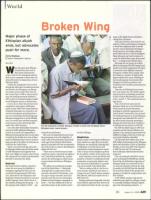
The aid compound in Gondar, Ethiopia, includes a school and synagogue where
Ethiopians learn Jewish prayers.
resented new petitioners.
The court recommended, however, that
the government review the eligibility of
some 1,400 of the petitioners, and several
weeks ago Prime Minister Ehud Olmert
agreed in principle with that recommenda-
tion. That means, in essence, that Ethiopian
aliyah still isn't over.
"There was no event because an event
would have made a statement that aliyah is
over:' said Michael Jankelowitz, a spokes-
man for the Jewish Agency, which carries
out government decisions on Ethiopian
aliyah.
The debate surrounding the immigra-
tion of the Falash Mura — Ethiopians
claiming links to people whose Jewish
ancestors converted to Christianity a cen-
tury ago to escape economic and social
pressures, but who now are returning to
Judaism and petitioning to immigrate to
Israel — has been influenced by the fre-
quent fluctuations in the number said to
be left in Ethiopia.
Skepticism
Skeptics point to the frequent additions to
those numbers as signs that non-Jewish
Ethiopians are deceptively claiming links
to Ethiopians of Jewish descent and
exploiting lax Israeli immigration regula-
tions to escape Africa's desperate poverty
for the relative comfort of the Jewish state.
Israeli ministers, Jewish aid officials and
members of Israel's own Ethiopian Jewish
community are among the skeptics, and
they have been behind efforts to quantify
and cap the aliyah of the Falash Mura.
"We are creating a hell of a job for our-
selves because of political correctness or
trying to be nice Israel's interior minister,
Meir Sheetrit, told the Jerusalem Post in a
2007 interview.
Echoing sentiments frequently voiced in
Israel, Sheetrit expressed fears that the ali-
yah would never finish. He also cast asper-
sions on the Falash Mura's Jewishness,
calling them Christians.
Advocates, however, claim that the vast
majority of those petitioning to immigrate
to Israel have legitimate links to Jewish
ancestry and are genuinely returning to
Jewish practices, not simply adopting
Jewish observances in a bid to immigrate.
Many advocates say Israel's reticence to
accept the Falash Mura stems from racial
bias — a charge Israeli officials reject.
Advocates are not giving up on their
effort for the group of 8,700, saying Israel
should review their applications for aliyah
to determine their eligibility instead of
refusing to consider them outright. They
have lined up a number of high-profile
figures behind their cause, including for-
mer Israeli Supreme Court justice Meir
Shamgar, Harvard law professor Alan
Dershowitz and Canadian parliamentarian
Irwin Cotler.
They also are lobbying Knesset mem-
bers. Last month, the 120-member parlia-
ment passed two nonbinding resolutions
in favor of the 8,700 petitioners, by votes
of 44-1 and 43-1. The resolutions have no
legal power.
Some of the fiercest advocates for
Ethiopian aliyah are in the United States.
North American Jewish federations,
including its umbrella organization, the
United Jewish Communities, have pressed
the Israeli government to accept Ethiopian
immigrants and bankrolled the work of
the main Jewish aid group operating in
Ethiopia, the North American Conference
on Ethiopian Jewry, known as NACOEJ.
But with the aliyah begun in 2003 now
complete, and the Interior Ministry and
Supreme Court saying the government has
fulfilled its pledges, American Jewish sup-
port for the aliyah has dwindled.
UJC fell nearly $30 million short of its
$100 million fundraising goal for Ethiopian
aliyah and absorption as part of Operation
Promise, a three-year effort that launched
in 2005. In June, the UJC announced
that its Ethiopia-related funds had been
exhausted.
That cut funding for NACOEJ's aid pro-
grams in Ethiopia by $68,000 per month.
Several big-city federations supportive of
Ethiopian aliyah were informed of UJC's
cut and were advised to pick up the slack
if possible, but NACOEJ says the shortfall
has forced the closure of the group's food
program in Gondar for young mothers and
their children.
A UJC official said last week that the
umbrella group might be willing to consid-
er resuming funding in Ethiopia, depend-
ing on the humanitarian situation.
❑
August 14 • 2008
A29