
World
Inside Jewish Beijing
Diverse community offers combination plate of choices.
Alison Klayman
Jewish Telegraphic Agency
Beijing
D
ror Poleg, an Israeli who has lived
in Beijing for three years, says
being Jewish is "easier in China
than in Israel!'
"In Israel there is lots of politics, what
school you go to, what yarmulke you wear,"
Poleg says. "Here you can just be you!'
Beijing has had an organized Jewish com-
munity since China's open-door policy of the
late 1970s. The city's Chabad-Lubavitch and
liberal congregations cooperate well, notably
on education.
And Jewish visitors coming to the Chinese
capital for the Summer Olympics will find
plenty of choices for davening on Friday
night and Saturday morning.
While Judaism is not among the five world
religions recognized by the Chinese govern-
ment, foreigners are basically free to observe,
as long as they are diligent about keeping in
touch with authorities and registering any
activities.
The lack of official recognition, however,
does not put a damper on Jewish activities
in Beijing.
Some 1,500 Jewish residents and a regular
flow of Jewish tourists can pray at the liberal
Kehillat Beijing and Chabad services at mul-
tiple locations.
Two New Yorkers established Kehillat.
Roberta Lipson and Elyse Silverberg, both
Long Islanders, met in Beijing in 1979 when
a Chinese colleague told Silverberg there
was "another Jewish girl just like you" across
town, and handed her Lipson's business card.
Lipson and Silverberg became friends and
in 1981 founded Chindex International Inc.,
a successful health-care and medical equip-
ment company now listed on the Nasdaq
Dates In Chinese Jewish History
Beijing/JTA
The following are key dates in
Chinese Jewish history:
• 1920 Ohel Rachel Synagogue is
established in Shanghai (still standing).
• 1928-49 The first Lubavitch rabbi in
China, Meir Ashkenazi, leads Shanghai's
Congregation Ohel Moshe. Built in
1927, Ohel Moshe is now the site of the
Shanghai Jewish Refugee Museum.
• 1938-45 20,000 Jewish refugees
from Germany and Austria escape to
Shanghai.
• 1939-40 Approximately 1,000
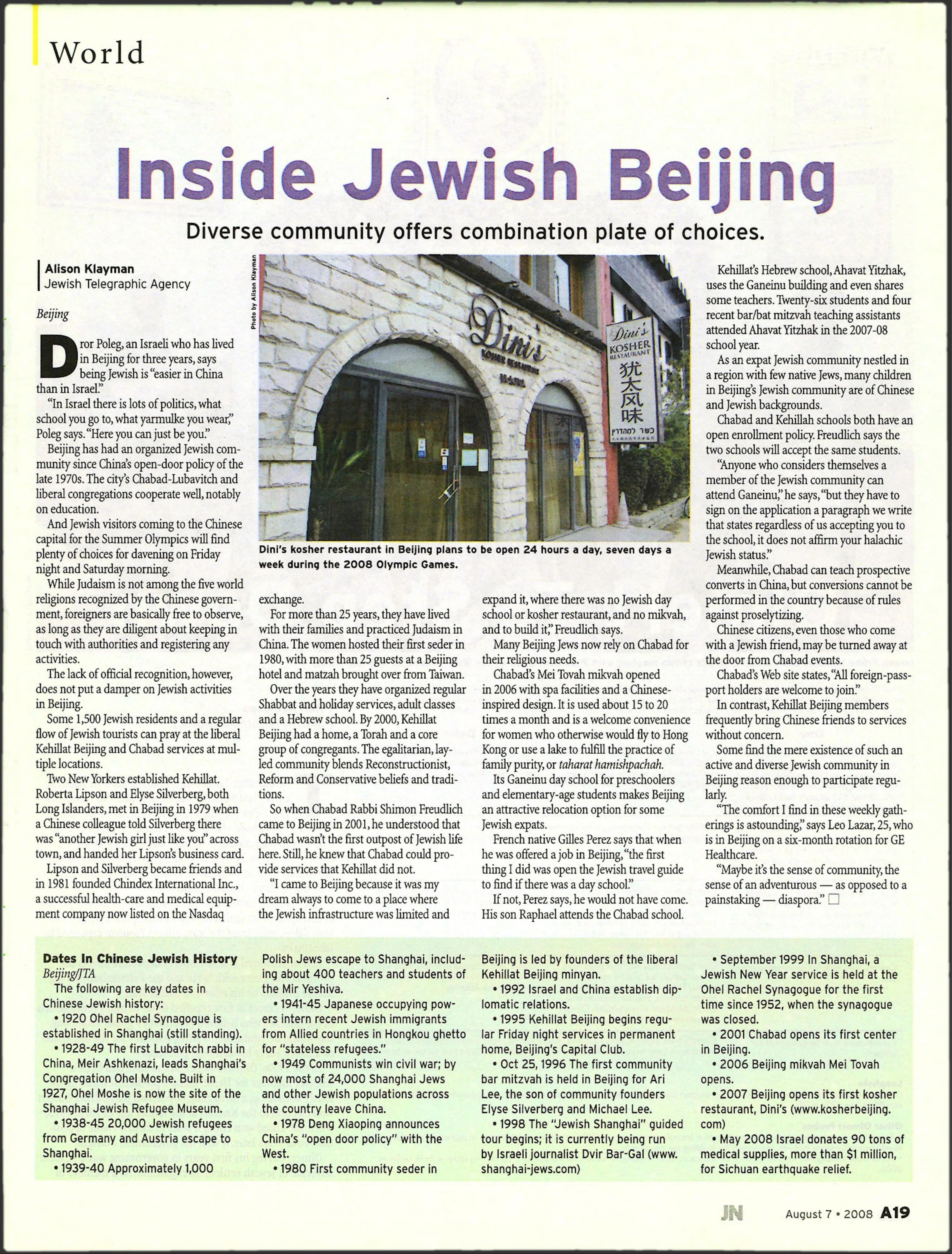
Dini's kosher restaurant in Beijing plans to be open 24 hours a day, seven days a
week during the 2008 Olympic Games.
exchange.
For more than 25 years, they have lived
with their families and practiced Judaism in
China. The women hosted their first seder in
1980, with more than 25 guests at a Beijing
hotel and matzah brought over from Taiwan.
Over the years they have organized regular
Shabbat and holiday services, adult classes
and a Hebrew school. By 2000, Kehillat
Beijing had a home, a Torah and a core
group of congregants. The egalitarian, lay-
led community blends Reconstructionist,
Reform and Conservative beliefs and tradi-
tions.
So when Chabad Rabbi Shimon Freudlich
came to Beijing in 2001, he understood that
Chabad wasn't the first outpost of Jewish life
here. Still, he knew that Chabad could pro-
vide services that Kehillat did not.
"I came to Beijing because it was my
dream always to come to a place where
the Jewish infrastructure was limited and
expand it, where there was no Jewish day
school or kosher restaurant, and no mikvah,
and to build it," Freudlich says.
Many Beijing Jews now rely on Chabad for
their religious needs.
Chabad's Mei Tovah mikvah opened
in 2006 with spa facilities and a Chinese-
inspired design. It is used about 15 to 20
times a month and is a welcome convenience
for women who otherwise would fly to Hong
Kong or use a lake to fulfill the practice of
family purity, or taharat hamishpachah.
Its Ganeinu day school for preschoolers
and elementary-age students makes Beijing
an attractive relocation option for some
Jewish expats.
French native Gilles Perez says that when
he was offered a job in Beijing,"the first
thing I did was open the Jewish travel guide
to find if there was a day school."
If not, Perez says, he would not have come.
His son Raphael attends the Chabad school.
Polish Jews escape to Shanghai, includ-
ing about 400 teachers and students of
the Mir Yeshiva.
• 1941-45 Japanese occupying pow-
ers intern recent Jewish immigrants
from Allied countries in Hongkou ghetto
for "stateless refugees."
• 1949 Communists win civil war; by
now most of 24,000 Shanghai Jews
and other Jewish populations across
the country leave China.
• 1978 Deng Xiaoping announces
China's "open door policy" with the
West.
• 1980 First community seder in
Beijing is led by founders of the liberal
Kehillat Beijing minyan.
• 1992 Israel and China establish dip-
lomatic relations.
.1995 Kehillat Beijing begins regu-
lar Friday night services in permanent
home, Beijing's Capital Club.
• Oct 25,1996 The first community
bar mitzvah is held in Beijing for Ari
Lee, the son of community founders
Elyse Silverberg and Michael Lee.
• 1998 The 'Jewish Shanghai" guided
tour begins; it is currently being run
by Israeli journalist Dvir Bar-Gal (www.
shanghai-jews.com )
Kehillat's Hebrew school, Ahavat Yitzhak,
uses the Ganeinu building and even shares
some teachers. Twenty-six students and four
recent bar/bat mitzvah teaching assistants
attended Ahavat Yitzhak in the 2007-08
school year.
As an expat Jewish community nestled in
a region with few native Jews, many children
in Beijing's Jewish community are of Chinese
and Jewish backgrounds.
Chabad and Kehillah schools both have an
open enrollment policy. Freudlich says the
two schools will accept the same students.
"Anyone who considers themselves a
member of the Jewish community can
attend Ganeinu," he says, "but they have to
sign on the application a paragraph we write
that states regardless of us accepting you to
the school, it does not affirm your halachic
Jewish status."
Meanwhile, Chabad can teach prospective
converts in China, but conversions cannot be
performed in the country because of rules
against proselytizing.
Chinese citizens, even those who come
with a Jewish friend, may be turned away at
the door from Chabad events.
Chabad's Web site states,"All foreign-pass-
port holders are welcome to join."
In contrast, Kehillat Beijing members
frequently bring Chinese friends to services
without concern.
Some find the mere existence of such an
active and diverse Jewish community in
Beijing reason enough to participate regu-
larly.
"The comfort I find in these weekly gath-
erings is astounding," says Leo Lazar, 25, who
is in Beijing on a six-month rotation for GE
Healthcare.
"Maybe it's the sense of community, the
sense of an adventurous — as opposed to a
painstaking — diaspora."
• September 1999 In Shanghai, a
Jewish New Year service is held at the
Ohel Rachel Synagogue for the first
time since 1952, when the synagogue
was closed.
• 2001 Chabad opens its first center
in Beijing.
• 2006 Beijing mikvah Mei Tovah
opens.
• 2007 Beijing opens its first kosher
restaurant, Dini's (www.kosherbeijing.
corn)
• May 2008 Israel donates 90 tons of
medical supplies, more than $1 million,
for Sichuan earthquake relief.
August 7 • 2008
A19