

World
Bench Watch
Ron Kampeas
Jewish Telegraphic Agency
Washington
p
erhaps the most noteworthy devel-
opment for Jewish groups that
watch the Supreme Court was not
what it decided this session, but what it
decided not to decide. •
In its 2007 08 session, which ended June
20, the majority conservative court turned
away a number of church-state cases where
its decisions might have had a long-lasting
impact in areas of traditional concern to
Jews.
"The less church-state cases the Supreme
Court takes, the better off we are said Jeff
Sinensky, the counsel for the American
Jewish Committee.
Otherwise it was a mixed bag, court
watchers said, with an encouraging victory
on the right of prisoners to request court
review and a major defeat on gun control.
Most major Jewish organizations favor
the liberal view in cases that come before
the court, although Orthodox groups often
join with conservative groups on some
issues, particularly in the church-state area.
The narrow 5 4 votes in the decisions
on prisoners and guns underscored a lon-
ger-term concern for most Jewish groups:
Members of the court's aging liberal minor-
ity are likelier than the more youthful
conservative bloc to leave during the next
president's term.
On the right of detainees to demand judi-
cial review — the principle of habeas cor-
pus —which was decided in a case brought
by accused terrorists in Guantanamo Bay,
Nancy Ratzan, the president of the National
Council of Jewish Women, said, "We were
relieved that we got five votes on habeas
and deeply concerned about five votes that
hung together in the gun case'
The court struck down a strict District
of Columbia ban on handgun ownership
in a case that brought the greatest number
of friend-of-the-court briefs from Jewish
groups of any this session.
Briefs were filed by AJCommittee, the
American Jewish Congress, the Religious
Action Center of Reform Judaism and the
NCJW.
Marc Stern, the counsel for AJCongress,
said Jews overwhelmingly support gun con-
trol because they tend to live and work in
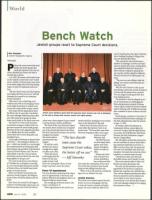
Supreme Cour t of the Un ited Sta tes
Jewish groups react to Supreme Court decisions.
-
-
A24
July 10 • 2008
h.
iE
Jewish court watchers agree that this Supreme Court session was not as damaging
as the last to issues that concern Jewish civil rights groups.
urban areas, where support for gun control
is strong and gun violence proliferates.
The extent of the court decision's impact
was unclear, Stern said, because it targeted
one of the strictest gun bans in the nation.
New York City laws, for instance, do not ban
handguns but require
that owners show a
special need for the
weapon.
He said the court's
decision was narrow
enough that it might
not affect such a ban.
"What this means
is full employment for
lawyers for the next
couple of years," said
Stern, who anticipated a flurry of chal-
lenges to gun laws across the nation.
munity should be speaking out on nomina-
tions on the federal level: she said.
Federal court decisions often do not
come before the Supreme Court or are
turned away. "The cases that came down
this term are going to affect us for a gen-
eration or more
Weinstein said.
The NCJW has led
an often-lonely battle
against such nomi-
nations throughout
Bush's two terms in
office.
Ratzan said a deci-
sion in the previous
session upholding a
ban on late-term abor-
tions made the composition of the courts
"one of the three priorities" Jews should
bring into the polling booth this year.
"What we do in this election is decide the
legacy for our children:' she said.
"The less church-
state cases the
Supreme Court takes,
the better off we are."
— Jeff Sinensky
Power Of Appointment
The close decisions underscored the impor-
tance of appointments to the bench, said
Barbara Weinstein, the legislative director at
Reform's Religious Action Center.
The average age of the four justices who
tend to vote liberal is 75.
"More organizations in the Jewish com-
Jewish Concern
The Jewish court watchers agreed that this
session was not as damaging as the last
to issues of concern to Jewish civil rights
groups. The court ended the 2006-07 ses-
sion by striking down the right of individu-
als to challenge funding for religion that
does not directly affect them.
This session the court turned away a
number of challenges to lower-court deci-
sions on church-state issues. Among them,
one upheld New York City's decision to
allow schools to display a menorah but
not a creche. Another upheld a California
library's decision not to allow prayer ses-
sions.
"The court was not willing to take the
plunge" into church-state issues this ses-
sion, Stern said.
Why the court chooses to take up one
issue during a particular session and ignore
it in the next has always been a mystery.
The nine judges closely guard their deci-
sion-making process.
The decision to join the alleged terror-
ists at Guantanamo in challenging the
Bush administration's denial of habeas
corpus rights marked the Jewish establish-
ment's rejoining with civil liberties groups
after a number of years of silence on such
issues.
Jewish groups, sensitive to the threat of
terrorism, had limited their challenges of
the Bush administration after the attacks
of Sept. 11, 2001.
By voting to allow the detainees at
Guantanamo habeas corpus rights, the
court was "trying to find the right balance
on security and civil liberties;' said Steven
Freeman, the Anti-Defamation League's
director of legal affairs.
The AJCongress praised the decision but
did not contribute an amicus brief, reflect-
ing continued ambivalence over how to
fight terrorism, Stern said. The group did
not want to be identified with some com-
mentators who insist that terrorism is best
handled as a criminal matter, he said.
"Criminal law alone can't deal with
Hezbollah, Hamas and Al Qaida," he said.
There were mixed results in other civil
liberties decisions, the groups said.
The ADL and AJCommittee were dis-
appointed by the decision to uphold an
Indiana law requiring voter identification.
They said the ruling would adversely affect
the poor, minorities and the elderly, who
are less likely to have driver's licenses.
Conversely, the court allowed fired workers
to file suits alleging retaliation for bringing
discrimination actions. ❑