
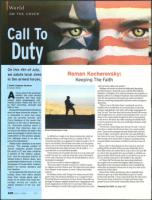

On this 4th of July,
we salute local Jews
in the armed forces.
Roman Kocherovsky:
Keeping The Faith
Shelli Liebman Dorfman
Senior Writer
A
mong Jews in the American
military are local service
members who have built
sukkot, eaten prepackaged, self-
heating kosher meals and who live
by their conviction, strength and
faith in God.
Becausethe Department of Defense
does not keep records by religion, "it
is impossible to know how many
Jews are currently serving," said
Cheryl Waldman of the Jewish War
Veterans of the USA in Washington,
D.C. "Anecdotal evidence seems to
indicate that American Jews are
serving in the military at least in the
same percentages in which they are
represented in the general popula-
tion, although there is no way to
prove this hypothesis."
Debbie Astor attempts to be more
precise. "The average number of
Jewish chaplains posted around
the world is 27, and Jews comprise
2 percent of the military popula-
tion," said the executive director of
Temple Israel in Sharon, Mass., who
spearheaded thebrave.com , a United
Synagogue of Conservative Judaism
listsery for service members and
their families.
As we approach the Fourth of July
holiday, three from Metro Detroit
share their stories about what it
means to be within that small per-
centage, serving our country as
Jewish members of the U.S. mili-
tary.
A20
July 3
a
2008
Roman Kocherovsky in Iraq
As difficult as it might be for Jessica Kocherovsky while her
husband, Roman, is serving in Iraq as a captain in the U.S.
Army, she says there is no question it's where he needs to be. "It
says in our ketubah, 'We will allow each other to be the person
they are yet to be We both take that seriously:' she said. "In the
Army, Roman has been able to become who he really is — a
man who lives a very hard life honorably.
"It has meant a lot of sacrifice for both of us to be Army and
Jewish," she said. "As a wife, the Army life is one of the hardest
to live; and as the head of a house, the Jewish lifestyle is one of
the hardest to maintain."
Yet, the two are able to observe religiously.
"The Army makes virtually no limits on a soldier's request
for religious services:' Roman said. "My supervisors have always
been receptive to my requests. At chow, I always have kosher
options?'
On holidays, Jessica said, "being a Jew means one more dan-
gerous trip to the American Embassy or to a Larger Forward
Operating Base for community services. Roman often relies on
packages of religious supplies donated from congregations and
Jewish organizations in both the U.S. and Israel. Other times,
he has nothing but a lonely Friday night by himself in his room
with his Torah, siddur and candles."
Holidays and rituals are observed differently, depending
on where Roman is based. He serves with the First Infantry
Battalion, 1st Brigade, 101st Airborne Division (Air Assault) as a
logistics advisor on a Military Transition Team in North Eastern
Iraq. His team partners with Iraqi Army units and mentors
them on conducting independent and joint counter-insurgency
operations.
"When I was in the Green Zone, I would grab one of my
buddies and we would drive in an armored gun truck to the
embassy and celebrate with what I call a large congregation for
Iraq," he said. "One time, they had the place blocked off because
they thought there was a bomb in the parking lot. But I was not
about to let a minivan full of explosives deter us from getting
to the service. We had to do a little searching but finally found
a way in and all was fine. Hey, you would figure Hashem would
spot us on that one.
"On the base, I keep things more private he said. "I am not
sure there is another Jewish person here. It is a much smaller
place. I pray in the mornings and read Torah before missions.
I pray at night. I pray before I get in the truck and definitely a
few times on the road. The prayers are not loud or beautiful, but
they are mine and I mean them. So long as I maintain strong
emunah [faith] and continue to build it at all times I have no
fear?'
Jessica said, "In Iraq, Roman has met Iraqi Jews who have
nothing left but emunah. When you meet people like that or
hear their stories, you realize that it is up to you to live your life
as a Jew. It does not matter how easy or hard it is, whether you
get your kosher MRE's [meals ready-to-eat] flown in to you or
live in a Jewish community in the middle of the suburbs:'
An "Army wife" for the past four years, Jessica delivered
the couple's now-6-month-old daughter, Meah Katerina, at
Blanchfield Army Community Hospital in Fort Campbell, Ky.
where they are stationed. Roman was in Iraq; he is now on his
second tour of duty there.
Jessica, from Canton, and Roman, who is originally from
Russia but grew up in West Bloomfield, are part of a small
Jewish Army network. "I learn a great deal from the other mem-
bers because many of them have a longer and deeper back-
ground as part of the Jewish community," Roman said. "Plus
Keeping the Faith on page A21