

World
Ethiopian Countdown
Days away from aliyah's end, Falash Mura advocates step up campaign.
Uriel Heilman
Jewish Telegraphic Agency
New York
W
ith the final planeload of
Ethiopian immigrants sched-
uled to land in Israel early in
July, advocates of Falash Mura aliyah are
hoping a last-ditch intervention by Israel's
prime minister will extend immigration
rights to thousands more.
Former Israeli Supreme Court Justice
Meir Shamgar held a closed-door meet-
ing with Ehud Olmert in late May in a bid
to convince the prime minister to order
the immediate screening of an additional
8,500 to 8,700 Ethiopians for immigration
eligibility.
Also, a coalition of advocates is peti-
tioning Israeli Knesset members, rallying
American Jews and filing lawsuits to force
Israel to take in thousands more Ethiopian
immigrants.
"Experience teaches us that when the
Israeli government says no, when we, the
members of the community, do not give
up, we prevail;' said Avraham Neguise, an
Ethiopian aliyah advocate and director of
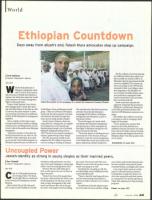
Falash Mura gather at the synagogue of a Jewish aid compound in Gondar, Ethiopia.
South Wing to Zion, an Ethiopian-Israeli
group. "There are 8,700 Jews left behind.
I hope that the prime minister will check
this situation and make the right deci-
sions, and not make another mistake!'
Israel's Interior Ministry, which was
responsible for verifying who was eligible
for immigration, several months ago
finished going through a list of potential
Ethiopian immigrants dating back to
1999. That list is now closed, according to
ministry spokeswoman Sabine Hadad.
The UJC announced recently it had
exhausted the $71 million it had raised
and was ceasing its funding in Ethiopia.
The national arm of the North American
network of local Jewish federations
had pledged $100 million to Ethiopian
immigration and absorption as part of
Operation Promise.
The Jewish Agency for Israel, which
coordinates the Ethiopians' immigration
and absorption in Israel, anticipates the
final flight of Ethiopian immigrants will
arrive in Israel in early July.
"The Jewish Agency is winding down its
activity based on the decision of the gov-
ernment to cease the current immigration
of the Falash Mura at the end of June," said
agency spokesman Michael Jankelowitz.
But the coalition of activists pressing
for additional Falash Mura aliyah says
there actually are another 8,500 or so
Ethiopians that the government should
screen for eligibility. The activists say
these were people on the 1999 list but
remained in their rural villages rather
than migrating to the Ethiopian cit-
ies of Gondar and Addis Ababa, where
most petitioners congregated while
Israel reviewed their cases and where
they received Jewish aid.
Israeli courts have rejected this
argument, ruling that the government
fulfilled its commitments dating back
to the 2003 government decision and
that the 8,500 Ethiopians represent a new
group.
Nevertheless, the coalition of activists
is pressing on with its campaign, which
began last December.
"I know people have concerns that
there's no end to this, that this is an
indefinite extension, that they're not really
Jews:' said Irwin Cotler, a former Canadian
justice minister and longtime advocate for
Ethiopian aliyah. "Our entire position rests
on two points:
Countdown on page A22
Uncoupled Power
Jewish identity as strong in young singles as their married peers.
Sue Fishkoff
Jewish Telegraphic Agency
New York
C
lose to 3,500 people showed up
the evening of June 7 for Dawn,
the all-night Shavuot celebration
at San Francisco's Contemporary Jewish
Museum.
Most in their 20s and 30s, they paid
$15 to mark a Jewish holiday in a Jewish
institution, with performance art, danc-
ing to live bands, listening to cutting-edge
authors and even studying Jewish texts.
Between 500 and 1,000 didn't get in.
Even so, this year's event was 10 times as
big as last year's.
"Many, if not most of the people there
had never celebrated Shavuot before says
David Katznelson, 39, who has run this
dusk-to-dawn reimagining of the tradi-
tional Ley' Shavuot four out of the past
five years. "And people weren't just filling
the rooms with the fun stuff. They were
filling the rooms where the serious conver-
sations were going on as well."
Something else was going on with this
overwhelmingly young, unaffiliated Jewish
crowd, Katznelson says.
"There's a thirst for Jews being with Jews.
And for understanding what Judaism is,
and how to make it relevant to 21st-century
culture."
The tidal wave of Jewish cultural creativ-
ity in the under-40 crowd and their willing-
ness to show up for Jewish-themed events
has been noted for some years by Jewish
communal leaders, sociologists and writers.
A new report lends muscle to certain
aspects of the phenomenon, hinted at
by Katznelson: young Jews' desire to be
with other young Jews and their interest
in creating their own Jewish experiences
rather than signing up for long-standing
programs.
Power on page A22
June 26 • 2008
A21