

Sayeghl Zimny
_ _
C
*Roard ceilified
medkine speeialiA,
Robo Cop
Kelly Purcell, D.O.
Family Medicine
Anthony J. Sayegh, D.O.
Family Medicine
Matthew C. Zimny, D.O.
Family Medicine
*Specializing in All Aspects of Pediatric, Adult,
and Geriatric Medicine including...
•
•
•
•
Annual Physicals
School/Sports Physicals
Gynecologic Care
Sick Visits
*Same Day Appointments Available*
MaPie Rt
4 Mile Rd.
Nig
13 Mile Rd.
F, MI12 Mb Rd.
0
BEAUMONT MEDICAL STAFF MEMBERS
394)30 14 Nlile Rd. in \e‘%lwri.k Square (I tiller's Shopping Center)
(248) (..)60-3797
\ /)111' convenien ce. e‘ellin't and weekuud hour:, are ;n
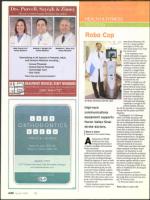
Dr. Bruce Silverman with the robot.
High-tech
communications
equipment supports
Huron Valley-Sinai
stroke doctors.
Shari S. Cohen
Special to the Jewish News
A
mericans have 780,000
strokes per year, many
causing permanent injury
or death, according to the American
Stroke Association.
Advanced medicine has expanded
stroke treatment options, but quick
diagnosis and treatment are essen-
tial to prevent neurological damage.
Ideally, the diagnosis of stroke is made
in less than three hours after the onset
of symptoms since that is the win-
dow for administering tPA, the only
acute intervention available, explains
David Green, D.O., chief of neurology
at DMC-Huron Valley-Sinai Hospital
(HVSH). After three hours, there is too
great a risk of bleeding complications
to administer tPA.
Stroke symptoms require immediate
attention at an emergency depart-
Steven M. Lash, DDS, MS
Rebecca L. Rubin, DMD, MS
248-851-7272
6177 Orchard Lake Road, West Bloomfield, Michigan
www.lashorthodontics.com
American As35 , ,Ciati, 41 of Orthodontists
1385900
A36
May 29.2008
JH
ment. Bruce Silverman, D.O.,
EA.C.N., a board-certified
neurologist at HVSH, and
other stroke experts say, "Time
loss is brain loss."
In an emergency room,
4p1
trained staff quickly recognize
the signs that indicate stroke
4 and a CT scan, blood tests and
an EKG diagnose the patient's
.) condition. For patients expe-
riencing an ischemic stroke
(caused by a clogged blood
vessel to the brain), an injec-
tion of tPA within three hours
of the symptoms' appearance
can dissolve the clot.
HVSH neurologists on call
may seek an opinion from a
Detroit Medical Center stroke
specialist at its central Detroit
campus. The specialist may
want to see and speak with
the patient immediately. In
such cases, a special robot
with audio and videotaping
capabilities is brought to the
patient's bedside, allowing
the off-site specialist to communicate
directly with the patient and HVSH
physician.
"Strokologists," as Dr. Silverman
refers to the DMC specialists, will
assess the patient and decide whether
tPA can be administered infra-arteri-
ally, an option which can extend the
treatment window from three to six
hours after an ischemic stroke. Other
treatment options may include sur-
gical removal of the clot through a
catheter retrieval device. The patient
can be quickly transferred to Harper
University Hospital in Detroit for
advanced treatments if necessary.
HVSH stroke care follows the estab-
lished standards of evidence-based
medicine. The foundation is early
identification of stroke-like symptoms
and early initiation of treatment. The
robotic technology brings the doctors
and patient together quickly to assess
the patient's condition, explains Dr.
Silverman of Farmington Hills. He has
offices in Southfield, Novi, Farmington
Hills and Milford.
"Early response is critical for
administering brain-sparing medicine
that might limit or prevent brain dam-
age Dr. Silverman says.
Dr. Silverman aided in the devel-
Robo Cop on page A38