

HEALTH & FITNESS
AS&
Confronting
Eating Disorders
Spirituality, diet, exercise help Jewish women cope.
What Are Eating Disorders?
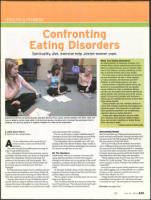
Registered dietitian and eating disorder specialist Beverly Price, center, extracts pledges from Holly, right, and
Lucy to abide by certain rules while in the two-hour session, including not to interrupt the participant that is
speaking, nor give any positive or negative feedback nor make hurtful statements.
An eating disorder is marked by extremes. It is
present when a person experiences severe distur-
bances in eating behavior, such as extreme reduc-
tion of food intake or extreme overeating, or feel-
ings of extreme distress about body weight.
The main types of eating disorders are anorexia
nervosa and bulimia nervosa. A third category
is "eating disorders, not otherwise specified"
(EDNOS), of which binge-eating is one type.
Eating disorders frequently appear during ado-
lescence or young adulthood, but can develop
during childhood or later in adulthood. Women
and girls are more likely than males to develop an
eating disorder. Men and boys account for an esti-
mated 5-15 percent of patients with anorexia or
bulimia and an estimated 35 percent of those with
binge-eating disorder.
Eating disorders are real, treatable medical ill-
nesses with complex underlying psychological and
biological causes. They frequently co-exist with
other psychiatric disorders such as depression,
substance abuse or anxiety disorders.
People with eating disorders also can suffer
from numerous other physical health complica-
tions, such as heart conditions or kidney failure,
which can lead to death.
❑
- National Institute of Mental Health
Judith Doner Berne
Special to the Jewish News
A
ll of our celebrations revolve around food, yet
we have to look a certain way. It's the Jewish
dichotomy.
That's what a Jewish client suffering from an eating dis-
order recently told Beverly Price.
Price, a Huntington Woods-based nutritionist, exercise
physiologist and yoga teacher, uses all three to help people
explore their relationship with food, body image and
emotions in her Reconnect with Food programs. She's
the co-author of Nutrition Secrets for Optimal Health and
has recently released a DVD, Reconnect With Food .. .
Unplugged.
Her yoga and group support classes, workshops and one-
on-one sessions are designed to move beyond simply talk-
ing about food and issues to showing her clients solutions.
They often supplement psychotherapy or reinforce recovery.
Using the many aspects of yoga, including the physical
practice, clients are urged to confront issues and work on
a deeper level. Later, as they gather in a circle, they may be
asked, for instance, to close their eyes and chew just a single
raisin, then describe their sensations.
It is one way, Price says, to explore "mindful eating" by
choosing to eat food that is both pleasing and nourishing
and using all your senses to explore, savor and taste.
"Our relationship with food parallels every other rela-
tionship in life,' Price tells her students. "Yoga can help us
become aware of how all these relationships are connected.
The answers are right here on your mat!'
By The Numbers
Jewish females make up an estimated 13 percent of the
eating-disorder population in United States hospitals,
although Jewish women are just one percent of the overall
population, according to the April 2005 issue of Hadassah
magazine. That doesn't include outpatients or the undiag-
nosed.
Dr. Alexander Sackeyfio, director of the eating disorders
program at Beaumont Hospital, Royal Oak, says that hospi-
talization figure may be misleading.
"We see a greater number of Jewish people who are more
likely to get help',' he says.
"This is a disease that kills up to 8 percent of those that
have it',' Sackeyfio says. "Those that are Jewish tend to get it
treated. That's something one should be proud of!'
Overcoming Denial
But Price and others see widespread denial among local
Jewish institutions and families. Although she began hold-
ing classes at her Oak Park synagogue, Beth Shalom, she
has since moved to a Royal Oak church.
"All of us Jews will go for the medicine',' but recovery
can be a lifelong journey, says Susie, who asked that her
last name not be used. Identifying herself as "a compulsive
over-eater, food addict and anorexic:' she leads the weekly
Overeaters Anonymous group hosted by the Daniel B. Sobel
Friendship House, 6892 West Maple, West Bloomfield.
"There's nothing Jewish about it:' Susie says of the 7 p.m.
Monday OA 12-step meetings. "There are some people
averse to going to a church. Coming to this building is more
comfortable!'
Price says she sees too many Jewish parents leave it up to
their child struggling with an eating disorder as to whether
to begin a recovery program or parents who choose to
believe "they will grow out of it!'
"Eating disorders have the highest mortality rate of any
mental illness and can affect every cell, tissue and organ
in the body:' she says. "The participants in Reconnect with
Disorders on page A34
May 29 . 2008
A33