

World
Missing In Action
Males disappearing from liberal Jewish life.
Sue Fishkoff
Jewish Telegraphic Agency
San Francisco
T
he stereotypical portrait of a
seder table with the man of the
house leading the service may
look out of place to the next generation of
liberal Jews.
This is because outside the Orthodox
world, men are becoming less and less
engaged in every aspect of Jewish life,
from the home to the synagogue to com-
munal organizations.
Numerous studies show that fewer
boys than girls go to non-Orthodox youth
groups, religious schools or summer
camps, fewer go into the rabbinate and
cantorate and fewer serve on synagogue or
federation committees.
This comes as women and girls in the
liberal movements are benefiting from a
host of programs and initiatives aimed
at increasing their Jewish involvement,
from gender-neutral prayer books to the
popular Jewish identity-building program
for teenage girls, "Rosh Hodesh: It's a Girl
Thing."
Some are calling it the feminization of
liberal Judaism — but few say so out loud.
"It's not politically correct:' says
Brandeis University sociologist Sylvia
Barack Fishman, whose new report "The
Growing Gender Imbalance in American
Jewish Life" gives statistical muscle to
anecdotal evidence that has been piling up
for several years in liberal Jewish circles.
The report will be published later in
May, and will be available online June 1 at
www.brandeis.edu/hbi.
Some Dissent
Fishman notes that some experts reject
the notion of a "boy crisis" in liberal
Judaism. It's a particularly touchy topic for
feminist scholars.
"Thirty-five years ago — when women
were not ordained as rabbis, when girls
in the Conservative movement celebrated
a bat mitzvah on Friday night, when
Orthodox girls did not receive an educa-
tion remotely comparable to that of their
brothers, when women were not called
to the Torah for aliyot or allowed on the
bimah at all — where were the headlines
proclaiming a girl crisis?" wrote Rabbi
Rona Shapiro, senior associate at Ma'ayan:
The Jewish Women's Project, a program
of the JCC in Manhattan, in a Jan. 2007
op-ed.
"Given the history of women's exclusion
A28
May 22 • 2008
JN
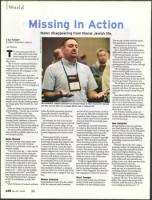
Men of Reform Judaism sponsored an all-male minyan at their movement's biennial
last Dec. 13 in an effort to re-engage Reform men in religious life.
within the Jewish community, approach-
ing equality should be something to
celebrate, not a crisis in the making;' she
wrote.
For Fishman, "As soon as you say that
women dominate certain aspects of Jewish
life, it sounds as if you're saying, 'Let's go
back to the way things were.' That's not the
point of my research, but we need to look
at what's happening and be honest about
it:'
Fishman goes further: As Jewish
men outside the Orthodox fold become
increasingly estranged from religious and
communal life, the more likely they are
to marry non-Jewish women, her report
suggests. And because women usually set
a home's religious tone, even if non-Jewish
women are open to raising Jewish chil-
dren, they will rarely do so because they
are not encouraged by husbands are who
are "ambivalent at best, if not downright
hostile to" Jewish tradition, she says.
She concludes that the boy crisis in
liberal Judaism is leading to a continuity
crisis that will not be resolved until liberal
Judaism finds a way to engage its boys and
men.
and two of her previous books, as well as
data from the 2000-2001 National Jewish
Population Study, Fishman and her stu-
dent co-author Daniel Parmer describe an
American Jewish life increasingly popu-
lated by women.
Ironically, this increased involvement
of women in liberal Jewish life does not
extend to the highest levels of Jewish orga-
nizational leadership, where top profes-
sionals remain overwhelmingly male.
The dominance of women is especially
apparent within the Reform movement,
where decreasing numbers of boys in its
post-bar mitzvah religious schools, youth
groups and summer camps has caused
concern. This absence goes all the way to
the top levels of religious leadership: More
than half of the recently ordained Reform
rabbis are women, as are all this year's
entering cantorial students.
To help re-engage Reform men in reli-
gious life, the Men of Reform Judaism has
sponsored men's worship services at the
last few movement biennials, and pub-
lished a "Men's Haggadah" that more than
250 congregations ordered for Passover.
Women Oriented
Using hundreds of interviews she conduct-
ed for the American Jewish Committee
Start Younger
Liberal Jewish teenage boys don't have
models of adult male commitment to
Jewish life as do their Orthodox peers.
This sets up a vicious cycle that repeats
from generation to generation.
Some groups are more successful than
others at attracting Jewish boys.
One is B'nai B'rith Youth Organization,
BBYO, which claims that 47 percent of its
23,000 teen participants are male.
The group's director, Matt Grossman,
says this is because BBYO chapters have
always been single-sex. This model is
gaining ground in liberal circles, although
not without criticism.
"We can target programs to boys
without throwing fake stuff out there
Grossman says. While most other non-
Orthodox Jewish youth groups report
declining membership, he says that BBYO
has been growing by 20 percent a year.
"We tell them, we need you guys to help
strengthen the Jewish world. And that
resonates with them. We have guys doing
what guys like, and girls doing what girls
like."
Jason Wachs, BBYO's 18-year-old inter-
national president for the boys' chapters,
says the concept works. "It's not cool for
boys to be in touch with their emotions
or care about the environment or religion
when girls are around," he says. "BBYO
allows them to open up."
The Orthodox world has always pro-
moted single-sex group activities. It may
be time, some adolescent experts suggest,
to revisit the notion.
New Initiative
Moving Traditions, the non-profit that
runs Rosh Hodesh: It's a Girl Thing, has
launched "Where Have All The Young Men
Gone a three-year research and action
campaign that is studying the groups that
have been most successful at attracting
and holding young men, from BBYO to
Boy Scouts.
Fishman's report notes that "a dispro-
portionate number" of young Jewish men
doing cutting-edge innovation in Jewish
cultural and religious fields has come
from Orthodox backgrounds. "This illus-
trates the power of these environments to
prove intellectually and spiritually com-
pelling to men, even when men reject their
patriarchal premise she notes.
The challenge to the liberal Jewish
world, she says, is to provide the same
compelling stimulus to its young men
without sacrificing egalitarianism.
"Over the ages, men felt very involved
in Judaism," she says. "It was their respon-
sibility. This is gone today, except in the
Orthodox world. We need to look at how
we are raising our Jewish sons:'
❑