

Southfield At 50
ON THE COVER
Northwest(ern)ly
17.
The Jewish
community followed
its traditional path
on its way through
Southfield.
In the 1950s, several major develop-
ments helped turn the community
towards Southfield and Oak Park. The
construction of the John C. Lodge Freeway
north and then west through Detroit ulti-
mately made the James Couzens link to
Northwestern Highway a familiar 55-mile-
per-hour canyon. And the Lodge pointed
to a new promised land, the world's first
"mega" shopping center — Northland.
These two new dimensions made it
ith a few small deviations on
ever easier for folks to live in that new
the compass, Detroit's Jewish
world, suburbia, while continuing to work
community has migrated
in Detroit. There was also that magnetic
north and northwesterly during
draw to north of Eight Mile
its 246-year history in the met-
Road for larger lots, bigger
ropolitan area.
homes and brand new schools.
From Jefferson Avenue, up
Another factor, far less men-
both sides of Woodward Avenue
tioned, is the issue of integra-
through midtown, until the
tion.
Northern and Central High
Often, when the Jewish com-
School eras before and after
munity began its moving cycle,
World War II, the Jews of Detroit
blacks were part of the equa-
followed the northerly direction
tion. The old Hastings Street
Alan Hitsky
of Woodward before turning
Jewish
homeland on downtown
Asso ciate
west and north during the 1950s.
Detroit's
near east side in the
Edi for
You can follow the path of
early 1900s became the legend-
the community by the location of its
ary Black Bottom before 1-75 leveled any
favorite public high schools: Old Central
trace of either neighborhood.
(now Wayne State University's Old Main);
The Jewish 12th Street and Dexter of
Northern and Central; Mumford and
the 1940s and '50s became the birthplace
Ford; Oak Park, Southfield and Berkley;
of the race riots of 1967. That event, more
Southfield-Lathrup; North Farmington,
than anything, spurred on white (and
West Bloomfield and Bloomfield Hills
Jewish) flight to the suburbs.
Andover.
It seems that every Jewish neighbor-
W
alio
ho_i
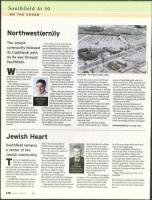
Northland — the original 'mega' center.
hood in this area has had its 20-30-year
heyday, and Southfield is no exception.
According to Thomas Sugrue, a Detroit
native and University of Pennsylvania
expert on 20th century history, in 1990 the
Metropolitan Detroit area was second only
to Gary, Ind., as the most segregated area
in the United States. In the 1990s, he said
segregation in the Detroit area had fluctu-
ated only slightly since 1940.
That testimony by Dr. Sugrue on behalf
of the University of Michigan came in
two affirmative action college admissions
cases. He reported that Southfield had 102
black residents in 1970; 7,000 in 1980; and
29,000 in 1990. The 2000 U.S. Census said
42,280 (54 percent) of Southfield's resi-
dents were black.
Dr. Sugrue also said that as blacks
moved in, whites moved out. In 1980, 87
percent of Southfield public school stu-
dents were white. In 1990, 44 percent were
white; in 1994-95, 33 percent were white;
in 1997, 27 percent were white. The Jewish
News annual Cap & Gown section for
Jewish high school seniors with moderate-
ly high grade point averages last included
a student from Southfield High School in
1998; the last two listings from Southfield-
Lathrup were in 2000.
According to Jewish Federation of
Metropolitan Detroit estimates, in 1989
there were 26,600 Jews in Southfield. In
2005, there were 6,868.
In many aspects Jewish Southfield has
broken the mold and shown some resil-
iency. There are thriving Jewish neighbor-
hoods surrounding Orthodox synagogues
Northwest(ern)ly on page A20
Jewish Heart
Southfield remains
a center of the
Jewish community.
T
he city of Southfield has been
at the heart of the Jewish corn-
munity for a majority of the time
that it has been a city. In conjunction with
Oak Park, the two communities house a
significant number of agencies, facilities
and services that reflect the finest of our
Jewish values.
Southfield has always been a diverse
community whose residents represent
various ethnicities, religions and cul-
tures. Many of its neighborhoods are
A18
April 24 • 2008
some of the most beautiful in
nity, but has been the address
the Detroit area, with sloping
of many of the most impor-
ravines and natural habitat, yet
tant events that have affected
close to the most active centers of
Jewry at large and the State
Metropolitan Detroit.
of Israel. From times of war
My wife and I have had the
and fear for the welfare of the
privilege of raising our four chil-
State of Israel and its inhabit-
dren in Southfield, where they
ants to times of great joy and
received their education and
jubilation
when miraculous
Mark
participated in youth activities,
victories
have
been achieved,
Schiussel
from ice hockey to baseball to
Shaarey
Zedak
has been the
Special to the
golf. From a religious perspec-
place
of
gathering
for the
Jewish News
tive, we found synagogue life in
community.
Southfield rich with diversity,
When I had the privilege of
from yeshivot and Orthodox synagogues,
serving as a city councilman in Southfield
across the spectrum that represents the
some 35 years ago, I was touched by the
fabric of the Detroit Jewish community.
cohesiveness of the community's collec-
Congregation Shaarey Zedak has served tive leadership in its desire to provide
not just the Conservative Jewish commu-
Southfield's residents with the best qual-
ity of life as one large family made up of
many varied backgrounds.
Today, in Southfield's 50th anniver-
sary year, the fabric of diversity remains
even as the population changes have
transformed the city. Southfield remains
a very important business hub in the
Metropolitan Detroit area that has synthe-
sized the qualities of a vibrant economic
center with the qualities of a bedroom
community housing one large family with
great diversity.
Happy 50th anniversary to the city of
Southfield. ❑
Mark Schiussel is an attorney, former member
of the Southfield City Council and former presi-
dent of the Jewish Federation of Metropolitan
Detroit.