

r
l World
ANALYSIS
Passover Slight
Arthur Szyk's Haggadah challenged Adolf Hitler.
Dr. Rafael Medoff
Special to the Jewish News
cartoonist for the New York Post while
also contributing anti-Nazi illustrations
and cartoons to Collier's, Time, Esquire
and other leading magazines. His work
earned him widespread praise, including
from First Lady Eleanor Roosevelt, who
remarked, "This is a personal war of Szyk
against Hitler, and I do not think that Mr.
Szyk will lose this war!"
Szyk closely followed the news reports
in 1941-1942 about German massacres of
Jews. He was appalled at the Allied leaders'
refusal to acknowledge that the Jews were
being singled out for persecution. "They
treat us as a pornographical subject
— you cannot discuss it in polite society:'
he protested.
Washington, D.C.
0
ne of the most popular
Haggadot in the world almost
didn't make it into print
—because nervous publishers were afraid
that some of its illustrations might offend
Adolf Hitler.
The story of Arthur Szyk's controversial
Haggadah begins in the early 1930s when
Szyk [pronounced "Shick"], the renowned
Polish Jewish artist, began creating a lav-
ishly illustrated edition of the traditional
Passover Haggadah.
But Szyk's was no ordinary
Haggadah. Deeply pained by the Nazi
persecution of German Jews, Szyk hoped
to call attention to their suffering by link-
ing it to the plight of the Jewish slaves in
ancient Egypt. The illustrations in his
Haggadah featured numerous overt refer-
ences to the Nazis. The armbands worn by
Szyk's Egyptian taskmasters bore swasti-
kas, as did the snakes. Two of the snakes
had the faces of Nazi chieftains Joseph
Goebbels and Hermann Goering. The
"wicked son" was dressed in distinctly
German clothing and sported a Hitler-
style mustache.
When Szyk began looking for a
publisher, he immediately ran into
problems. Publishing houses in
Czechoslovakia and (according to
some accounts) Poland rejected Szyk's
Haggadah for fear that the anti-Nazi imag-
ery would offend Adolf Hitler.
It was a tense time in Europe. Hitler
had recently annexed the Saar region,
remilitarized the Rhineland and launched
a massive military buildup, in blatant
violation of the peace treaty Germany
had signed at the end of World War I. The
Poles, Czechs and other nations bordering
Germany watched nervously, wondering
if they might become the next meal on
Hitler's menu.
Telling Mustache
In 1937, Szyk moved to London, where his
Haggadah was accepted for publication by
the newly formed Beaconsfield Press. But
the publisher insisted on one condition:
All overt anti-Nazi images had to be
removed.
Art As A Weapon
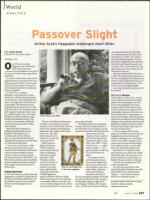
Arthur Szyk, circa 1950
The faces of Goebbels and Goering on
provocation of Berlin.
the snakes were removed, as were the
"The English public was so desperate
swastikas on the snakes' bodies. The swas- for peace that they averted their eyes to
tikas on the armbands of the Egyptian
the reality that war was coming:' says the
taskmasters were replaced with a small
eminent British author Michael Moorcock,
black circle. The small
whose recent novel, The
black mustache on the
Vengeance of Rome, deals in
wicked son was the only
part with the international
surviving symbol.
community's failure to stop
Public opinion in
Hitler in the 1930s. "People
England during the
really believed — or simply
1930s strongly sup-
wanted to believe — that
ported the government's
appeasing Hitler would work.
policy of appeasing,
They were horribly mis-
rather than confront-
taken:'
ing, Hitler. Oxford
As it happened, Szyk's
University students
anti-Nazi passion became
voted, by 64 percent to
an asset after England was
36 percent, that they
forced, by the German inva-
Hitler as the W icked Son,
would "in no circum-
sion of Poland, to go to war
in the Szyk Ha ggadah
stances fight for King
against Hitler. Impressed
and Country." More than
by the powerful illustra-
130,000 Englishmen
tions Szyk contributed to
signed a petition by the Peace Pledge
the war propaganda campaign, the British
Union renouncing war. Even something
government asked him to go to America
as seemingly small as an anti-Nazi cari-
to rally public opinion to support U.S.
cature in a Jewish religious book could be
aid to England. Settling in New Canaan,
seen by jittery Britons as an unnecessary
Conn., in 1940, Szyk became the editorial
Szyk decided to use his art as a weapon
to raise public awareness of his people's
plight, as he had attempted to do with
his anti-Nazi Haggadah. He became a
leading member of the Bergson Group,
a Jewish political action committee that
raised public awareness of the mass mur-
der and lobbied the U.S. government to
rescue Jewish refugees. Szyk's illustrations
appeared in the Bergson Group's full-page
newspaper advertisements, brochures and
publications. Bergson activist Ben Hecht,
the famous playwright, called Szyk "our
one-man art department."
As Passover approaches this year,
many of us will take our copy of the Szyk
Haggadah down from the bookshelf
and gaze admiringly at its extraordinary
artwork. It is mostly a showpiece, since
owners enjoy viewing and discussing it,
but hesitate to bring it to a seder table
laden with things that spill and stain.
Nevertheless, we remember Arthur
Szyk's greatness, not only for his remark-
able artistic talent, but even more so for
his determination to use that talent on
behalf of the persecuted Jews of Europe.
"I am but a Jew praying in art," Szyk
would sometimes say.
At a time when most of the world
ignored the plight of Europe's Jews, Syzk
answered their cries with his unique
"prayers" — his art and activism on
behalf of an abandoned people. ❑
Dr. Medoff is director of the David S. Wyman
Institute for Holocaust Studies,
www.WymanInstitute.org.
April 17. 2008
A37