

I
World
NEWS ANA.YST
Pressure Point
Israel eases up on Palestinians as secret peace talks continue.
Leslie Susser
Jewish Telegraphic Agency
Jerusalem
F
or the first time since the Annapolis
peace parley last November, the
United States is leaning heavily on
Israel to move ahead in peacemaking with
the Palestinians.
This week, on her second visit to Israel
and the Palestinian areas in a month, U.S.
Secretary of State Condoleezza Rice secured
a long list of Israeli commitments designed
to improve Palestinian living conditions and
indicated that the United States would make
sure Israel carried them out.
The Americans seem intent on achiev-
ing tangible progress on the ground before
President Bush's second visit to Israel this
year, scheduled for May to coincide with
Israers 60th anniversary celebrations.
To pre-empt further U.S. pressure, the
Israelis were keen to show progress is being
made in negotiations with the Palestinians
on the core issues of borders, Jerusalem,
security and Palestinian refugees.
Israel wants to show it is doing all it can
to reach a peace deal by the end of 2008
— the target date set at Annapolis.
50 Working Meetings
A day before Rice's arrival, strategic
government leaks to the Israeli media
disclosed that Foreign Minister Tzipi
Livni and former Palestinian Authority
Prime Minister Ahmad Qureia have held
more than 50 unpublicized working meet-
ings since Annapolis. All the core issues,
including Jerusalem, have been on the
table.
During her visit, Rice focused on condi-
tions on the ground.
"I really do think that what we have to
do is to have meaningful progress towards
a better life for the Palestinian people': Rice
declared upon her arrival in Jerusalem.
After a three-way meeting between Rice,
Israeli Defense Minister Ehud Barak and
P.A. Prime Minister Salam Fayyad, Israel
announced a package of measures to ease
restrictions on Palestinian movement
in the West Bank, improve the quality of
Palestinian life, boost the Palestinian econo-
my and help Palestinian security forces keep
law and order.
The measures included:
A34
April 3 • 2008
• dismantling 50
roadblocks around
the West Bank cities
of Jenin, Tulkarm,
Kalkilya and
Ramallah;
• streamlining oper-
ations at the remain-
ing 500 or so Israeli
roadblocks in the West
Bank;
• dismantling a
permanent checkpoint
near Jericho, giving
Palestinians direct
access to the Dead Sea;
• allowing the con-
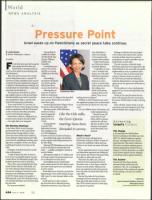
Condoleezza Rice
struction of 5,000 to
8,000 new Palestinian
homes in some 25 villages in the Ramallah
area, a project that has been on hold for
more than a year;
• connecting Palestinian villages without
electricity to the Israeli power grid;
• allowing another 5,000 Palestinian
workers to work in
Israel, bringing the
total number per-
mitted to do so to
23,500;
• issuing permits
to another 500
Palestinian business-
men, enabling a total
of 1,500 Palestinians
to move in and out of Israel on business;
•providing Israeli support for develop-
ment programs and foreign investment in
the West Bank;
• allowing 700 Palestinian security police
to move into Jenin to maintain law and
order — a similar contingent is already at
work in Nablus;
• allowing the supply of 125 vehicles and
25 Russian-made armored personnel carri-
ers to Palestinian security forces;
• and building dozens of Palestinian
police stations across the West Bank to oper-
ate under Israeli supervision and ultimate
security control.
Barak aides say he decided to provide the
large package at once rather than incremen-
tally to give it a more dramatic effect on the
ground.
Israel's goal is not only to impress
the Americans but to alleviate growing
Palestinian restiveness. Some observers
warn that failure to
make such changes
on the ground could
prompt a third intifada.
Despite Israel's prom-
ises, Palestinian leaders
remained skeptical.
"I will believe it when
I see it," declared Saeb
Erakat, one of the chief
Palestinian negotiators.
Israeli media are
skeptical as well. A
cartoon in Israel's daily
Yediot Achronot showed
Rice riding a slow
Barak-faced tortoise,
saying to Bush on the
phone, "Boss, we are
making fantastic progress."
Whether or not the Israeli moves consti-
tute significant progress, Rice is determined
to see that they are carried out "very, very
soon."
U.S. Gen. William Fraser will monitor and
verify implementation.
"General Fraser will
ensure that 50 road-
blocks will be removed
and that this will actu-
ally have an effect on the
freedom of movement
in the West Bank': Rice
declared.
Like the Oslo talks,
the Livni-Qureia
meetings have been
shrouded in secrecy.
What's Next?
Israel's next steps will depend on
Palestinian terrorists. If there is more ter-
rorism, the roadblocks will go back up.
If there is not, Israel says more will come
down.
On the negotiations front, it seems Israeli
and Palestinian negotiators are holding far
more intense and extensive discussion than
the public on either side was told.
Away from the public eye, Livni and
Qureia have been meeting discreetly in
Jerusalem twice or three times a week for
the past several months. Officials in the
know say negotiations this intense haven't
been held since the initial Oslo talks in the
early 1990s.
Like the Oslo talks, the Livni-Qureia
meetings have been shrouded in secrecy.
Both apparently agreed early on to steer
clear of the cameras and not to issue prog-
ress reports of any kind.
Nothing of substance has been leaked
to the media. Some reports have said the
meetings include maps, the occasional
participation of experts and follow-ups by
professionals on both sides.
The aim is produce a detailed Israeli-
Palestinian agreement to be approved by the
United Nations by the end of the year and be
implemented as soon as conditions allow.
For now, it is clear to all the parties that
as long as Hamas remains in control of
the Gaza Strip, and until the Palestinian
Authority demonstrates it can stop attacks
against Israel, the agreement will remain on
the shelf.
The big unknown is how much genuine
progress, if any, Livni and Qureia have been
able to make.
Clearly, as Rice said, the better the situ-
ation on the ground, the more concessions
the parties will feel ready to make on the big
issues.
That's why Rice went to Israel: to secure
concessions and move things forward. Time
will tell whether these changes hold up.
❑
Answering
Israel's Critics
The Charge
It is feared that the 2009 Durban
Review Conference, the follow up to the
2001 U.N. World Conference Against
Racism, will degenerate into an anti-
Israel hate fest. The earlier conference
fell victim to nations and non-govern-
mental organizations (NGOs) bent on
using it to criticize Israel for a so-called
racist Zionist agenda and for allegedly
committing crimes against humanity.
The Answer
Canada and Israel have already
announced they will boycott the
conference. The U.S. is awaiting the
development of the conference's agenda
before making a decision on whether
to attend.
- Allan Gale,
Jewish Community Relations Council of
Metropolitan Detroit
(c) Jewish Renaissance Media, April 3, 2008