

Tirade
Jews criticize Methodist guide that evokes Holocaust against Israel.
Ben Harris
Jewish Telegraphic Agency
New York
A
study guide prepared by the
United Methodist Church on the
Israeli-Palestinian conflict is
drawing fierce condemnation from Jewish
and pro-Israel organizations already con-
cerned that divestment is making a come-
back among mainline Protestant groups.
The Anti-Defamation League, the Jewish
Council for Public Affairs and B'nai B'rith
International have issued harsh apprais-
als of the guide, 225 pages authored by
a Jewish-born minister, the Rev. Stephen
Goldstein. Four Jewish women's groups
and pro-Israel Christian groups also
have protested the guide, called "Israel-
Palestine'
Among the most troubling passages
of the guide, published last spring, are a
reference to Israel's "original sin," the sug-
gestion that Israel's "hysteria" and "para-
noiac sense of isolation" have prevented
it from making peace, and the assertion
that Israel's "denial of the word Palestinian
reveals a racism that considers Arabs less
than human."
The guide, whose introduction
describes it as a "balanced survey" of the
conflict, is one of three "mission stud-
ies" published annually by the church's
General Board of Global Ministries to
"motivate, inform and enrich" the church
community, according to the board's Web
site.
"I've never seen anything like this, other
than material published by known and
recognized hate groups:' said Sister Ruth
Lautt, the national director of Christians
for Fair Witness on the Middle East, which
works to counter anti-Israel sentiment in
churches. "It descends to that level."
The condemnations come as Jewish
groups are bracing for a renewed push
among mainline Protestant denomina-
tions to divest from companies they deem
to be supporting Israeli occupation.
The United Methodist Church, the larg-
est mainline Protestant denomination
in the United States, will consider two
divestment resolutions when its chief poli-
cymaking body, the General Conference,
gathers in Fort Worth, Texas, in April.
If the resolutions pass, Jewish lead-
ers fear the move may reignite a push
for divestment in other denominations,
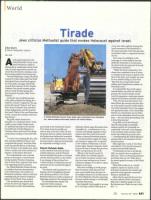
A United Methodist Church study guide urges divestment from Caterpillar
Inc., whose products have been used by the Israeli military.
particularly in the Presbyterian Church
USA, whose General Assembly con-
venes in June in San Jose, Calif The first
Protestant church to endorse divestment,
the Presbyterians backtracked somewhat
in 2006 from their 2004 decision to divest,
moving instead to apply general principles
for responsible investing in Israel.
Church Defends Guide
A joint statement from General Board
of Global Ministries and the Women's
Division defended the guide as consistent
with the church's position on the conflict.
It says charges of bias are based on a
"twisted reading" of Goldstein's personal
reflections that are included throughout
the study.
"The mission study's perspective is in
keeping with the thoughtful, informed,
and consistent position of The United
Methodist Church on Israeli occupation of
Palestinian territories:' the statement said.
The Global Ministries denied JTA's
request for further comment.
One resolution before the United
Methodist Church urges divestment from
Caterpillar Inc., a manufacturer of con-
struction and mining equipment whose
products have been used by the Israeli
military to destroy Palestinian property.
A second resolution targets all compa-
nies deemed to support the "occupation"
or the violation of Palestinian or Israeli
human rights. Targeted companies would
be given 60 days to change their practices
before stock purchases are cut off.
Officials at the Jewish Council for
Public Affairs, the umbrella organiza-
tion of Jewish community councils, said
they have been reaching out to General
Conference delegates in an effort to open a
dialogue on the issue.
Even more troubling to Jewish groups
than divestment, which they have had
some success deflecting in the past, are
the multiple references to the Holocaust in
the United Methodist Church's supporting
literature and the attempt to cast Israel in
excessively dark terms.
One frequently cited example is an essay
by Dr. Sara Roy, a child of Holocaust sur-
vivors who, while explicitly denying that
Israel's treatment of the Palestinians is
the moral equivalent of the Nazi genocide,
nevertheless makes a comparison between
the two.
Roy's essay was published on the
front page of a recent bulletin from the
Methodist Federation for Social Action,
the church body that proposed the broad-
er divestment resolution.
"Within the Jewish community it has
always been considered a form of heresy
to compare Israeli actions or policies with
those of the Nazis, and certainly one must
be very careful in doing so:' Roy wrote.
"But what does it mean when Israeli
soldiers paint identification numbers on
Palestinian arms?"
It is material like that, Jewish organi-
zational leaders say, which not only has
poisoned the church's attitude toward
Israel but represents a much more sinister
impulse that threatens interfaith relations.
"This isn't just about divestment:' said
Ethan Felson, the associate executive direc-
tor of the Jewish Council for Public Affairs.
The United Methodist Church "has elegant
and appropriate policy on the relationship
between our communities and our faiths,
and to see the relationship abused over this
issue — this isn't about peacemaking. This
is about demonization."
Doug Mills, one of the Methodist
Church's point people on interfaith
relations, said he was "personally not
comfortable" with some of the language
in the Goldstein study and that it repre-
sented only Goldstein's personal views
— notwithstanding the Global Ministries'
assertion that it was consistent with the
church's position.
Mills urged Jews to look at "the whole
constellation" of the church's statements
on Israel and interfaith relations.
"It's absolutely not fair to say that the
UMC sees Israeli action as original sin,"
Mills said. "That's an interesting statement
that Bishop May put out." Felton May is
the interim general-secretary of the Global
Ministries.
While Mills would not, as a church
employee, express an opinion on the
divestment resolutions, his remarks sug-
gested the study represents a potential
setback in interfaith ties.
Asked what he expected the next time
he meets with his Jewish counterparts,
Mills said, "I think it's going to be a lot
like this interview. There's no way to hide
this." ❑
February 28 • 2008
A21