

feature: book clubs
love of
books
brings new
friends
by Jordana Hoffman
am in love with the written word. Most teens either don't want
to read, finding it a cumbersome hardship, or simply do not have
the time in their busy schedules to fit it in. But me, if I don't have
the time I make the time, even if it means staying up till three in the
morning on a school night.
I'm so in love — and that is how the members of the Temple Israel
teen girls book club in West Bloomfield feel, too.
Books create bonds you would have never known were there, and
suddenly you have friends for life!
"I met probably half of my friends because we like the same au-
thors or books," said book club member Emmy Corman, a North
Farmington freshman. "It was just BOOM ... friendship."
When discussed in a group, books can bring people closer through
a shared memory or a feeling for the character.
When read alone, "books help you to escape your wor-
ries," says Lauren Soltz, 18, a senior at Walled Lake Cen-
tral.
Books also allow you to feel elated, frustrated, pained, sorrow ful
and angry. If you belong to a book club, you can express and share
those feelings with others, creating lifelong friends not only with your
Check These Books Out!
Librarian Lauren Marcus Johnson of Temple Israel's Hodari Family Children's
Library offers these suggestions for young adult books with Jewish themes
or by Jewish authors:
The Weight of the Sky by Lisa Ann Sandell
Real Time by Pnina Moed Kass
Daniel, Half-Human and The Good Nazi by David Chotjewitz
Incantation by Alice Hoffman
Notes from the Midnight Driver by Jordan Sonnenblick
The Unresolved by T.K Welsh
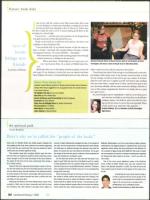
Sammye Chaness listens to Emmy Corman, both 14 and freshmen at North
Farmington, talk about a book at Temple Israel in West Bloomfield.
fellow readers but also with the characters themselves.
I have found that when I lack courage or am feeling sad or even sim-
ply feeling a little lonely, some of my favorite stories are there to lend
me the courage, to hold my hand and to give me comfort. It is friend-
ship that never asks you to explain yourself and doesn't take anything
from you other than a couple hours of sleep. And the best part is that
you can always identify with the main characters, finding a little bit of
you; so this caring, compassionate friend is not simply ink on a page
but a part of you.
So, even though it may be unthinkable to add one more thing you're
not even sure you'll like to your busy day, you should give
reading a chance. You'll like it, and it's not like the read-
ing you do for school. It can be fun and enjoyable! Open
a book and let your mind feast. Bon appetite! •
Black Mirror by Nancy Werlin
Julia's Kitchen by Brenda Ferber
Jordana Hoffman, 15, is a freshman at North Farmington
High School.
the spiritual path
by Avi Buckman
Here's \Ay we're called the "people of the book,"
Every year on Simchat Torah, the Jewish people complete the
convert to Islam, Muhammad changed his view of the people of
final reading of the Torah, then embrace and read the beginning
the book, and he accused them of distorting God's word. Despite
philosophers and religious leaders in medieval times, wrote many
of the Torah the very same day. This cycle has existed for about
his bitterness, he believed strongly that because they paid the
significant Jewish books. His most prominent is the Mishneh To-
1,000 years and remains significant today.
jizzya, the special poll tax, they deserved favoritism. So he gave
rah, compiled in Egypt during 1170-1180 CE. This code of Jewish
This example, along with countless rabbinic texts that inter-
pret the Torah and respond to problems within Jewish law, seems
reason enough to call the Jews the people of the book. However,
Mishnah. Maimonides, one of the most famous rabbis, scholars,
the people of the book the status of dhimmi, which protected the
law encompasses all aspects of Judaism including laws regarding
Jews and Christians in the Muslim world.
the Temple that didn't apply to his time — and to our time, for
So why does this ancient term still exist and why does it only
that matter.
the origins of this term are far more controversial than simply a
apply to Jews? Well, the Jews lived in the Muslim world for a while,
One of the more recent significant codes is the Shulchan
list of Jewish authors.
so they adopted this term as a positive thing even though it publi-
Aruch, written by Rabbi Yoseph Caro, who was expelled from
People of the book originated within Islamic society. In the Ko-
cized that they did not accept Muhammad's revelation. Christians
Spain in the Spanish Inquisition in 1492. This code serves as the
ran, the holy Islamic text, the term ahl-al-kitb (people of the book)
were a targeted minority in Muslim eyes so it is not surprising they
most updated code of Jewish law that applies to the modern Jew-
not only refers to Jews, but also Christians. This statement seems
dropped the name tag.
ish life.
to put the people of the book in a good light, referring to the Jews
When thinking of people of the book, it is hard not to think of
Considering the many Jewish authors today, it
and Christians as cousins because they have a similar holy text
the myriad of Jewish authors that date back from antiquity. The
is safe to assume that the current people of the
and believe in the same God.
first codified law book is called the Mishnah, written in approxi-
book will go on and spread their valuable knowl-
Abiding by his beliefs in the Koran, Muhammad, carrier of the
mately 200 CE by Rabbi Yehuda Hanasi. It incorporates six gen-
edge to the world, just as our ancestors did.
revelation of God's word in Islam, cooperated well with the Jews
erations of great rabbinic thought. After this era came the Talmud,
Avi Buckman, 14, is a freshman at the
and Christians. But, after failing to persuade either religion to
which records the later rabbis discussions in trying to clarify the
Frankel Jewish Academy in West Bloomfield.
B2 teen2teen February • 2008