

February 21, 2008 / 15 Adar 1 5768
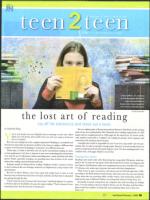
Jordana Hoffman, 15, a freshman
at North Farmington High School.
enjoys a few good books at
Temple Israel's Hodari Family Chil-
dren's Library in
West Bloomfield.
T2T photo by Jessica Polk
the lost art of reading
Lay off the electronics and check out a book.
by Gabriella Ring
ou've just found out your English class is starting a novel unit. Most
likely, you will groan and wonder how you will ever enjoy a book you
have to analyze.
But who says reading has to be a negative experience? Reading is a wonderful tool
that lets you step inside an alternate world for a few hours to explore a different time
or place or feel emotions belonging to a character very different from you.
These days, it's hard to find kids who are up for recreational reading, let alone
in-class assignments. Let's face it, America is now more technologically inclined than
ever, with the use of cell phones, online-networking sites, e-mail, television and video
games. People, especially teenagers, are spending more time in front of the screen
rather than reading a good-old fashioned book.
In Japan, people are doing both by reading "cellphone novels," romances written
in short sentences like text messages authored on cellphones by young women with
quick thumbs.
But here in Metro Detroit, some teens argue they simply have no time to read
between tons of homework and extra-curricular activities and that they're exhausted
just getting through the day.
"I don't read any more because I don't have time," said Sarah Spitzer, 16, a junior
at Yeshivat Akiva in Southfield, who says she enjoys reading. "That's a luxury; it's not
something I have time for because of homework."
For me, eighth grade at Norup International School in Oak Park was the turning
point in my own reading habits. Mrs. Kennedy had a reading requirement of 1,000
pages read per marking period or 4,000 pages for the school year. To receive credit,
each student would need to "validate" her reading by giving a brief summary and
answering a few questions about the plot.
I thought this would be impossible for me! I was not a big reader and was pes-
simistic that I would accumulate enough pages. However, I cared enough about my
grades to push forward and reluctantly began to read. The first marking period, I was
credited with 1,019 pages. Maybe I can do this.
Finding Your Genre
Reading came much easier after discovering the young adult (YA) genre, which ap-
peals to the 12-and-over age group. Series like Gossip Girl by Cecily von Ziegesar and
the Clique by Lisi Harrison really were intriguing because they resembled 0. C.-esque
TV dramas, only readers got to picture the scenes with their imaginations.
These series, in part, account for a 23 percent rise in YA book sales since 1999,
according to the Book Industry Study Group. And teens aren't the only ones buying.
These series also are attracting adults, mostly women. And mainstream authors of
adult novels, such as Michael Chabon, are trying their hand at writing them, too.
Eventually, I started cutting down my computer time and increasing my reading
time. I was just dying to find out whether Serena van der Woodsen and Dan Hum-
phrey would stay together in Gossip Girl, and socializing online took a back seat.
continues on B4
teen2teen February • 2008 Bi