

World
ORT AMERICA
MICHIGAN
REGION
-t/e/_5/e/vii&_5/
World-Wide Search
E R
From Maimonides to Brooklyn: The mystery of the Aleppo Codex.
Dina Kraft
Jewish Telegraphic Agency
Tel Aviv
FASHION FOR
THE FUTURE:
: Ceoat2t,t;i/
th,e/ c-C
/
frfr
,
PLEASE JOIN US FOR BRUNCH
AT THE TOWNSEND AND A
FASHION SHOW PRESENTED BY
TENDER
litm 9 . 22AL
FRIDAY, FEBRUARY 1ST,
t/e/.5,e/ t/c/I- a/&-Crkv_57
'et/el 1,vei t/a
PLEASE RSVP BY
MONDAY,
JANUARY 21ST, 2008
SPACE IS LIMITED
COUVERT $95
FOR MORE INFORMATION, CONTACT
THE ORT AMERICA MICHIGAN REGION
OFFICE AT
248-723-8860
OR
MICHIGAN ORTAMERICA.ORG
ALL PROCEEDS TO BENEFIT WORLD
ORT SCHOOLS YOU WTI. T, HAVE AN
OPPORTUNITY TO MAKE A G11-1 TO
ORT'S ANNUAL CAMPAIGN
Educating individuals.
Impacting communities.
Improving the world.
ORT
AMERICA
Lois G. SANDBERG MICHIGAN REGION OFFICE
6735 TELEGRAPH ROAD, SUITE ISO
BLOOMFIELD HILLS, MICHIGAN 48301-3172
Phone: 248-723-8860 Fax: 248-723-8861
1345270
A18
January 10 •
2008
I is been a long journey for the
brittle pieces of parchment inked
more than 1,000 years ago along
the shores of the Sea of Galilee.
The manuscript considered the
most authoritative text of the Bible,
the Aleppo Codex, was studied by
Maimonides, ransomed by Crusaders
and dismembered during rioting in the
Syrian city of Aleppo.
A tiny patch of the codex even spent
several decades in the wallet of a busi-
nessman from Brooklyn, N.Y. — Sam
Sabbagh revered it as an amulet with
sacred powers.
In November, that fragment was
brought to Israel, prompting a new
drive for the return of the text's other
long missing pieces.
"Our feeling is that if there is one
piece of it, there must be others:' said
Michael Glatzer, academic secretary of
the Yad Ben-Zvi Institute in Jerusalem,
which has worked to track and study
the codex.
The institute has launched a new
campaign to bring other missing pieces
of the famous codex home to the Holy
Land. "We are trying to reach out to
Jews from Aleppo who live all around
the world;' Glatzer said, "to see if they
have [pieces] and if they will come
forward.
"We would like to contact anybody
who thinks they might have a piece of
the codex. We are very eager to put this
puzzle back together"
About 60 percent of the manuscript
is in Israel. It was smuggled in from
Syria by a Jewish family in 1958, but
more than a third of it remains incom-
plete. Originally it was assumed that
the remainder was burned during
the anti-Jewish riots that broke out in
Aleppo in 1947 following the United
Nations vote partitioning Palestine.
But an additional page presented by
a Syrian Jewish family in the 1980s and
recent forensic testing on the part of
the manuscript that is in Israel found
that the codex was not burned. That
fueled speculation that other pieces
---
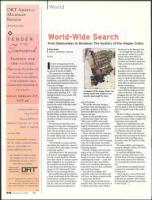
A fragment of the Aleppo Codex, con-
taining verses from Exodus 8, was
recently was brought to Israel.
may yet be found.
"We are like detectives trying to
hunt down these missing pages:' said
Yosef Ofer, a professor in Bar-Ilan
University's Bible department and an
expert on the text.
"Some of it did possibly burn or
could have been stolen:' Ofer said.
"Other parts could be with people,
but so many years have passed that it
might be in the hands of the second
or third generation who do not realize
what they have in their hands."
Glatzer said the institute is negotiat-
ing with several former members of
the Aleppo community in hopes of
retrieving at least part of the remaining
codex. He would not give any further
details about the discussions for fear of
disrupting progress.
The Jews of Aleppo, who trace their
origins in the city to the period fol-
lowing the destruction of the Second
Temple in the year 70, saw the codex as
something holy in itself — a relic that
protected them. They viewed them-
selves as its custodians, believing that
if any harm came to it their community
also would be in danger.
Soon after the synagogue that
housed the codex was set ablaze in the
1947 riots, the Aleppo community fled
to cities across the world.
"It had an aura of sanctity beyond
scholarly value. They were protective of
it:' Glatzer said of the codex, which is
also known as the Masoretic Text.
It is thought that the 10th cen-
tury text was written by a scribe
named Shlomo ben Buya'a in
Tiberias around 920. It was then
vocalized and edited by Aaron Ben
Asher, a renowned grammarian
and scholar.
From Tiberias it was brought to
Jerusalem. After it was stolen by
Crusaders, it was somehow bought
back by the Jewish community of
Cairo. It was there that Maimonides
used it as the authoritative version
of the Bible on which he based his
famous commentary.
Sabbagh, the Brooklyn business-
man, found his small piece of the
codex on the floor of the Aleppo
synagogue after the 1947 riots. For
years, he kept it in his wallet, refus-
ing to part with it. He even kept it
with him during open heart surgery.
It took several years of negotiation
after his death in 2000 for his family to
agree to bring the scrap of the codex to
Israel.
The Jews of Aleppo, who had a rich
history as a community of scholars and
successful traders, remain a tightly knit
community even in the exile.
Aleppo's Jews established new com-
munities in Israel, Brooklyn and Deal,
N.J., as well as the South American cit-
ies of Buenos Aires and Sao Paulo.
The portions of the codex that have
been retrieved are housed in the Shrine
of the Book at the Israel Museum in
Jerusalem, where the Dead Sea Scrolls
are located.
The newest addition, the fragment
carried in Sabbagh's wallet, soon will be
included in the display.
In small but still-legible Hebrew
letters, it contains a few lines of verse
from the Book of Exodus. Among them
are the words Moses said to Pharaoh:
"Let my people go, that they may serve
me."
Israeli scholars are hoping the quest
to retrieve the remainder of the codex
will help Jews.
"This is the No. 1 asset of the Jewish
people said Zvi Zameret, the director
of Yad Ben-Zvi Institute. "And I believe
the Jewish people would do a great deal
to have it back." ❑