

Spirituality
0 DAY
S SS
m,
Chanukah At A Glance
had survived the onslaught. Instead
of burning up in one day, the oil
lasted for eight days until the priests
could prepare more.
Viewed as a sign of divine
approbation for the efforts of the
Hasmoneans, the rabbis ruled that
henceforward Jews would kindle
lights for eight days to commemo-
rate the rescue of Judaism and the
Temple.
• How To
Celebrate:
Kindle lights
(oil is preferable,
but most people
use candles) in
a menorah, or
a chanukiyah.
Light candles
progressively
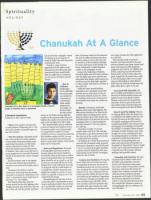
Chanukah art by Ben Sider, 9, of Huntington Woods, a fourth-
each night: one
grader at Yeshivat Akiva in Southfield.
the first night,
two the second
and
so
on.
On
Friday
evening,
light the
Elizabeth Applebaum
candles
on
the
menorah
before
those for
Special to the Jewish News
Shabbat. Put candle in the menorah from
right to left, but light them left to right.
The Chanukah light must be sufficient
From
sundown
Tuesday,
Dec.
• When:
to
burn 30 minutes into Shabbat; if your
4, until sundown, Wednesday, Dec. 12. On
Chanukah
candles are not long enough,
the Jewish calendar, Chanukah begins on
try
using
Shabbat
candles (of course,
the 25th of Kislev.
you'll have to have a menorah in which the
thick Shabbat candles will fit). You may
• Why We Celebrate: Chanukah marks
have one menorah for the entire house-
the victory of the Jews, led by members
hold or one for each member of the family
of the priestly Hasmonean family (espe-
(plus one for each guest).
cially Judah Maccabee), over the Greco-
Syrians (Seleucids) in 164 B.C.E. The
• Rules And Regulations: The point
Seleucids severely repressed the practice
of
having lights is pirsumey nisah, an
of Judaism. They tried to force the Jews to
Aramaic
phrase that means "publicize
accept paganism and converted the Jewish
the
miracle
either to the world or within
Temple in Jerusalem into a house of pagan
one's
own
household.
Thus, the Chanukah
worship.
lights should be set up in such a way that
The Hasmoneans went to war against
an observer can easily tell the day of the
the Seleucids, defeated them, liberated
holiday
(this is why traditional menorahs
Jerusalem and restored the Temple and its
are
designed
with the candle holders in
altar.
a
straight
line).
Modern menorahs may
Chanukah is the Hebrew word for
display
the
candles
in a variety of ways,
"dedication" and comes from the phrase,
which
is
acceptable
so long as one is not
of
the
chanukat ha-mizbayach,"dedication
confused
by
the
design.
ha-bayit,"dedication
of
altar',' or chanukat
Chanukah lights do not have to be in
the house" (i.e., the Temple).
a menorah, and it is permissible to place
The Talmud relates that when the
priests arrived for the daily lighting of the them in individual holders that are lined
Temple menorah, they found that only one up. It is preferable to place the menorah
jar of olive oil, with the priestly seal intact, in a window facing the street for the
sake of pirsumey nisah; but the menorah
also may be within the house away from
windows, where it can be observed only
by members of the household. Although
the major observance of the holiday is at
home, traditionally we light Chanukah
candles in the synagogue, as well.
Except at the beginning of Shabbat,
Chanukah lights must be lit after sundown
only. The lights may not be used for any-
thing other than display, which means you
should not read by them, light cigarettes
or other candles with them or use them in
any other way.
Unlike the major Jewish holidays,
Chanukah is not considered sacred time
and thus has no restrictions on the use
of electricity, vehicles, money, etc. There
is a tradition, however, for women not to
do household work while the candles are
burning.
• Rituals: A blessing is said before
lighting, and a prayer after lighting. The
daily service includes Al ha-Nisim in the
Amidah (silent, standing prayer) and in
Birkat ha-Mazon (grace after meals); the
full Hallel prayer is recited each day. In the
synagogue, there is a Torah reading for
each day (Numbers 7 8:4); four persons
are called up.
Chanukah straddles two Jewish
months, Kislev and Tevet. The sixth day
of Chanukah is also Rosh Chodesh Kislev
(the first day of the month) and includes
an additional Torah reading.
On Shabbat, the weekly Torah portion is
read with the Chanukah maftir. A special
haftorah for Chanukah is read (Zechariah
2:14-4:7), in which the prophet describes
a golden menorah flanked by olive trees,
representing restored Jewish sovereignty
under the rule of Torah.
• Customs And Traditions: We sing the
hymn "Maoz Tzur," and some also recite
or sing Psalm 30. Because the miracle of
Chanukah involved oil, over the centuries
Jews developed the custom of eating foods
prepared in oil. Thus, Ashkenazi Jews eat
potato pancakes (latkes) fried in oil (olive
and canola are the healthiest). Depending
on what part of Europe your family came
from, the latke recipe will differ. Polish
Jews eat latkes made from potatoes only,
sprinkled with sugar. Russian Jews add
onions to the potatoes and top them with
sour cream. German Jews like applesauce
as a side dish.
Why pancakes made of potatoes?
Potatoes were harvested late in the year
and were plentiful and cheap. Israelis (and
many Americans) eat jelly doughnuts
(sufganiot), also fried in oil. Children play
dreidel, a spinning top inscribed with a
Hebrew letter on each of four sides. The
game is played for chocolate coins, candy
or nuts. Each player takes a turn at spin-
ning, and depending on which Hebrew
letter turns up when the dreidel stops, the
player either gets or gives to the pot.
• Associated With Chanukah: The
story of Judith and Holofernes, and also
the story of Hannah and her seven sons.
Judith is found in the Book of Judith;
Hannah comes from the Second Book
Maccabees. Both are part of the Jewish
Apocrypha, books of Jewish origin that
were not accepted in the Tanach (Bible).
• How To Spell The Holiday: There is
an ongoing debate about the proper way
to transliterate the Hebrew chaf nun, vav,
kaf, heh. For most of the 20th century,
the English-speaking world resorted to
transliterating Hebrew into German (long
the language of scholarship) and spelled
the holiday as Chanukah. Others dropped
the final h to make Chanuka. Later, some
thought the ch was confusing and used
the spelling Hanukah (or Hanuka). Others
proposed to double the k (because in
Hebrew the corresponding letter con-
tains a dot) and produced Hanukka (or
Hanukkah or Chanukkah). There no single
correct way to spell and the holiday and
eventually you will encounter all these
spellings (and probably others).
• Chanukah And Christmas: Because
Chanukah almost always comes out in
December and sometimes coincides
directly with Christmas, some people
have come to think of Chanukah as Jewish
Christmas. Aside from the timing, the
holidays have nothing in common. And
while the giving of presents, the gala,
the glamour and the glitz of Christmas
have become ingrained in American
culture to such an extent that many Jews
have adopted the Christmas custom of
exchanging gifts, this has nothing to do
with Chanukah.
November 29 2007
C3