

World
Evangelizing
Missionaries seek the vulnerable and soften the differences.
Barry Yeoman
Jewish Telegraphic Agency
This is the second of two articles, excerpted
from a Jewish Telegraphic Agency series.
Cary, N.C.
I
srael has more than 100 Messianic
congregations, says Yaakov Ariel,
associate professor of religious stud-
ies at the University of North Carolina
and author of Evangelizing The Chosen
People.
"Thousands of young Israelis — gradu-
ates of Israeli schools, graduates of the
army — are in Messianic congregations,"
says Ariel, adding, "Almost all of them
come from non-Orthodox homes and
many from secular backgrounds."
What's more, evangelicals perform an
increasing share of the charitable work
in the Jewish state. "They've become an
important part of the welfare network:
taking care of the elderly, taking care of
the needy," Ariel says.
Last year, Chosen People Ministries
brought $50,000 worth of food to southern
Israel, where Jews had taken refuge from
the conflict on the Lebanese border.
Mitch Glaser, CPM's president, says his
staff was "buying food from grocery stores
in Jerusalem and schlepping it seven
hours to Eilat."
"Was that evangelism? It might be," he
says. "We did talk about our love for the
Lord as we did it."
Back in the United States, as the move-
ment has boomed, so have its educational
institutions. Some of the nation's leading
evangelical schools, including Criswell
College in Dallas and Western Seminary
in San Jose, Calif., offer accredited pro-
grams in Jewish studies or Messianic
Judaism.
Chosen People Ministries has teamed
up with California's Biola University to
create a three-year master's program in
Messianic Jewish studies. The Union of
Messianic Jewish Congregations has an
institute — linked informally to an evan-
gelical seminary in Florida — to ordain
Christ-centered "rabbis."
Myriad publications on how to win
over Jews are readily available, including
theological journals and a four-volume
set titled Answering Jewish Objections
to Jesus. An international umbrella group,
the Lausanne Consultation on Jewish
Evangelism, brainstormed strategies this
summer in Hungary.
Groups such as Jews for Jesus partner
with large evangelical congregations, such
as the McLean Bible Church in Vienna,
Va., to train members in reaching Jewish
neighbors and co-workers.
Only rarely does the issue attract main-
stream attention, as when conservative
pundit Ann Coulter told CNBC talk-show
host Donnie Deutsch in October, "We just
want Jews to be perfected."
Jewish leaders are far from uni-
fied about how much damage these
efforts inflict. "I am not convinced that
this is a major crisis," says Rabbi Gary
Greenebaum, U.S. director of interreli-
gious affairs for the American Jewish
Committee, explaining that the number of
actual conversions appears low.
Greenebaum worries, though, that when
churches fund Jewish-directed missionary
work, it creates an obstacle to interfaith
dialogue.
Others express more alarm. "Is it an
existential threat to the future of the
Jewish community? No," says Rabbi
Craig Miller, education director of the
anti-missionary task force at the Jewish
Community Relations Council of New
York. "Is it hurting Jewish individuals? Yes.
"The loss of any Jewish person is a trag-
edy for family and friends:' he says, "and
it's also a loss of that person's creativity
and input to the Jewish community as a
whole."
Soviet Emigres
Through a doorway marked with a
Star of David and up a staircase is the
Russian Community Life Center, a mod-
est cluster of rooms that has become one
of Brooklyn's missionary hot spots. On
a Saturday morning, 60 immigrants on
black plastic folding chairs watch as center
director Leslie McMillan dons a head scarf
and lights a pair of Shabbat candles.
She recites the traditional Hebrew bless-
ing, but with an addition: B'shem Yeshua,
which translates as "in the name of Jesus."
The Shabbat candles, a worship leader
explains in Russian, "is like a symbol of
the light of Jesus Christ, our Savior."
Evangelists have identified Russian
Jews as particularly ripe for their message.
They lived under a government that for
decades suppressed worship, leaving them
with few religious preconceptions.
"It's been forbidden fruit for gen-
erations," says Eugene
Lubman, a 31-year-old
computer programmer 0
from Kiev, Ukraine, who
serves as vice president
of the center's board.
"In the Orthodox
community, there are
things you are expected
to start practicing;'
he says. "You have to
change the way you eat.
You have to change the
way you dress. You have
to change the way you
act."
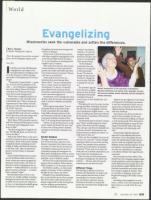
Two summers ago, the Recent immigrants fill the sanctuary of Brooklyn's
center became a staging Russian Community Life Center every Saturday morning.
ground as Jews for Jesus The service includes Jewish elements, but the message is
missionaries descended strictly Christian.
on Brighton Beach en
masse as part of their Behold Your God
Judaism has the righteous of all nations
campaign.
as being saved; Christianity says heaven
Throughout the year, the center teaches
is reserved exclusively for those who rec-
sewing and offers citizenship assistance.
ognize Jesus as Messiah. When the two
But the bulk of its evangelism comes by
religions diverge, Messianic Jews tend to
way of inexpensive English classes — two
side with Christians.
hours of small-group instruction followed
Ray Gannon, who directs Jewish out-
by 30 minutes of mandatory Old and New reach for the Assemblies of God, says,
Testament study.
"We're not interested in filling our church-
"We absolutely have to do this:' Lubman es with Jewish people. We're interested in
says. "There's so little support for immi-
enabling Jewish people to enjoy the best
grants. They don't know the language.
things of Jewish life while at the same
They can't get a job. They're absolutely lost time entering a real relationship with
in the new society" If missionaries can
God."
help newcomers acclimate, he insists, "we
Jewish leaders find this relational
really deserve their ear."
approach no less offensive than street
Critics say that evangelists' successes do encounters. "One is the harder sell, one
not occur in a vacuum. "I always thought
is the soft sell; but they're both trying to
missionary efforts were an early warning
sell you a false set of goods," says Scott
system;' says Jonathan Sarna, professor
Hillman, former executive director of Jews
of American Jewish history at Brandeis
for Judaism, a two-decade-old organiza-
University. "If you want to see where the
tion that was established as a response
weak parts are in Jewish communities, you to the efforts of those who target Jews for
look at where the missionaries are.
conversion.
"Most recently you find missionaries
How successful are these efforts? The
focusing on immigrants, the elderly and
Behold Your God campaign targeted major
students — all areas where the Jewish
Jewish population centers throughout the
community has not done its work!"
world. Representatives handed out 16 mil-
lion broadsides, mailed Yiddish DVDs to
Different Views
Orthodox households and trained mem-
The theological differences between
bers of large evangelical churches. They
Judaism and Christianity are deeper and
set up kiosks in shopping centers and
more complex than the issue of Jesus'
bought advertising in New York's subway
messiahship. For instance, Judaism
system.
says God forgives repentant sinners;
According to the evangelists' own sta-
Christianity describes an irreparable
tistics, a total of 1,227 Jews declared their
breach that could have been bridged only
faith in Jesus as a result of the five-year
by Jesus' death.
effort.
November 29 • 2007
A31