

Arts & Entertainment
ON THE COVER
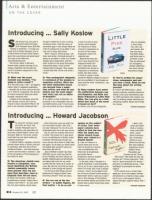
Introducing ... Sally Koslow
ally Koslow has one goal in
mind with Little Pink Slips
(G.P. Putnam's Sons; $24.95).
"Simply to entertain — to make you
laugh and to briefly transport you to
a world where the holy trinity means
good hair, good shoes and good bags,"
she says on her Web site,
www.sallykoslow.com .
The former editor of McCall's,
Koslow takes readers through a fun,
bumpy, insightful ride through the
world of women's magazines in this,
her first book.
S
thought I might like to join a writing
workshop (since I had the luxury of
severance pay). I have always liked the
craft of writing, but as an editor it was
only one of many daily tasks.
When I found a writing group, I sat
down and wrote a fictional account of
going, as an editor in chief, to a Chanel
sample sale in Manhattan, and the
other writers in the group thoroughly
enjoyed the piece. It was at that
moment that I thought, "Aha, maybe
I should take this further and write a
novel."
0: What was the exact
moment you decided, "I'm
going to write a book"?
Q: Your protagonist, Magnolia,
is convinced of the wisdom in
magazine articles. What was
the most memorable lesson
you learned from a maga-
zine article, and what do you
believe was the most impor-
tant story you ran as editor
of McCall's?
A: A few years ago, I was — as happens
rather often in magazine publishing
— abruptly let go from a job as the edi-
tor in chief of a magazine. The director
of human resources asked me what I
thought I would do next.
I looked at her strangely, since the
pink slip was a shock and I had no
reason to have considered Plan B. Yet
part of me instantly answered that I
A: As editor in chief of McCall's, I'm
proudest of our remarkable, life-sav-
ing health stories; and if I had to pick
just one of them to cite, it would be
LITTLE
F I NK
a report we did on lung
who, for example,
cancer, which despite
is from Fargo,
its frequency is rarely
N.D., like I am,
SHIPS
covered in magazines on
and Jewish. But
account of the money
N ov
the only thing
magazines make from
that Bebe Blake
cigarette ads.
and Rosie have in
Beyond the many les-
common is that
sons I have learned from
they are big-heart-
magazine health arti-
ed, outrageous,
cles, I think that I have
/4 /I
shrewd celebrities
11141 ,
benefited from stories in
who have started
magazines on emotional
eponymous maga-
health. One that comes
zines.
to mind is a piece I wrote
myself for Reader's Digest on how to
Q: You've written for maga-
be more confident. If you Google my
zines, newspapers and now
name and the word "confidence," you
you have a book. What do you
can read it.
like best about the writing
Q: Many readers have noted
the similarities between you
and Magnolia, and Bebe and
Rosie O'Donnell in Little Pink
Slips. Can you give us a hint
about how much of the novel
is based on fact?
A: There's a lot of me in Magnolia,
process?
A: I love it all! With fiction, I adore
turning a phrase, creating characters,
telling a story and entertaining read-
ers. With journalism, the rewards con-
nect to meeting people, learning and
educating readers. Please don't make
me choose.
- Elizabeth Applebaum
Introducing Howard Jacobson
T
he cleverist, funniest, sharp-
est writer we have," the
Sunday Telegraph says of
Howard Jacobson, who describes his
new book, Kalooki Nights (Simon and
Schuster; $26) as "the most Jewish
novel that has ever been written by
anybody, anywhere."
In Kalooki Nights, Jacobson, who has
penned seven works of fiction and four
of nonfiction, tells the story of two
childhood friends — one who becomes
a writer and the other a criminal — and
of the persistence of the Holocaust in
the minds of Jews.
Q: The American Jewish com-
munity is outspoken, very
much identified; the British
Jewish community seems
more private. Give me one
word that describes Jews in
England; then tell me more.
A: Timid. You'll notice I didn't say
pusillanimous, though I might have. I
confess I don't like it — as Jews don't
like non-Jews making Jewish jokes
B14
October 25 • 2007
— when American Jews say what I've
just said about English Jews. But I
can say it because I'm one of us and
understand why we're the way we are.
But it's still our problem that we're
so timid. The reason for it goes back
to our re-admittance to Britain under
Cromwell. We had been thrown out
once, and we were afraid it might hap-
pen again. So we kept our heads down
and hoped they wouldn't notice we
were here. We still do.
Jews in Britain number less than
300,000, so you could say that for
all our timidity, we punch above our
weight. Intellectually and artistically
we make a big noise for our small
number. But we rarely do it noisily as
Jews. We want to show that we have
blended in, even though we haven't.
It is the case that things are just
beginning to change. English Jews
becoming vibrant? There are signs.
Q: You are one of the few
writers — or public figures, for
that matter — to be so out-
spoken on the subject
of Israel. Your news-
paper columns have
called to task the hos-
tility the media has
shown toward Israel.
Were your raised in a
Zionist home?
I didn't visit
Israel and didn't
think of visiting
Israel until 1990
when I wrote
Roots Schmoots.
But I remember
getting a scare
H ja4o
0 4/44. bso
Y'S
A: I was not raised in a
before the Six-Day
Zionist home and do not
War and suddenly
think of myself as a Zionist.
imagining a world
kt,11
I am an Englishman who
without Israel.
thinks like an Englishman
Thereafter, par-
and writes like an
ticularly as the "brave
Englishman and has English
little Israel" that went into the war
literature in his blood.
became the "Zionist oppressor" that
In the past, when I thought of a
won it, I grew conscious of a wrong —
Jewish homeland, it was Manhattan.
primarily an intellectual wrong — that
This is not to say I was brought up to
had begun to permeate the whole
think ill of Israel. But it was a distant
subject.
country. I wasn't encouraged to join
So it's above all as a writer that I
any of the pro-Zionist youth groups in
speak as I do on this subject. British
Manchester where I grew up; I wasn't
anti-Zionism is virulent in many ways;
sold on the ideology of the kibbutz;
but it's as a crime against history,
but the family always put money in the
against thought, against reason, that I
charity box to plant Israeli trees when
attack it.
it came round.
- Elizabeth Applebaum
1<0
ta, 10