

Arts & Entertainment
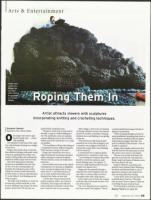
Studio view:
Artist Orly
Genger sits
atop her
2007 work to
be eichibited
at Leinberg
Gallery,
Artist attracts viewers with sculptures
incorporating knitting and crocheting techniques.
Suzanne Chessler
Special to the Jewish News
0
rly Genger can't seem to give
herself enough rope — artisti-
cally speaking.
The material is at the core of her sculp-
ture, and she keeps devising new configu-
rations for it.
Genger, a New Yorker about to have her
first exhibit in Michigan, will spend a week
in the area, speaking to the artistic com-
munity, visiting studios and working with
students to install a large-scale new work.
The artist's appearances surround
Posedown, an installation on view Sept.
29-Nov. 10 at the Lemberg Gallery in
Ferndale. She will speak as part of the
College for Creative Studies Woodward
Lecture Series at 7:30 p.m. Thursday, Sept.
27, in the Walter B. Ford Building on the
Detroit campus.
"The large-scale installation is made out
of nylon rope, which essentially is used
for rock-climbing," says Genger, 28, whose
family is from Israel. "All the rope was
painted black using latex paint.
"Posedown comes from a term used to
describe a stage in a body-building con-
test. The contestants come out and dem-
onstrate different poses to show off their
bodies, and all the contestants try to outdo
one another.
"The installation will have this feeling of
a competition between different elements.
That's the basic concept of the show."
Genger has invented her own way to
adapt knitting and crocheting techniques
while creating post-minimal sculpture.
With her hands as tools, she builds knots
into forms.
Recent exhibits have been at the Aldrich
Contemporary Art Museum in Ridgefield,
Conn.; Socrates Sculpture Park in Long
Island City, N.Y.; the Haifa Museum of
Art in Israel; and the Stux Gallery and
Elizabeth Dee Gallery in New York.
"I always drew but got involved with
making sculpture while I was at Brown
University," says Genger, who will meet
with Cranbrook art students. "I knew then
that I wanted to take it very seriously.
"After college, I went to the Art Institute
of Chicago and had a teacher who showed
me how to crochet. I remember watching
the hook move and thinking it was getting
in the way.
"The movement of the hook seemed
natural for me to do with my fingers, and
I started to use my finger as the hook. It
seemed like a more direct way of dealing
with the material."
A commission for a sculpture garden
introduced her to using heavy-duty rope.
"I was looking for a material that would
be able to sustain the outdoors, and I
found climbing rope," she explains. "It
has to be a high-quality product because
people's lives depend on it."
Genger gets her materials through a
manufacturer in New England. After the
rope takes on various shapes and sizes,
she applies color with a large sprayer.
In her studio close to home, the sculptor
needs the help of assistants because of the
size of her projects.
"I'm a very directed person and like to
feel I have control:' she explains. "There's
a primal satisfaction having a full day of
physical concentration.
"When I'm going through a period cre-
ating installations, spending many hours a
day with heavy material, I feel my fingers
and hands get stronger. They hurt, too,
and I'm watchful of that because I want to
be able to continue."
Genger, who is single, was born in New
York but lived for two early years in Israel.
She returns once a year to visit family.
"Because I am Jewish and Israeli, reli-
gion has to do with who I am and every-
thing I make, but themes of Judaism never
have been literal:' she says.
Genger's influences, conceptual and
aesthetic, have included Claus Oldenburg,
Eva Hesse and Richard Tuttle. A mix of
approaches merges as she sculpts from
early morning until early evening.
"I write short stories, but I haven't tried
to publish them," she says. "They help
with my ideas. They're a place to flush out
everything that goes on in my head.
"It's interesting to read them a month
Roping Them In on page 50
September 20 • 2007
43