
To Life!
HEALTH & FITNESS
Vital Training
Israeli "dummy" saves lives.
Ramat Gan, Israel/JTA
A
rmy medics hover over the sol-
dier with a bullet wound in his
chest. The sounds of helicopters
buzzing and mortars falling surround
them.
"Give him morphium, liquids:' the com-
mander snaps.
The soldier's vital signs do not look
good and he has gone silent.
"Are you still with me?" one of the med-
ics shouts, kneeling closer.
A few steps away, a medical student in
a soundproof booth makes the casualty's
blood pressure and oxygen levels plunge
with a few clicks of a computer mouse.
The injured soldier is actually a
$200,000 high-tech plastic dummy, and
the medical team is in a windowless train-
ing room at the Israel Center for Medical
Simulation.
The center is the brainchild of Amitai
Ziv, a fighter pilot turned pediatrician
whose accomplishments won him the
2007 Charles Bronfman Prize for humani-
tarian work.
Ziv, 48, has a mission: to reduce the
number of medical errors. Drawing from
his Israel Air Force experience and his
medical training, he created the center
— known as MSR — in the hope that
it would change the culture of medical
training, not just in Israel but internation-
ally.
The national center, which uses technol-
ogy based on flight simulators, is unique
in its scope worldwide and has served as a
model for other training programs.
Ziv's eyes grow wide as he cites findings
from a U.S. National Institutes of Health
study that some 100,000 Americans a year
die due to medical error.
"That's as if a jumbo Boeing 747
crashed into the sea every day:' he said.
Of the center, which is located at the
Sheba Medical Center near Tel Aviv, Ziv
said, "This is a place to make mistakes in
order to learn from mistakes. We need to
have low tolerance for errors and no toler-
ance for not learning from errors!'
At MSR, one enters a world of virtual
patients — the computerized mannequins
react like humans, with heart rates, blood
pressure and the ability to bleed, and even
go into shock. Sessions are videotaped and
followed by debriefings with a doctor.
Ofir Raz, a 28-year-old medical student
who helped conduct the
training session with
the army medics, sits in
the control room mar-
veling at the techno-
logical capability of the
equipment. He demon-
strates on the comput-
ers how to determine
heart contractions in
either the left or right
ventricle. The goal is to
make the scenario as
challenging as possible,
Raz said.
Since its founding
in 2001, the center has
become a model at
institutions worldwide,
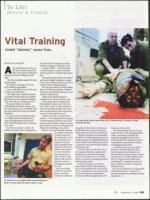
An Israeli army medical team tends to an "injured person," actually a lifelike
computerized doll.
including the Mayo Clinic in Minnesota,
McGill University in Montreal and Case
Western Reserve University in Cleveland.
"Methods developed and implemented
by MSR are revolutionizing the manner in
which physicians and allied health person-
nel are trained;' said William Dunn, medi-
cal director of the Mayo Multidisciplinary
Simulation Center.
At his desk, Ziv opens file after file on
his computer, offering a sampling from
hundreds of scenarios: from training a
doctor to break the news of a terminal
illness to a patient, to managing chemical
and biological warfare.
In May, Ziv traveled to New York to
receive the $100,000 Charles Bronfman
Prize, which celebrates the vision and tal-
ent of an individual or team younger than
50 years old and whose humanitarian
work has contributed significantly to the
betterment of the world.
The award founders said, "Dr. Ziv rep-
resents the best of the young generation's
values, commitment, creativity and
energy. His insightful and innovative
work responds to the imminent need for
reshaping the way medical care is deliv-
ered throughout the world."
In addition, Ziv serves as the deputy
director of the Sheba Medical Center,
Israel's largest medical institution. An
internationally recognized expert in medi-
cal education, he also has testified before
the U.S. Congress on how MSR trains
professionals to respond in the event of
mass casualties caused by a chemical or
biological attack.
Ziv also has briefed the U.S. Department
of Homeland Security on ways to use
medical simulation in training for medical
emergencies.
Dr. Amitai Ziv, an ex-fighter pilot turned pediatrician,
shows how the high-tech plastic model is used.
September 13 0 2007
101
Scanned image of the page. Keyboard directions: use + to zoom in, - to zoom out, arrow keys to pan inside the viewer.
September 13, 2007 - Image 109
- Resource type:
- Text
- Publication:
- The Detroit Jewish News, 2007-09-13
Disclaimer: Computer generated plain text may have errors. Read more about this.