

Arts & Entertainment
American Jewry's Family Album
In new book and accompanying exhibit, the Forward plumbs its vast photo archives,
creating a vivid history of long-gone Yiddish life.
Sandee Brawarsky
Special to the Jewish News
women, all named Ida, sitting proudly in
straw hats, neighbors in Biala, Poland, who
all immigrated to America; and the win-
dow of the now-closed landmark Ratner's
restaurant on the Lower East Side.
Art and creativity is a theme picked up
throughout the book, with several pho-
tos of artists at work, including painter
Ben Tsisyon Rabinovitch and one of his
models, dressed in a white sheath, in his
Paris studio; the sculptor Rene Shapshak
finishing his bust of President Harry
Truman at Manhattan's Chelsea Hotel;
Norman Raeben, a painter and the son
of Sholom Aleichem (and the art teacher
of Bob Dylan) working on a canvas; art
students in a painting class that was part
of the Works Progress Administration;
and the portrait artist Elias Grossman,
who worked with the Forward, sketching
Benito Mussolini in person.
Some of the photographs are familiar;
those taken in Europe and Palestine are
less so. The strongest images are those
oshua Lubliner, a journalist in
his native Ukraine, became a
window washer when he immi-
grated to New York in 1922.
Each weekday, he'd get up at 4 a.m.,
gulp down a raw egg or two and leave
his Brooklyn home for a full day of work.
Upon his return, his nightly ritual was
to sip tea with sugar cubes and read the
Jewish Daily Forward — the Forvertz, as
the Yiddish newspaper was known — in
its entirety, clipping articles of interest for
his personal scrapbook.
In the years following his arrival in New
York, Lubliner was one of about 250,000
readers of the Forward, then the largest
Yiddish newspaper in the country. For him
and other immigrants, the Forward was a
necessity, their link to America and to the
world they left behind. The first paper in
this country to have a national readership,
in its heyday, the Yiddish-language
daily had a larger circulation than
even the New York Times.
In a new book and exhibition
at the Museum of the City of New
York, the Forward is seen as a
guide, a source of news, enter-
tainment and advice. To look
back at its pages, as the exhibi-
tion suggests, is to look through
a window into life among the
Jewish immigrant community.
Published on the newspaper's
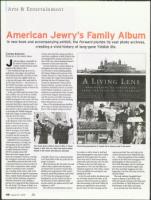
110th anniversary, A Living Lens:
Photographs of Jewish Life from
Two Israeli police officers direct traffic in Times
the Pages of the Forward, edited
Square in New York as a New York police officer
by Alana Newhouse (Norton;
stands in the center and observes stoically.
$39.95), includes about 500
black-and-white images drawn
from the newspaper's archives, covering
of people, whose eyes, as photojournalist
the immigrant community and beyond.
Leni Sonnenfeld would say, speak the lan-
Beautifully produced, the book is full
guage of memory.
of pictorial treasures; some are works of
Alana Newhouse, the Forward's arts and
art for their composition, others simply
culture editor, explains that the photos
capture a moment in time. Included
are drawn from an archive of more than
are a meeting of the century club of the
40,000 prints spanning the 20th century.
Hebrew Home for the Aged in Dorchester,
Stored in metal filing cabinets and moved
Mass.; Sophie Tucker showing off a hand
in 1974 from the newspaper's former
of cards; Jewish watchmen on guard in
headquarters on the Lower East Side to
Palestine, dressed in Arab clothing; a
the basement of their Midtown build-
portrait of a young David Ben-Gurion and ing, the archive was rediscovered by staff
his wife Paula; "Six Chums of Biala," as it
members in 1997.
was originally captioned, a portrait of six
The collection includes photos sent in
j
44
August 23.2007
PHOTOGRAPHS OF JEWISH LIFE
FROM THE PAGES OF THE
E 1) 1 l'ED..BY
ALANA
NI it 0.0 •CT!ON B
FORWA - RD
NE . W-11:0USE,
i
11 HAMIL
•
Chronicling generations of Jewish life in America and in the world
by readers as well as those by staff and
other photographers; only some of them
appeared in the pages of the Forward.
Some were shot by well-known photog-
raphers like Alter Kacyzne, who was sent
to Poland as the Forward's photo cor-
respondent in 1921 and was killed in a
Ukrainian pogrom in 1941; Polyn, a book
of his remarkable Forward photos, was
published in 1999.
In the Forward archive, the photos were
not all clearly marked with dates or full
captions, which has become an unfortu-
nate shortcoming of the book. While the
photos are organized by time periods,
specific dates are often missing and the
captions are brief. One can't help but be
curious about the stories behind the pho-
tos — when the members of the weekday
minyan at the Wall Street Synagogue were
photographed or when Grossman sat
down with Mussolini; why the watchmen
were dressed in full Arabic regalia (and
how they used their daggers) and what
happened to the Idas once they arrived in
the New World.
The book includes thoughtful short
essays on themes of Jewish life, with
Deborah Lipstadt writing on the Holocaust,
Leon Wieseltier on "Holy Hollywood" and
Paul Berman on the labor movement.
In an introduction, Pete Hamill, the