

Dad In A Sharkskin Suit
Memoir about debonair father brings to life
the cosmopolitan world of pre-Nasser Cairo.
Sandee Brawarsky
Special to the Jewish News
W
hen Leon Lagnado would
walk at his brisk pace through
the streets of Cairo in the
1940s, heads would turn: He was said to
resemble Cary Grant.
The suave, elegant gentleman made
deals in several languages, played the stock
market and made himself essential to busi-
ness transactions all over the city. Evenings,
he frequented Cairo's liveliest nightspots,
where he was known as Leon by the own-
ers and as Captain Philips by the British
soldiers who enjoyed his presence.
Dressed in one of his signature white
sharkskin suits and two-toned shoes,
he dined and danced with exuberance,
appreciated the company of women and
loved "the shuffle of a deck of cards and
the spin of a roulette wheel!' As a bachelor
and then a married man, Lagnado was a
prince of the night, sometimes invited to
join King Farouk for a round of cards at
his table.
For Lagnado, a descendant of a long
line of rabbis from Aleppo, Syria, religion
was taken as seriously as his pastimes.
Friday nights and Saturdays, he went to
synagogue.
In The Man in the White Sharkskin
Suit: My Family's Exodus from Old Cairo
to the New Wrold (Ecco; $25.95), Lucette
Lagnado, an award-winning investigative
reporter for the Wall Street Journal, por-
trays her father and the cosmopolitan Cairo
he loved and had to flee in 1963 when life
became exceedingly difficult for the Jews,
in the decade after King Farouk's fall and
Gamal Abdel Nasser's ascent to power.
While her father had encouraged his
siblings, years earlier, to leave for Israel,
the one country that would take them
unconditionally, he initially insisted on
staying, not able to imagine life outside
of Egypt. But as synagogues were shut-
tered, cemeteries looted and Jewish shops
abandoned, the family boarded a ship for
Marseilles, France.
Forced to leave their wealth behind,
they went to Paris before they were able
to enter the United States and eventually
move to Brooklyn.
But if Cairo was a well-cut suit for Leon,
THE NI IN THE WHITE St ARKS
my
-Family `
SNIT
exodus frimi Old Cairo to the new Warrd
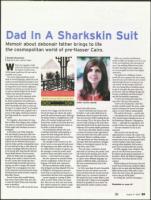
Author Lucette Lagnado
America was a baggy coat that never fit.
He lost his home, his culture, his profes-
sional life and his buoyant spirit. Although
the family settled in a neighborhood with
others of Levantine background and he
found some comfort in the shuls that were
familiar, he never regained his stature or
his ability to help his family.
The resettlement officials who were
to aid them had little understanding or
respect for their background. Even in
Leon's last days, he had a suitcase nearby,
ready to return to Egypt.
The strength of this memoir is in the
writer's prose, at once graceful and power-
ful. Reporting on her father with the awe
of a child and the wisdom of a grown-up,
she manages to make the reader under-
stand his charm and foibles and her love
for him — and to feel his loss deeply.
She also captures her extended family
and the complexities of their lives and
longings with depth and compassion.
She joins memoirists Andre Aciman
(Out of Egypt) and Gini Alhadeff (The Sun
at Midday) in writing lyrical, personal
books that are important documents of
communities that have been extinguished.
Lucette Lagnado is wearing all white
when we meet. White cotton, not shark-
skin. She's not sure she's ever seen shark-
skin, and her requests for a fabric sample
through friends in the textile business
haven't met with success.
A petite whirlwind, she bounces into
M. Rohr's, a cafe on East 86th Street in
Manhattan, where she greets the owner,
who asks about her debut reading the pre-
vious evening. This is the place where she
sat every day, working on the book when
she'd take breaks from the quiet basement
bedroom of her nearby duplex apartment.
The 50-year-old author admits to being
a woman of routine, in part superstition:
Every day she'd order iced coffee and two
homemade Mexican wedding cookies.
(The superstition was about writing, not
marriage: She's been married to Douglas
Feiden, an investigative reporter for the
Daily News, since 1995.)
This cafe seems a much less formal
place than La Parisiana, the popular Cairo
cafe of the book's opening scene, where
her parents first meet. She describes that
as a place where different languages are
spoken at different tables, sometimes in
the same conversation and even in the
same sentence.
In 1943, Leon, then 42, eyed a beautiful,
demure 20-year-old woman across the
room and knew that she was the one he'd
finally marry. In a romantic moment of
film quality, he had a waiter deliver a note
to her that said, "I find you very beautiful.
Would it be possible for us to meet?" He
then joined her and her mother at their
table.
Edith was a teacher and librarian,
hardly worldly and thought Leon to be one
of the most handsome men she had ever
met. A big wedding followed soon after,
but their marriage wasn't a happy one,
as Leon promptly reverted to his nightly
adventures.
Throughout her childhood, Lucette
heard this story replayed. She was 6 when
they left Cairo and retells the story of their
exile through the eyes of Loulou, as she
was known. As the youngest child and
often one facing illness, including cancer
at age 16, she spent the most time with
her parents. Like her siblings though, she
became assimilated and Americanized
and left the Brooklyn community
"I wish I had written this when they
were alive she says of her parents.
"I have a lot of memories. I have this
terribly unwieldy mind;' she notes, credit-
ing her training at the Journal with help-
ing her to write without sentimentality.
The seed for this book — and the title
— was planted soon after Leon's death in
1993. Lucette began attending services at
the Manhattan Sephardic Congregation,
where — although the congregants were
mostly of Moroccan and Algerian decent
— she was reminded of Leon as she
mourned.
After services one day, she was
approached by a woman who asked if she
was related to Leon Lagnado of Cairo. This
woman knew Leon as a young man who'd
visit her mother's Cairo home, always
wearing white sharkskin. She became a
great source of information for Lucette.
In 2004, Lagnado wrote a Father's Day
piece for the Wall Street Journal about
her father and his gradual repayment of
his debt to HIAS, the Hebrew Immigrant
Aid Society. Soon after, she had a book
contract.
While working on the memoir, she took
a leave from the Journal, traveled to Milan,
Italy, to visit a cousin who had lived in her
father's home in the 1940s and to Cairo,
where she went to their old apartment as
soon as she got off the plane.
In writing, she used her investigative
Sharkskin on page 60
August 9 • 2007
59